The problem this book helps you examine
Many people want more control over their time, but the financial-independence conversation can feel like a choice between relentless deprivation and indefinite work. If you are asking how to retire early without penny-pinching, the better question is: what kind of life should your money make possible, and what level of saving, investing, and risk management supports it?
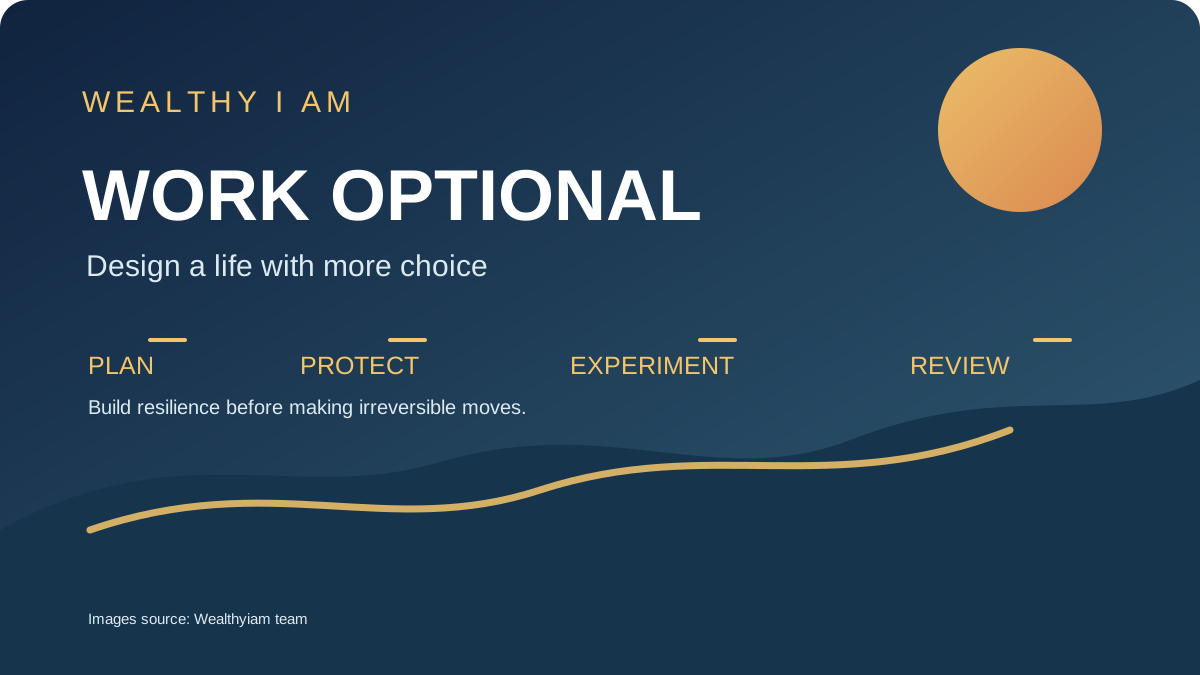
Early answer: Work Optional: Retire Early the Non-Penny-Pinching Way by Tanja Hester presents financial independence as an intentional life-design problem, not merely a race to the largest portfolio. A useful application is to define the life you want, identify spending that genuinely supports it, build resilience, and test assumptions before making irreversible decisions.
The publisher describes the book as a practical guide to financial independence and early retirement that combines a customized financial plan with whole-life design. The seven lessons below are Wealthy I AM’s practical synthesis, not a claim that Hester presents this exact numbered framework.
Cover image: Open Library Covers API, cover ID 8803937. Image identity and source verification are recorded in the editorial metadata.
What work optional means—and what it does not mean
Work optional means having enough financial flexibility that paid work becomes more of a choice than an unavoidable condition of meeting basic needs. It does not necessarily mean never working, abandoning ambition, or reaching a guaranteed number by a particular age. The appropriate target depends on household spending, health, dependants, location, taxes, benefits, portfolio construction, and tolerance for uncertainty.
Financial independence is not a promise of permanent safety. Investments can lose value, expenses can change, and a plan that looks robust under one set of assumptions may fail under another. This article is general education, not individualized financial, tax, legal, or retirement advice.
Seven practical lessons from Work Optional
1. Start with the life, not the spreadsheet
Book idea: The publisher describes Hester’s approach as a whole-life plan designed around the reader’s own priorities, including health care, children, and different forms of stepping away from full-time work.
Plain-language meaning: A portfolio is a tool. Before optimizing savings, describe what “enough” would let you do: reduce hours, change careers, care for family, create, travel occasionally, or remove financial pressure.
Try this: Write a one-page “ordinary Tuesday” five years from now. List the activities you want to protect, the work you would still choose, and the expenses that make the scenario worthwhile. Mark each as essential, valuable, or optional.
2. Spend generously on what matters—and scrutinize the rest
Values-based spending is not indiscriminate spending. It means directing money toward relationships, health, time, capability, or meaningful enjoyment while questioning purchases driven mainly by habit or social pressure. Cutting every enjoyable expense can make a plan unsustainable; calling every preference a value can conceal lifestyle inflation.
Ask whether a recurring expense buys time, health, connection, capability, or genuine enjoyment. If not, consider a smaller version or a pause. There is no universal correct answer; the point is to make the trade-off visible.
3. Treat resilience as part of the return
A plan is not resilient merely because its projected average return looks attractive. Resilience means having a reasonable way to handle job loss, market declines, large repairs, illness, or changing family circumstances without being forced into a poor decision.
Risk management may include an appropriate cash reserve, insurance review, manageable debt, diversified investments, and flexible spending. The right mix is personal. More complexity is not automatically more safety.
Try this: Create a “bad year” worksheet. List expenses you could reduce, commitments that remain, and one assumption that needs verification, such as insurance coverage or debt terms.
4. Build flexibility before declaring victory
A work-optional plan can be useful before full retirement. Savings may support fewer hours, a better-fit role, or a carefully tested business experiment. That is flexibility—not a guarantee that an experiment will succeed.
Avoid treating a preliminary cushion as permission for an unexamined leap. Consider fixed obligations, benefits, dependants, and downside scenarios. If health coverage or legal status depends on employment, investigate those consequences before changing work arrangements.
Try this: Design a reversible one-to-three-month experiment. Define a stop condition and an evidence threshold before beginning.
5. Use investing as a process, not a prediction contest
The publisher presents the book as a customized plan that accounts for recessions and future unknowns. A cautious investment process is one way to apply that resilience principle; it is not a promise of a particular return, asset, or retirement date. Diversification—spreading exposure across investments—reduces reliance on one holding but cannot eliminate loss.
Write down your objective, time horizon, contribution plan, broad allocation, fees, and rebalancing rule before market emotion supplies the answers. Check whether the plan fits your ability to withstand declines, not just your preferred outcome.
Try this: Make a one-page investment policy note covering purpose, timing, acceptable risks, review triggers, and information you will not use as a trading trigger. A licensed professional can help assess fit.
6. Measure progress in options created, not only dollars
A balance matters, but it is not the whole outcome. Track reduced dependence on one employer, useful skills, lower fixed costs, stronger relationships, and the ability to make a considered choice. These are not substitutes for adequate assets; they are additional forms of resilience.
Review savings, high-interest debt, essential spending, skill or income experiments, and one quality-of-life measure. Record the decision each measure is meant to inform.
7. Let enough remain a living decision
Family responsibilities, health, markets, inflation, and priorities change. A rigid plan can create a new form of anxiety if every deviation feels like failure. Set review dates and change course deliberately.
Twice a year, ask what changed, what still matters, which assumption was wrong, and what small adjustment preserves both security and meaning. Continuing to work by choice can be compatible with financial independence.
A cautious 30-minute starting exercise
- Write your desired life in five sentences.
- Separate essential spending from spending that makes life meaningfully better.
- Gather accurate numbers from household statements: debt, liquid savings, investments, and obligations.
- Identify three uncertainties, such as housing, health care, or income.
- Choose one low-risk experiment, such as automating a contribution or reviewing a recurring cost.
- Set a review date and a stop-or-modify condition.
The output is a clearer set of priorities and questions—not a personalized retirement forecast.
Mistakes to avoid
- Copying another household’s target when its spending and risk capacity differ.
- Confusing frugality with deprivation that damages health or relationships.
- Treating a projected return as a promise.
- Ignoring debt terms, insurance, taxes, benefits, or care needs.
- Making an irreversible career or investment move too early.
- Treating work optional as work forbidden.
Frequently asked questions
Is Work Optional a conventional early-retirement book?
It is positioned as a practical guide to financial independence and early retirement, but the publisher’s description also emphasizes a personalized plan for health care, children, recessions, future unknowns, and a purpose-filled retirement, semi-retirement, or career intermission.
Does work optional mean I must stop working?
No. It describes a shift in dependence and choice. Part-time, purposeful, or changed work may fit if the financial and practical risks are understood.
Can this approach guarantee financial independence?
No. No book or routine can guarantee an investment outcome, income level, or retirement date. Plans should be stress-tested and updated.
What should a beginner do first?
Define the life the money is meant to support, gather accurate household numbers, protect against major risks, and choose one modest experiment. Avoid starting with speculation or an unsupported forecast.
Sources and further reading
<small><strong>Primary book source:</strong> <a href="https://www.hachettebookgroup.com/titles/tanja-hester/work-optional/9780316450898/">Hachette Book Group, <em>Work Optional</em> by Tanja Hester</a>. The publisher record confirms the title, subtitle, author, publication date, ISBN, and public description used in this article.</small>
<small><strong>Bibliographic and image source:</strong> <a href="https://openlibrary.org/works/OL20158807W">Open Library work OL20158807W</a> and <a href="https://covers.openlibrary.org/b/id/8803937-L.jpg?default=false">Open Library Covers API, cover ID 8803937</a>. The catalog search confirms Tanja Hester, first publication in 2019, and the matching cover. The publisher must confirm acceptable image use or substitute a suitable licensed/original image before publication.</small>
A grounded next step
Choose one decision you have postponed because the goal feels too large. Put it through the exercise above, verify the relevant facts, and take the smallest reversible action that creates useful information. Financial independence is not proved by a headline number; it is built through choices that make money support a life you can sustain.