Marketing becomes expensive when a business keeps adding posts, platforms, and campaigns without first deciding whom it is trying to help. The New Rules of Marketing and PR by David Meerman Scott offers a more direct starting point: create useful information for specific buyers and reach them through the channels they already use.
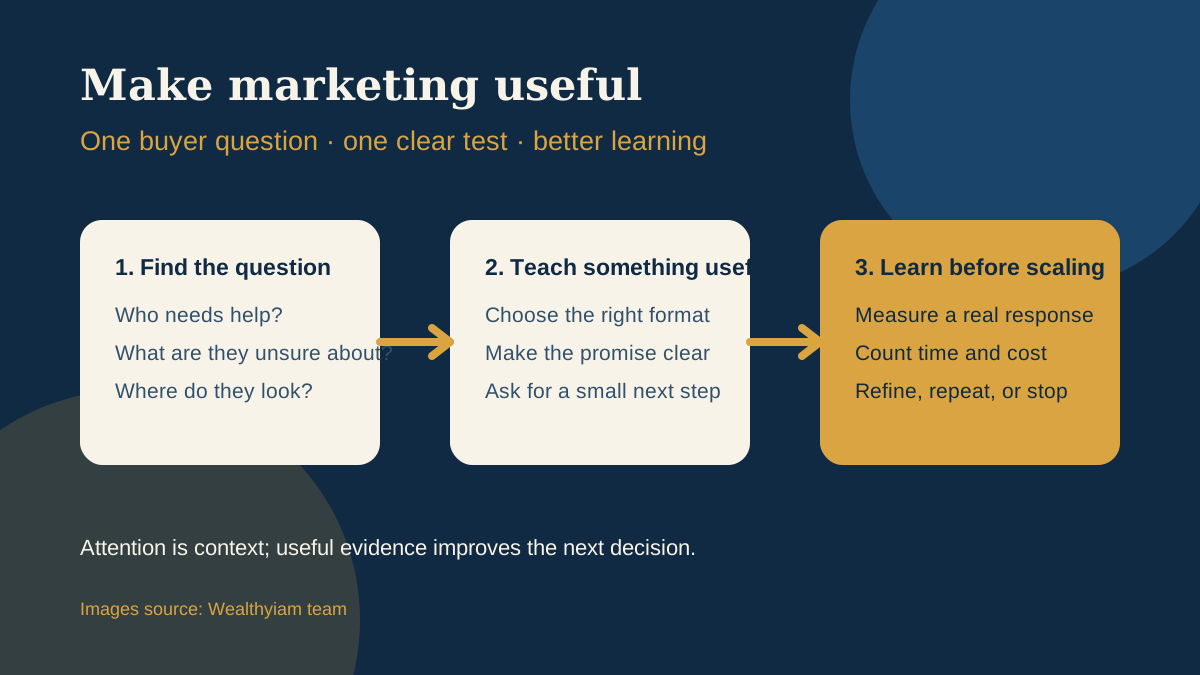
The practical takeaway is not “be everywhere.” It is to choose one buyer problem, publish a useful answer, invite a proportionate next step, and measure whether the response is meaningful before spending more.
This article uses the book’s documented premise as a starting point, not as a chapter-by-chapter reconstruction. The seven lessons are Wealthy I AM’s application rather than a claim that Scott presents this exact numbered framework. Marketing can create attention and conversations; it cannot guarantee sales, profit, or a particular return.
What The New Rules of Marketing and PR is about
Open Library identifies The New Rules of Marketing and PR as a work by David Meerman Scott and classifies it under internet marketing and public relations. Its edition records show that the book has been revised repeatedly. An edition catalogued in 2008 emphasizes news releases, blogs, podcasting, viral marketing, and online media. Later editions add or replace channels as digital communication changes.
That edition history reinforces a useful point: the durable idea is not loyalty to a particular platform. It is the ability to communicate directly with buyers by publishing information that helps them understand a problem, evaluate an option, or take a sensible next step.
The public records used here verify the work’s identity, author, subjects, edition history, and cover association. They do not provide enough of the full text to verify a detailed chapter framework, quotations, case studies, or claimed results. The applications below therefore remain deliberately cautious.
Seven practical lessons for building a less wasteful marketing system
1. Start with a buyer’s question, not your promotion calendar
A calendar can keep production organized, but it cannot tell you whether an idea matters to a buyer. Before asking what to announce, ask what a specific customer is trying to understand, avoid, compare, or accomplish.
“Marketing” is too broad to guide a useful article. “How should a two-person service business prepare for its first email campaign?” gives the writer a reader, a situation, and a concrete job to do.
Start by listing five questions that real customers have asked in conversations, inquiries, support requests, or sales calls. Choose one that is specific and connected to a problem your organization can responsibly help solve. Create the useful answer before creating the sales pitch.
2. Define one audience before choosing a channel
A first-time buyer may need definitions and reassurance. An experienced customer may need a comparison, implementation detail, or evidence. A format that works for a local service may not suit a technical product.
An audience description does not need to become an elaborate fictional persona. Record four things:
- the buyer’s current situation;
- the outcome the buyer wants;
- the objection or uncertainty most likely to delay action; and
- where the buyer already looks for reliable information.
Treat the definition as a testable constraint, not a permanent identity. Focusing on one audience does not guarantee demand. It makes the result easier to interpret because you know whom the message was meant to serve.
3. Teach before asking for a transaction
Useful content can demonstrate how a business thinks and what it knows. A checklist, short tutorial, comparison, demonstration, or explanation of an expensive mistake can help a reader judge whether an offer is relevant.
Teaching does not require giving away an entire service. It requires delivering enough value to fulfill the promise of the page. A guide titled “How to prepare for your first email campaign” should help the reader prepare, not hide every useful step behind a sales form.
Keep the boundaries honest. Do not present general marketing education as legal, tax, medical, or financial advice. Disclose material conditions and commercial relationships where required. Trust disappears when an educational headline leads only to an unrelated pitch.
4. Make the message specific enough to find and understand
Phrases such as “unlock growth” or “transform your brand” are difficult to evaluate. Specific language gives a potential reader a clearer reason to continue.
Compare “grow your business” with “a pre-launch email checklist for a two-person service business.” The second phrase identifies the format, situation, and intended reader. It also makes it easier for an editor to decide whether the page fulfills its promise.
Use the language customers naturally use, but do not repeat keywords mechanically. A clear title, descriptive headings, and an honest opening summary help searchers decide whether the article fits their question. Search visibility has little value when the page disappoints the people it attracts.
5. Match the format to the uncertainty you need to remove
Different formats do different jobs. A written guide can explain a process. A short video can demonstrate a physical task or software workflow. A comparison page can organize alternatives. A news release may suit a genuinely newsworthy event, but it is not automatically a substitute for useful buyer information.
Ask: “What does the reader need to see or understand before taking the next step?” Choose the simplest format that can remove that uncertainty. If a polished video adds cost but no useful evidence, a clear article or annotated screenshot may be the better test.
Channel choice should follow the same rule. The fashionable platform is not automatically the right one. Use evidence about where the intended audience already pays attention and what the team can maintain responsibly.
6. Run a small test before committing a large budget
Attention is not the same as demand. A post can receive views without creating qualified conversations, and a click can occur without a purchase. Begin with a defined experiment:
- one audience;
- one problem;
- one useful piece of content;
- one offer or next step;
- one primary measure; and
- one review date.
Choose a measure that matches the stage. An early educational test might track relevant replies, completed inquiries, or requests for a demonstration. A later-stage test might examine qualified opportunities, retained customers, or contribution after direct costs. Include production time, advertising spend, tools, and staff capacity when judging cost.
One experiment cannot prove that a channel will always work. Seasonality, audience mix, competition, pricing, delivery quality, and outside events can change the result. The goal is to make the next decision better informed, not to manufacture certainty.
7. Turn responses into the next useful question
Direct communication creates feedback. A question in a comment, a repeated sales objection, or a support request can reveal where the audience remains confused. That evidence can improve the next article, the offer, or the product itself.
Keep a simple learning log with four columns:
- question or objection received;
- evidence currently available;
- change tested; and
- result observed.
Separate documented responses from assumptions. A loud comment is not necessarily representative, and silence can have several explanations. If the evidence is mixed, preserve that uncertainty instead of forcing a confident story.
A 30-minute marketing clarity exercise
This worksheet is original Wealthy I AM advice, not a quoted framework from Scott’s book.
- Choose one reader. Describe the person or organization by situation rather than a vague demographic label.
- Write one urgent question. Use language heard in real customer conversations where possible.
- Name the useful proof. List the experience, demonstration, document, or process you can actually provide.
- Pick one next step. Ask for an action proportionate to the reader’s trust, such as reading a related guide, replying with a question, or requesting a demonstration.
- Set a decision rule. Decide what evidence would justify improving the test, changing the message, or stopping it.
- Record costs and constraints. Include time, production expense, ad spend, staff capacity, accessibility, privacy, and compliance review.
For example, a bookkeeping practice might publish a plain-language guide for new business owners preparing monthly records, invite readers to submit one relevant question, and review the quality of those questions after a defined period. The example does not predict leads or revenue. It shows how a narrow problem can produce a more interpretable test than a generic “we help businesses succeed” campaign.
Mistakes to avoid
Confusing reach with business value
Views, followers, and shares can provide context, but they do not by themselves establish profitable demand. Connect each measure to the buyer’s stage and to the cost of producing the result.
Copying a tactic without its conditions
A tactic that worked for another organization may depend on its reputation, timing, audience, resources, distribution, or offer. Treat examples as prompts for questions, not promises.
Publishing claims you cannot support
Do not invent case studies, testimonials, statistics, or claims of viral success. Cite reliable evidence for external factual claims and label hypothetical illustrations.
Expanding channels before learning
More platforms create more work and can make attribution harder. Improve one coherent test before adding complexity.
Making the call to action too large
A reader who has just found a helpful explanation may be willing to read another guide or ask a question, not immediately sign a long contract. Ask for the smallest useful next step.
Who should read the book—and what its age means
The book may help business owners, marketers, freelancers, and nonprofit teams rethink promotion around direct, useful communication. It is especially relevant to organizations that still plan messages mainly around announcements rather than buyer questions.
Edition context matters. The book has been revised as platforms and practices have changed, so examples involving mobile applications, blogs, news releases, podcasting, AI, live video, or social networks should be read in the context of a specific edition. Privacy expectations, platform rules, measurement tools, accessibility practices, and distribution systems continue to evolve.
The central premise also cannot fix product quality, pricing, fulfillment, legal compliance, or customer service. Marketing may reveal a mismatch faster; it cannot repair every underlying business problem.
Frequently asked questions
Is The New Rules of Marketing and PR only for online businesses?
No. Its subject is direct communication through digital media, but the underlying questions—who needs help, what can you demonstrate, and how will you learn—can apply to many organizations. The channel still needs to fit the audience and offer.
Does content marketing guarantee customers?
No. Useful content may improve understanding or create qualified conversations, but outcomes depend on the audience, offer, timing, competition, cost, and execution.
How much should a beginner spend on promotion?
There is no universal safe amount. Set a loss limit that does not threaten essential obligations, include the value of your time, and begin with a reversible test. Review advertising, privacy, and consumer-protection requirements that apply to your location and industry.
What should I measure first?
Measure the next meaningful behavior in the buying process. For an early educational test, that might be a relevant reply or completed inquiry. For an established offer, it may be a qualified opportunity or contribution after direct costs. Choose one primary measure and document what it does not capture.
A practical next step
Before buying another tool or increasing a campaign budget, choose one buyer question and publish one genuinely useful answer. Record the cost, the response, and what you learned.
The durable lesson is not that every organization needs every digital channel. Communication becomes more useful when it starts with a real buyer problem and creates a direct opportunity to learn. A narrow, honest experiment cannot guarantee sales, but it can make the next marketing decision clearer and more reversible.
Sources
- Open Library work record: The New Rules of Marketing and PR — work title, author association, subjects, and cover ID.
- Open Library editions record — edition dates, publishers, identifiers, and changing subtitles.
- Open Library author record: David Meerman Scott — author identity.
- Open Library Covers API, cover ID 10310574 — 2020 seventh-edition cover associated with the work; commercial reuse rights are not established by catalog availability.