What The Power of Selling is about
The Power of Selling is an open textbook by Dr. Michelle Clement, published in 2021 through the British Columbia/Yukon Open Authoring Platform and Pressbooks. The bibliographic record describes the book as focusing on forming and nurturing long-term relationships in a sales context and says that it uses a seven-step model.
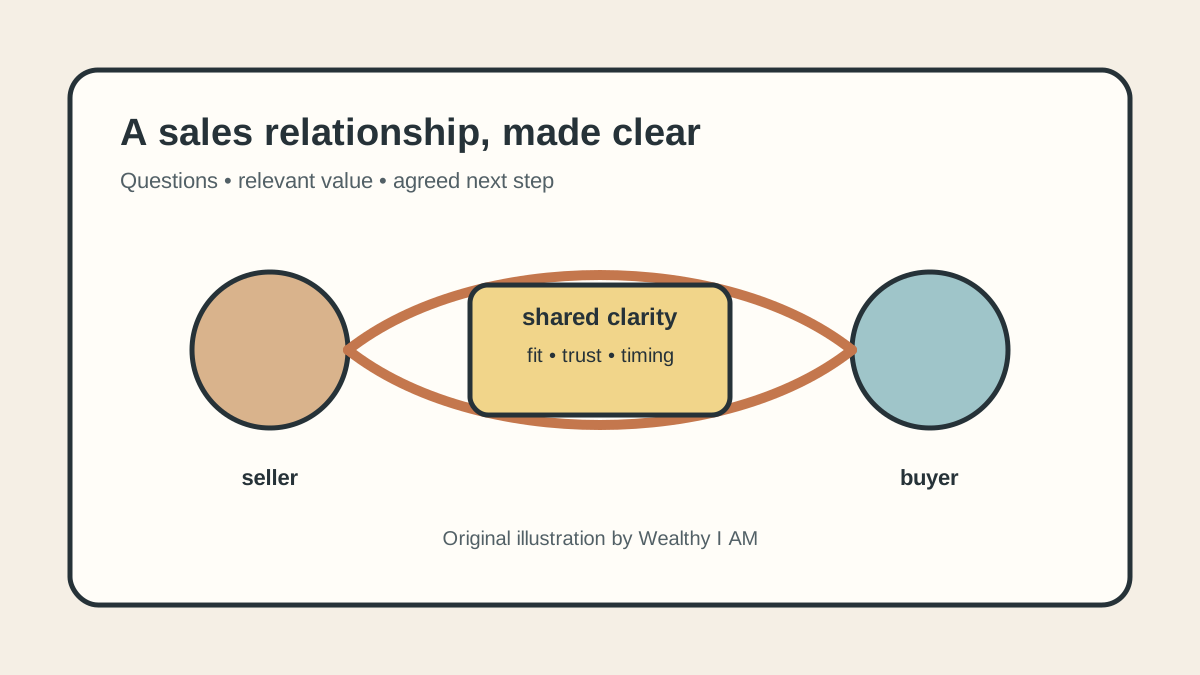
That description gives us a useful center of gravity: selling is not presented here as a single persuasive performance. It is a relationship process that develops over time. The available catalog record does not, by itself, establish the exact names or order of the seven steps. Rather than inventing a framework, this article stays with what the authoritative record verifies and offers clearly labeled Wealthy I AM applications.
Image: original Wealthy I AM illustration. It is not a reproduction of the book cover.
The verified premise: relationships are built, not forced
The phrase “long-term relationships” changes how a reader can think about a sales conversation. A transaction may be one event; a relationship includes expectations, communication, delivery, and the possibility of future decisions. That does not mean every prospect should be pursued indefinitely, or that a seller must turn every interaction into a friendship. It means that trust and usefulness are part of the commercial process rather than decorations added at the end.
The seven-step model mentioned in the edition record should be read in that context. Because the exact step labels have not been independently verified in this article, the seven practices below are not presented as Clement’s official seven steps. They are editorial applications of the book’s documented relationship-centered premise.
Seven applications for relationship-centered selling
1. Start with the buyer’s situation
A durable relationship cannot begin with an imagined customer. Before explaining an offer, learn what the person is trying to accomplish, what is blocking progress, and what constraints shape the decision.
Wealthy I AM application: Prepare three questions before a sales conversation: What outcome matters most right now? What has already been tried? What would make this a poor fit? The purpose is understanding, not steering every answer toward a purchase.
2. Make relevance visible
A seller may know every feature of an offer and still fail to communicate value. Relevance depends on the buyer’s particular situation. The same service can matter greatly to one organization and very little to another.
Wealthy I AM application: For each major feature, complete the sentence: “This may matter when you need to ___ because it can help you ___.” Treat the result as a hypothesis to test with customers, not as a guaranteed benefit.
3. Set accurate expectations
Long-term relationships are damaged by promises that cannot survive contact with delivery. Clear selling includes boundaries: what is included, what is excluded, which assumptions matter, and how the customer will judge progress.
Wealthy I AM application: Review one sales claim each week. Replace vague certainty with a specific deliverable, time frame, condition, or evaluation method. Do not use a forecast, testimonial, or best-case scenario as if it were a guaranteed result.
4. Let concerns improve the conversation
A question about price, timing, risk, or implementation is information. It may reveal missing context, a genuine constraint, or a mismatch between the offer and the buyer’s needs. Treating every concern as resistance to defeat can undermine the relationship the seller is trying to build.
Wealthy I AM application: Acknowledge the concern, ask what is behind it, answer only what you can support, and check whether the answer changes the buyer’s decision. If the fit is weak, say so.
5. Qualify for mutual fit
Relationship-centered selling does not require saying yes to everyone. A customer who cannot use the offer, implement it, or support the required process may be better served by a different option or a later conversation.
Wealthy I AM application: Use a short fit check covering the problem, implementation capacity, decision process, resources, and timing. Record “not now” separately from “not suitable.” Qualification is a way to respect both parties’ time, not a judgment of a person’s worth.
6. Make commitments concrete
A long-term relationship is easier to maintain when both sides know what happens next. “I’ll follow up soon” leaves ownership and timing unclear. A concrete next step creates clarity without pretending that a decision has already been made.
Wealthy I AM application: End with an agreed action, an owner, and a date. The next step might be reviewing a scope, answering a specific question, testing a small component, or deciding not to proceed. Ask for consent rather than interpreting politeness as commitment.
7. Follow up with usefulness
Nurturing a relationship is different from repeating pressure. A follow-up earns its place when it answers an unresolved question, records an agreement, or supplies information that helps the buyer decide.
Wealthy I AM application: After a conversation, record the stated problem, unresolved question, agreed next step, and preferred timing. If there is no new information to add, a respectful close-out is more relationship-preserving than endless reminders.
A practical 30-minute reset
- Choose one offer and one audience.
- Describe the customer’s problem without naming your solution.
- List the conditions that must be true for your offer to be useful.
- Write three discovery questions and two fit checks.
- Rewrite one promise so that it is specific and supportable.
- Define a small next step with an owner and date.
- Create a follow-up rule that includes when to stop contacting someone.
This exercise is a Wealthy I AM tool, not a claim that these are the book’s official seven steps.
What ethical selling cannot guarantee
A relationship-centered process cannot guarantee a sale, revenue, profit, or business growth. Demand, product quality, pricing, delivery, competition, resources, and external conditions also affect results. Better communication can improve the quality of a decision; it cannot control the decision.
That distinction matters for wealth-building. A sale that creates an unsuitable obligation, delivery failure, or unhappy customer is not automatically progress. Sustainable income depends on making promises the business can keep and serving customers for whom the offer is genuinely appropriate.
Frequently asked questions
Is this book only for professional salespeople?
The book is a sales textbook, but its relationship-centered premise can be applied by founders, freelancers, managers, and professionals who explain the value of their work. The application should fit the reader’s role and industry.
What are the book’s exact seven steps?
The Open Library edition record verifies that the book uses a seven-step model, but the catalog description does not list the exact step names or order. This article intentionally does not guess at them. Consult the full Pressbooks text for the authoritative model before quoting or teaching its individual steps.
How can I sell without being manipulative?
Ask honest questions, describe limits, check for fit, make the next step explicit, and make it easy to decline. Ethical selling is not passive; it is clear about value and boundaries.
Is follow-up always necessary?
Follow-up is useful when it respects the buyer’s preference and adds clarity. It is not permission for repeated pressure. A clear close-out can be the professional choice.
Sources and further reading
- Open Library work record for The Power of Selling — bibliographic identity.
- Open Library edition record for The Power of Selling — author, 2021 publication details, publisher information, relationship-centered description, and reference to the seven-step model.
- Pressbooks edition site for The Power of Selling — authoritative full-text source to consult for the exact model and section-level verification.
The seven practices in this article are Wealthy I AM applications, not a transcription of Clement’s framework. Verify any quotation, model label, chapter claim, statistic, or industry-specific legal requirement against the full source before publication or use.
Conclusion: build the relationship the sale depends on
The strongest verified takeaway from The Power of Selling is its emphasis on forming and nurturing long-term sales relationships through a seven-step model. The responsible practical translation is not “close more people at any cost.” It is to understand the buyer’s situation, communicate relevant value, set accurate expectations, qualify for fit, make commitments clear, and follow up with useful information. Start with one offer and one buyer problem, then measure whether your process becomes clearer and more trustworthy without becoming louder.