A founder can know a product deeply and still lose a promising customer by explaining it too soon. The buyer may not yet agree that a problem matters, understand its consequences, or see why solving it is worth changing an existing process. More features do not automatically create more value.
Neil Rackham’s SPIN Selling addresses this problem with a question-led approach to consultative sales. Its central idea is practical: understand the customer’s situation and problem, explore the consequences, and help the customer articulate the value of a solution before asking for commitment.
This selective summary explains the four-part SPIN framework and seven ways to apply it without turning a conversation into an interrogation. It is not a chapter-by-chapter substitute for the book.
SPIN Selling in brief
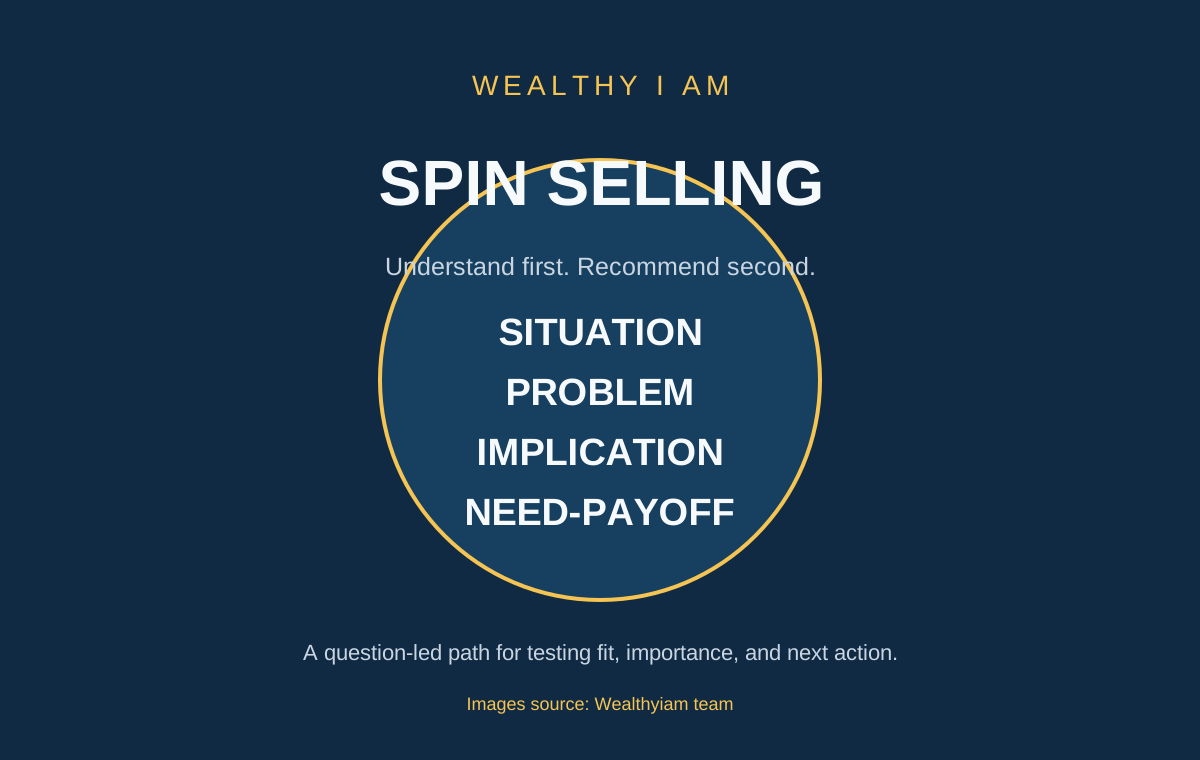
SPIN names four types of questions:
- Situation: establish relevant facts about the customer’s current context.
- Problem: identify difficulties, friction, dissatisfaction, or unmet needs.
- Implication: explore what those problems cause or make harder.
- Need-payoff: invite the customer to describe the value of improvement.
The practical sequence is to diagnose before presenting, ask only for context that matters, explore the importance of a confirmed problem, and connect any recommendation to an outcome the buyer values. The framework can improve the quality of discovery. It cannot create product-market fit or guarantee a sale.
Open Library records SPIN Selling by Neil Rackham as a 1988 McGraw-Hill book. The framework terminology and the book’s original emphasis on major sales are also reflected in public descriptions of the work. The applications and examples below are Wealthy I AM interpretations, not Rackham’s exact wording or promises of revenue.
What SPIN Selling is trying to solve
The book contrasts quick transactions with larger sales in which several people may be involved, changing systems may be costly, and the buyer may need to justify a decision internally. A product demonstration can be useful, but a demonstration before the problem is clear may create polite interest without a real buying case.
SPIN gives the conversation a structure for discovering whether a meaningful need exists and whether the seller’s offer is relevant. It is a framework for inquiry, not a license to pressure someone. Research what can be learned beforehand and use live questions to clarify what matters.
Lesson 1: Diagnose before presenting
A premature pitch asks, “How can I fit my product into this account?” A diagnostic conversation asks, “Is there a material problem here, and does this customer want to address it?” Before a call, write down three facts you need to confirm and one assumption you are willing to discard. During the conversation, summarize what you heard and ask whether your understanding is accurate.
A small software company might assume that a prospect needs automation. The prospect may instead need clearer ownership of a manual process. That problem could be solved by software, training, or a workflow change. Diagnosis prevents the seller from confusing a familiar product with the customer’s actual need.
Lesson 2: Use Situation questions sparingly
Situation questions establish context: what tools are used, who owns a process, or how a workflow operates. They are useful when an answer changes the next question. They are wasteful when the seller could have researched the answer or asks from habit.
A useful question is specific: “Which team currently reviews these requests?” A weaker approach is a long checklist of facts that produces no insight. Divide questions into “research first” and “ask live,” then keep only the live Situation questions that could change your understanding, qualification, or recommendation.
Lesson 3: Surface Problems in the buyer’s language
Problem questions move from context to difficulty. They should not manufacture pain or pressure someone into declaring a problem. Ask whether the current situation creates cost, delay, risk, rework, frustration, or a missed opportunity that the buyer recognizes.
“What is hardest about the current approval process?” invites discovery. “Would you agree that our approval tool is essential?” embeds the seller’s preferred conclusion. If the buyer says the process works adequately, that is valuable information: the product may not be a priority.
Treat a stated problem as a hypothesis until its scope and importance are clear. Ask what happens, how often it happens, who is affected, and what the customer has tried. Do not invent a monetary loss that the customer has not measured.
Lesson 4: Implications show why a problem matters
A problem can be real but not important enough to justify action. Implication questions explore what the issue delays, what other work it disrupts, or what decision it makes harder. Used responsibly, they make a trade-off visible rather than inflate fear.
For a hypothetical agency that loses requests in email, ask: “When a request is missed, what work is delayed or reprioritized?” A follow-up might be: “Who has to recover the schedule?” This is an illustration, not a claim about a real company or a guaranteed cost. If the implication is minor, the honest conclusion may be that the buyer should do nothing.
Lesson 5: Let the buyer articulate the payoff
Need-payoff questions ask what would improve if the problem were addressed. They shift the conversation from the seller’s feature list to the buyer’s desired result: “If requests were visible in one queue, what would that make easier for the team?”
If the buyer says the improvement would not matter, the seller has learned something important. If the buyer describes a meaningful benefit, connect the offer to that benefit without claiming more than the product can deliver. “That could reduce handoffs” is different from “this will cut costs by 30%.” Any numerical claim needs evidence, scope, and conditions.
Lesson 6: Match discovery to decision complexity
Expand discovery when a decision involves multiple stakeholders, implementation effort, switching costs, or material financial exposure. Keep it proportionate for a simple purchase. Map the decision: what problem is being considered, who experiences it, who evaluates the solution, what implementation requires, and what evidence would create confidence.
This map does not mean every sale follows one path. It prevents the seller from treating all customers and decisions as identical.
Rackham has since described the book’s original big-sale versus small-sale divide as less useful today than the distinction between consultative and transactional sales. That retrospective sharpens the application: use deeper discovery where the salesperson adds value by helping solve a problem, not merely because an account is large.
Lesson 7: Turn the framework into a learning loop
After a conversation, record the customer’s stated problem, the implication they confirmed, the payoff they described, the unanswered question, and the next agreed step. Review several conversations for patterns.
Do not use a win as proof that every question was good or a loss as proof that the framework failed. Outcomes can reflect timing, budget, competitors, internal politics, product quality, or luck. Review the reasoning and evidence available at the time.
A 20-minute practice exercise
Choose one customer segment and write:
- two researched Situation questions;
- three Problem questions;
- two Implication questions;
- two Need-payoff questions; and
- one stop condition that would show the offer is not a fit.
Role-play with a colleague whose job is to flag leading questions, jargon, unsupported claims, and premature presenting.
Mistakes to avoid
Treating SPIN as a rigid script
The four categories are a thinking aid. Memorized wording can make a conversation unnatural. Keep the sequence in mind, but follow the customer’s answers.
Manufacturing urgency
Implication questions should clarify consequences, not inflate them. Avoid invented savings, threats, countdowns, or claims that a buyer will fall behind unless they purchase.
Presenting benefits before needs are clear
A feature can be valuable in one context and irrelevant in another. Connect benefits to a confirmed problem and state uncertainty where evidence is incomplete.
Confusing activity with progress
More calls and more questions do not prove better selling. Track whether conversations produce clearer fit, better customer understanding, and agreed next steps.
Who should read SPIN Selling?
The book is most relevant to founders, account executives, consultants, and managers involved in consultative sales that require explanation, trust, implementation, or internal approval. It is less useful as a complete guide to transactional retail sales, modern digital acquisition, pricing strategy, or legal compliance.
Its research and examples also come from a particular sales era. The underlying discipline of understanding needs can remain useful, but channels, buying committees, privacy expectations, and procurement practices change. Test the ideas against your market rather than treating a 1988 sales book as a complete current operating manual.
Frequently asked questions
What does SPIN stand for?
SPIN stands for Situation, Problem, Implication, and Need-payoff. They are four types of questions used to structure discovery in consultative sales conversations.
Is SPIN Selling a closing technique?
It is better understood as a needs-discovery framework. It can support a clear next step when a genuine need and fit exist, but it does not remove objections, create demand, or guarantee a close.
Should every salesperson ask all four types?
Not mechanically. The relevant questions depend on what the buyer already knows, the complexity of the decision, and the information needed to judge fit. Preparation should reduce unnecessary Situation questions.
Can a small business owner use SPIN?
Yes, as a way to listen and clarify customer problems. Adapt it to the sales cycle and avoid turning conversations into manipulative scripts.
Does SPIN Selling prove that questioning increases revenue?
No such promise follows from this summary. Individual results depend on product quality, market conditions, execution, customer fit, and many other factors.
A cautious next step
Use the 20-minute exercise with one customer segment and one upcoming conversation. If the answers reveal no meaningful problem, do not force a pitch. If a problem is clear, ask what improvement would be worth pursuing, confirm what evidence is needed, and agree only to a next step that both sides understand.
Conclusion
SPIN Selling offers a useful correction to feature-first selling: understand the buyer’s situation, problem, consequences, and desired payoff before recommending a solution. The framework is not a promise of wealth or a substitute for a good product. Its practical value is narrower and more durable: it turns a sales conversation into a structured test of fit, importance, and next action.
The best first move is reversible. Prepare fewer, better questions; listen for the buyer’s description of the problem; and record what would change your mind. That practice can improve judgment even when the right decision is not to sell.
Sources and further reading
- Open Library: SPIN Selling by Neil Rackham — work identity, author record, 1988 publication record, and cover ID.
- Open Library: 1988 McGraw-Hill edition — publisher, author attribution, ISBN, edition date, jacket subtitle, and cover ID 55114.
- Goodreads: SPIN Selling — public book description and framework terminology.
- Lucid: The 4 Steps to SPIN Selling — secondary cross-check of the four question categories and practical sequence.
- Neil Rackham’s reflections on SPIN Selling — 2026 comments on transactional versus consultative sales and the limits of the original big/small distinction.