If you are working hard but your skills, income, or career options do not seem to be improving, the problem may not be a lack of ambition. You may be practicing without useful feedback, choosing a goal that is too vague, or relying on motivation while your environment makes focused work difficult.
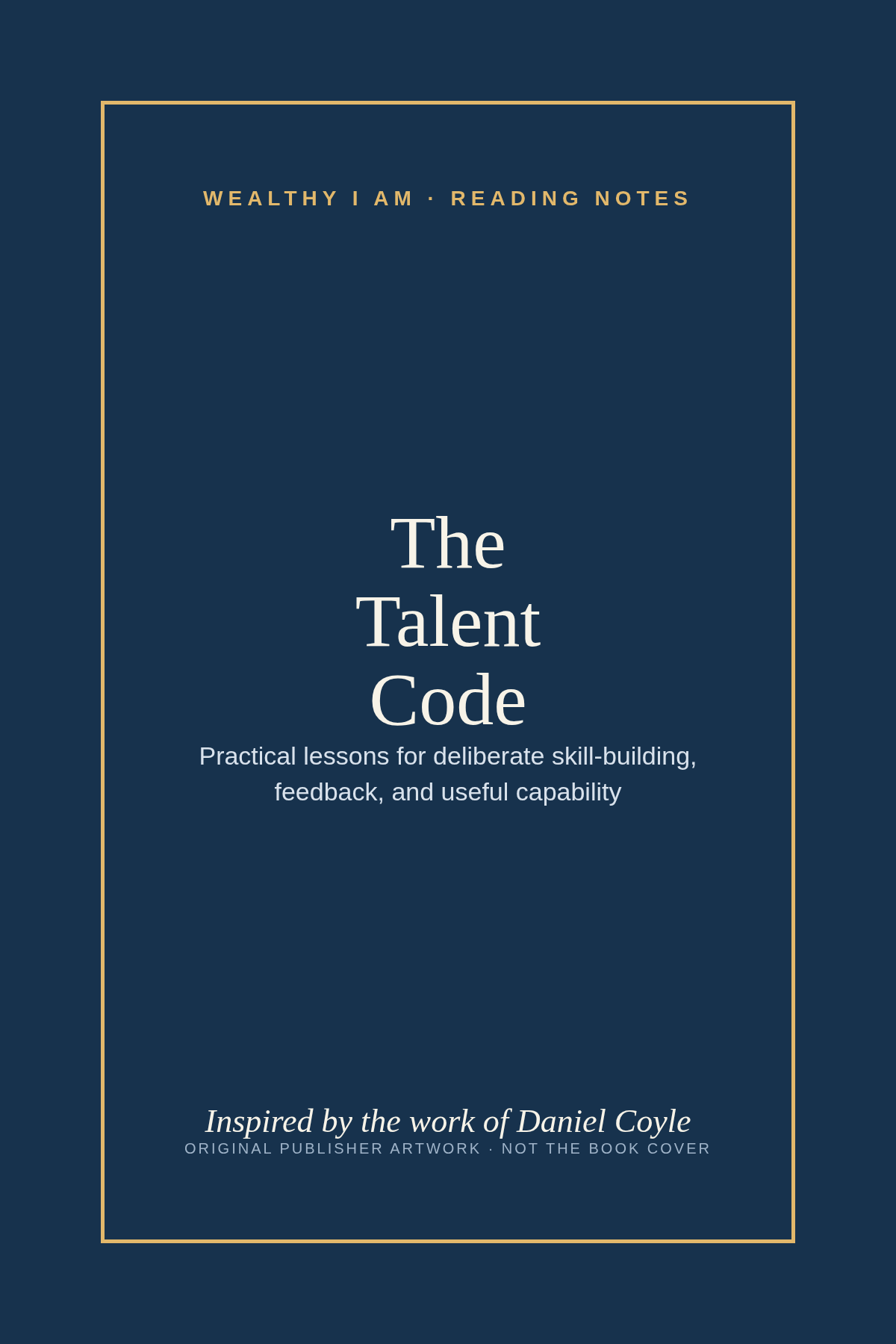
The short answer: The Talent Code: Greatness Isn’t Born. It’s Grown. Here’s How by Daniel Coyle explores how high-level skills can develop under the right learning conditions. Its ideas can inform a cautious approach to building valuable capabilities, but skill development is not a guaranteed route to a particular salary, business outcome, or investment return.
The seven lessons below are a Wealthy I AM editorial synthesis, not a claim that Coyle presents these exact numbered headings. The available catalog record confirms the book’s identity, author, and broad subject; it does not establish every chapter, anecdote, quotation, or research detail in the full text.
In this summary
- The book’s central idea in plain language
- Seven practical lessons for building useful skills
- A cautious 30-day skill-to-value experiment
- Common mistakes, limitations, and frequently asked questions
The book’s central idea in plain language
The Open Library work description presents three broad conditions associated with developing high-level skills: deep practice, ignition, and master coaching. In plain language, that means working at the edge of your current ability, having a reason to continue, and receiving useful guidance that reveals better ways to perform.
For Wealthy I AM readers, the practical translation is not “find a shortcut to riches.” It is: build a capability that solves a real problem, then create a learning loop that makes your performance more useful and reliable.
Seven practical lessons for building valuable skills
1. Choose a valuable problem before choosing a fashionable skill
A skill becomes economically useful when it helps someone accomplish something they value. “Learn artificial intelligence,” “learn marketing,” or “learn investing” is too broad to guide practice. A problem is more actionable: help a local business explain its service clearly, help a team organize recurring information, or learn to evaluate a business without relying on a headline.
Write one sentence: “I want to help [specific person or organization] improve [specific problem] by using [capability].” Then ask potential users whether the problem is real, frequent, and costly in time, money, risk, or frustration. Their answers are evidence about the problem—not proof that your future offer will sell.
2. Deep practice means working at the edge, not repeating what is comfortable
A useful practice task is difficult enough to expose an error but narrow enough to attempt again. If you already know how to write a basic spreadsheet formula, copying another easy formula may feel productive without extending your ability. A better task might be cleaning a messy dataset and explaining the choices you made.
Break the capability into small actions. Attempt one. Notice the failure. Correct it. Repeat. Reserve a short, repeatable block—perhaps 25 to 45 minutes—for one difficult subskill. Adjust the duration for your health, work, caregiving, and available attention; a routine should support learning rather than damage sleep or wellbeing.
3. Feedback tells you what to practice next
Without feedback, learners can become more confident in a method that does not work. Feedback can come from a qualified teacher, a user, a test with a clear answer, a peer review, or a comparison against a defined standard.
Ask for feedback on one observable behavior: Is the explanation understandable? Does the analysis contain a reproducible error? Can the customer complete the process without assistance? Feedback on a skill is not proof of financial success. A polished portfolio, certificate, or positive review does not guarantee employment, revenue, or investment performance.
4. Motivation is easier to sustain when the reason is concrete
“I should become better” is weak fuel when practice becomes frustrating. A concrete reason might be improving competence in your current role, opening a possible career path, serving customers more effectively, or gaining enough capability to test a small business idea without making a large upfront commitment.
This is the book’s “ignition” idea translated into a practical question: Why is this skill worth sustained effort for you, and whose problem will improve if you develop it? Do not turn purpose into pressure. A meaningful goal can guide attention without requiring you to sacrifice health, relationships, or essential financial stability.
5. A coach should improve your process, not replace your judgment
A useful coach shortens the feedback loop. They can demonstrate a technique, identify a blind spot, set a demanding but realistic exercise, and explain why a correction matters. The learner still has to perform the work and decide whether the guidance fits the situation.
Look for relevant demonstrated competence, clear boundaries, and a willingness to explain reasoning. Be cautious of anyone promising guaranteed income, secret access, or instant mastery. A low-risk experiment is to ask for one review of one real work sample, apply one correction, and assess whether the guidance improved the work.
6. Build a practice system that survives ordinary life
A plan that depends on perfect energy will fail under ordinary interruptions. Design around a minimum viable practice: the smallest version you can repeat during a busy week. Put the materials where the work happens, decide the next task in advance, and keep a short log:
1. Skill component practiced. 2. Deliberate difficulty attempted. 3. Feedback or error observed. 4. Next repetition and its date.
This is original Wealthy I AM advice, not a claim that these are Coyle’s exact instructions. Its purpose is to make learning visible and adjustable.
7. Convert capability into value through small, ethical tests
Learning is not the same as earning. Test whether a skill solves a real problem before buying expensive tools, quitting a job, or taking on debt.
Hypothetical example: Suppose you are learning to create clearer customer reports. Offer one small, well-defined report improvement to a known organization, with permission and clear limits. Ask whether it saved time or improved a decision. The outcome is uncertain; the point is to learn what users value and what still needs work.
Keep the book idea separate from the business decision. Coyle’s broad learning framework may help you practice. It cannot validate demand, set a price, address legal obligations, or forecast income.
A cautious 30-day skill-to-value experiment
Week 1: Define the capability and user
Choose one observable skill and one audience. Write what “better” looks like in a way another person could assess. Identify privacy, licensing, safety, or professional requirements before working with real data or customers.
Week 2: Run focused repetitions
Complete short sessions at the edge of your ability. Use one task, one feedback source, and one improvement target. Avoid changing tools every day; novelty can feel like progress while preventing enough repetition to learn.
Week 3: Test a small output
Create a bounded sample, prototype, explanation, or service. Label it as a test. Ask a potential user what was useful, confusing, missing, or unnecessary. Do not claim that one positive response proves a market.
Week 4: Review economics and learning
Record time spent, direct costs, quality changes, feedback, and next questions. Decide whether to continue, narrow the skill, change the audience, or stop. Do not treat sunk time as a reason to keep investing in a path that no longer fits.
Mistakes to avoid
Mistaking hours for progress
Time is an input, not a guarantee. Review task quality, attention, feedback, and recovery.
Practicing a vague goal
“Get better at business” cannot tell you what to repeat. Define a capability and an observable output.
Treating a coach as an oracle
Compare advice with your context and incentives. Ask what evidence supports the recommendation and what would falsify it.
Buying tools before proving the learning loop
A course, device, or software subscription may be useful, but spending can become a substitute for practice. Start with low-cost materials where appropriate.
Turning skill-building into a guaranteed income claim
Skills can improve your options, but income also depends on demand, competition, geography, negotiation, capital, timing, and execution. No outcome is guaranteed.
Ignoring health and safety
Some practice involves physical strain, sensitive data, regulated advice, or high-stakes decisions. Use qualified supervision and current requirements where necessary; stop or modify a routine if it creates harm.
Who should read this book?
The broad subject may interest students, professionals, athletes, artists, entrepreneurs, managers, and anyone trying to understand how capabilities develop. It is especially relevant if you want a practical learning lens rather than a promise of instant achievement. It is not individualized career, financial, medical, legal, or business advice.
Frequently asked questions
What is the main lesson of The Talent Code?
A cautious summary is that high-level skill can be developed through demanding practice, sustained motivation, and effective coaching. The exact evidence and examples should be checked in the full book.
Does the book say talent is completely irrelevant?
The title emphasizes development, but this article should not reduce a complex subject to a slogan. Access to instruction, time, health, resources, prior experience, and individual differences can affect learning. Look for controllable training conditions without claiming everyone will reach the same result.
How can beginners apply the book to career growth?
Choose one useful capability, practice a narrow component, seek specific feedback, and test a small real-world output. Track learning and costs separately from income expectations.
Can deep practice guarantee wealth?
No. Deep practice may improve capability, but wealth outcomes depend on many uncertain factors. Use it as a learning approach, not a financial guarantee.
How do I choose a coach?
Look for relevant competence, transparent incentives, specific feedback, reasonable boundaries, and a willingness to let you think for yourself. Avoid guarantees and pressure to make large commitments quickly.
A practical next step
Choose one problem worth solving and write the smallest skill component that would help. Schedule one focused repetition, obtain one specific piece of feedback, and record the next correction. After 30 days, judge the experiment by improved capability, user value, cost, and fit—not by a promise of instant wealth.
Wealthy I AM advice, separate from the book: treat skill-building as general education. Protect essential obligations, verify professional requirements, and seek qualified advice when decisions depend on your personal finances, health, safety, or jurisdiction.
Sources and image provenance
- Open Library work record for The Talent Code — book identity, author attribution, and broad description.
- Open Library author record for Daniel Coyle — author identity.
- Open Library Covers API image — exact-title cover reference, cover ID 11948223.
General education disclaimer: This article is not individualized financial, career, legal, medical, safety, or investment advice. Hypothetical illustrations do not guarantee employment, income, business success, or investment results.