If your real estate income depends on your memory, personal availability, and a constant scramble for the next client, earning more can make the business more fragile—not more valuable. You may be busy without having a repeatable way to generate leads, serve clients, measure performance, or hand work to a team.
The short answer: The Millionaire Real Estate Agent by Gary Keller, Dave Jenks, and Jay Papasan is best approached as a business-building book about models, lead generation, sales systems, teams, and leverage. A useful Wealthy I AM application is to turn a solo practice into a documented operating system: define the client you serve, measure the activities that create opportunities, protect cash, and add capacity only when the economics and service quality support it. None of this guarantees income, a sale, a valuation, or investment success.
The seven lessons below are a Wealthy I AM editorial synthesis, not a claim that the authors present these exact numbered headings. The available catalog record supports the book’s identity and broad subject; it does not establish every chapter, example, formula, or prescription in the full text.
What the book is about—and what it is not
The book is presented as a guide to building a real estate business through models, case studies, lead generation, sales systems, teams, and scalable operations. That makes it more relevant to an agent or broker designing a business than to a reader looking for a passive-income shortcut.
Real estate activity also carries material risks: variable demand, financing costs, transaction expenses, regulation, taxes, insurance, fair-housing obligations, and the possibility that a deal does not close. A business system can improve organization; it cannot remove market or execution risk. Apply these ideas as general education and check current rules and professional advice for your jurisdiction and situation.
Seven practical lessons for a real estate business that can grow without chaos
1. Define the model before adding more activity
A model is a plain-language description of how the business creates value and gets paid. Without one, an agent can collect disconnected tactics—more calls, more ads, more showings, and more software—without knowing which activities serve which client and economic goal.
Write one page answering: Who is the client? What problem do you solve? Where do qualified conversations come from? Which service is delivered repeatedly? What costs must be paid before revenue arrives? Treat an untested answer as a hypothesis, not a strategy, and review it against actual conversations, costs, and outcomes.
2. Measure lead generation as a process, not a personality trait
A lead is a potential client or opportunity; lead generation is the repeatable work that creates conversations. “I need to market more” is too vague to manage. A useful record distinguishes source, contact attempt, response, appointment, signed engagement where applicable, and closed transaction.
Choose one lead source you can legally and ethically use. Track activity and outcomes for a defined period: contacts attempted, conversations, appointments, and follow-up completed. Do not promise a conversion rate or copy a historical ratio as a forecast. The purpose is to learn where the process breaks.
3. Turn the best work into a documented playbook
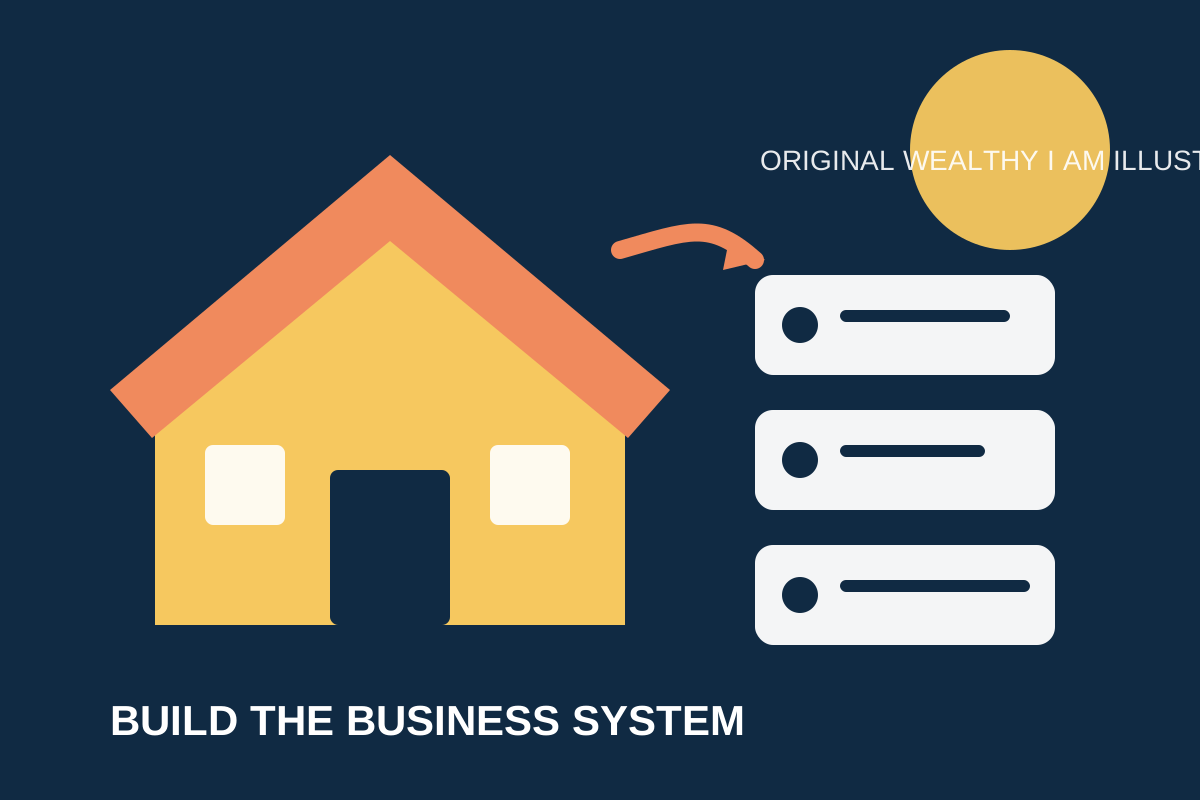
A system is a repeatable sequence with a clear owner and expected output. Documentation reduces dependence on memory and makes training, quality control, and improvement possible.
Start with one recurring workflow, such as new-client intake or post-closing follow-up. Record the trigger, the next three to five actions, the document or message used, the compliance or privacy check, the definition of “complete,” and the responsible person and backup. This is an original operating application, not a claim about the authors’ exact checklist. Have local professionals review legal, licensing, privacy, and fair-housing requirements before using templates.
4. Protect service quality before pursuing scale
Scale means increasing capacity or output without increasing every input in equal proportion. Hiring, referrals, automation, or more listings can increase capacity—but can also multiply errors and client frustration.
Before adding volume, inspect the handoffs. Can a client see what happens next? Are response times defined? Does the team know who can make a decision? Is sensitive information handled appropriately? If not, adding leads may enlarge the bottleneck. A hypothetical first step might be standardizing intake and response ownership, then testing a limited handoff with one trained assistant. The result is uncertain and should be assessed with client feedback, costs, and compliance checks.
5. Use leverage carefully: time, people, tools, and capital differ
Leverage means using a resource so that one unit of effort can support more output. A software tool, a trained person, a repeatable process, or borrowed capital can all create leverage, but they do not carry the same risk.
A tool may save time but create subscription cost or data exposure. A team member may add capacity but create payroll, training, and supervision obligations. Debt may fund an opportunity but adds repayment and interest risk. Before committing, ask: What bottleneck is this resource solving? What will it cost if revenue is delayed? How will you stop, reduce, or replace it if the hypothesis fails? Do not use leverage language to disguise an unaffordable commitment.
6. Separate revenue from retained wealth
A commission, fee, or business sale is not the same as personal wealth. Revenue must pass through transaction expenses, taxes, operating costs, owner compensation, reserves, and reinvestment decisions. A larger top line can coexist with weak cash flow.
Create a simple monthly view with four labels: money received, business costs, amounts reserved for obligations, and money available for personal or long-term decisions. The correct treatment of taxes, licensing, and business structure depends on jurisdiction and facts; use a qualified professional rather than relying on a generic article.
7. Build an owner-independent asset only if that is actually the goal
A business that functions without its founder for some periods may be more resilient, but “less owner-dependent” is not automatically better for every person. Some professionals deliberately choose a small practice for autonomy, craft, or lifestyle.
If transferability matters, document client relationships, processes, responsibilities, performance measures, and decision rights. Then test a small absence or handoff. If the system fails, treat the failure as information—not as proof that you need a larger team. The choice of size, lifestyle, risk, and ownership structure is reader-specific.
A practical 30-day operating-system experiment
This is an original Wealthy I AM application, not a guaranteed method from the book.
Week 1: Map one client journey. Choose one service and write the steps from first conversation to follow-up. Mark delays, duplicated work, missing information, and decisions that only you can make.
Week 2: Measure the inputs. Track the chosen lead source and the next meaningful actions. Avoid vanity metrics. Identify the smallest set of numbers that helps you see whether conversations and service are progressing.
Week 3: Document and test one handoff. Create a short playbook and have another person follow it on a low-risk task. Check accuracy, privacy, client experience, and time saved. Do not hire prematurely just to make the experiment look larger.
Week 4: Review economics and constraints. Compare cost, time, service quality, and useful output. Keep, revise, or stop the experiment. Do not assume a month of observations predicts future commissions, property prices, or business value.
Mistakes to avoid
- Treating a headline income target as a forecast. A target does not establish demand, conversion, expenses, or take-home income.
- Adding people before fixing the workflow. Hiring around an unclear process can move confusion from the owner to the team.
- Confusing borrowed money with business leverage. Debt increases both opportunity and obligation; review repayment timing, interest, collateral, and downside scenarios with an appropriate professional.
- Ignoring legal and ethical duties while optimizing. Lead generation, advertising, client records, contracts, disclosures, privacy, and fair-housing obligations vary by jurisdiction and are not optional friction.
- Treating real estate as automatically passive. Property ownership or a real estate business can require management, maintenance, capital, insurance, and attention.
- Copying a success story as a universal formula. A case study can illustrate a possibility, not prove that the same path works in every market, skill set, capital position, or economic cycle.
Who should read the book?
It may be useful for agents, brokers, team leaders, and aspiring real estate entrepreneurs who want to think in terms of lead generation, systems, teams, and business capacity. It is not a substitute for local legal guidance, tax advice, licensing education, market research, or individualized investment analysis. If your immediate problem is unstable personal cash flow, protect essential obligations and reserves before taking on expansion risk.
Frequently asked questions
Is The Millionaire Real Estate Agent an investing book?
Its inventory description centers on building a real estate sales and business operation. It may inform an agent’s enterprise-building questions, but it is not individualized advice for buying property or selecting investments.
What is the main lesson?
A cautious summary is that a real estate business should be designed as a system of lead generation, sales, people, and operations rather than as endless dependence on the founder’s individual effort. The exact framework and chapter-level claims should be checked against the full book.
Can systems guarantee higher real estate income?
No. Systems can make work more visible and repeatable, but income depends on demand, pricing, competition, costs, skills, regulation, and execution.
Should a solo agent build a team?
Not necessarily. First identify a bottleneck and test whether a documented handoff solves it without compromising obligations or client care.
A practical next step
Choose one client workflow today. Write its trigger, next actions, owner, completion standard, and one measure of quality. Review it after 30 days. The aim is not to imitate a millionaire label; it is to build a business that creates value clearly, serves clients responsibly, and makes its risks visible.
Sources and image provenance
- Open Library work record for The Millionaire Real Estate Agent — title, author links, subjects, broad description, and cover ID.
- Gary Keller author record, Dave Jenks author record, and Jay Papasan author record — author attribution.
- Open Library Covers API image, cover ID 60089 — image provenance and visual identity reference.
General education disclaimer: This article is not individualized financial, tax, legal, investment, or real estate advice. Past performance and hypothetical illustrations do not guarantee future results.