Readers looking for The Real Estate Investor’s Handbook often want both a concise summary of its property-investing ideas and a practical way to screen a rental opportunity before committing money. The most useful starting point is not a listing’s projected return. It is a repeatable process for making assumptions visible, testing downside conditions, and deciding whether the property fits your cash flow, skills, time horizon, and ability to absorb surprises.
The book’s broad idea—and the evidence boundary
Steven D. Fisher’s The Real Estate Investor’s Handbook: A Guide to Profitable Property Investment is described in the available catalog record as covering the evaluation, financing, acquisition, and management of real-estate investments, with attention to returns, risks, and operating decisions. That broad description supports a process-oriented reading of the book.
It does not establish every chapter, calculation, case study, or recommendation in the complete text. The five lessons below are therefore a Wealthy I AM editorial synthesis for applying that broad theme; they are not presented as the book’s exact numbered framework.
This is general education for a beginner comparing rental properties or reviewing an existing investment. It is not individualized financial, tax, legal, insurance, or property-management advice. Local rules, building conditions, lending terms, taxes, and insurance availability can materially change the decision.
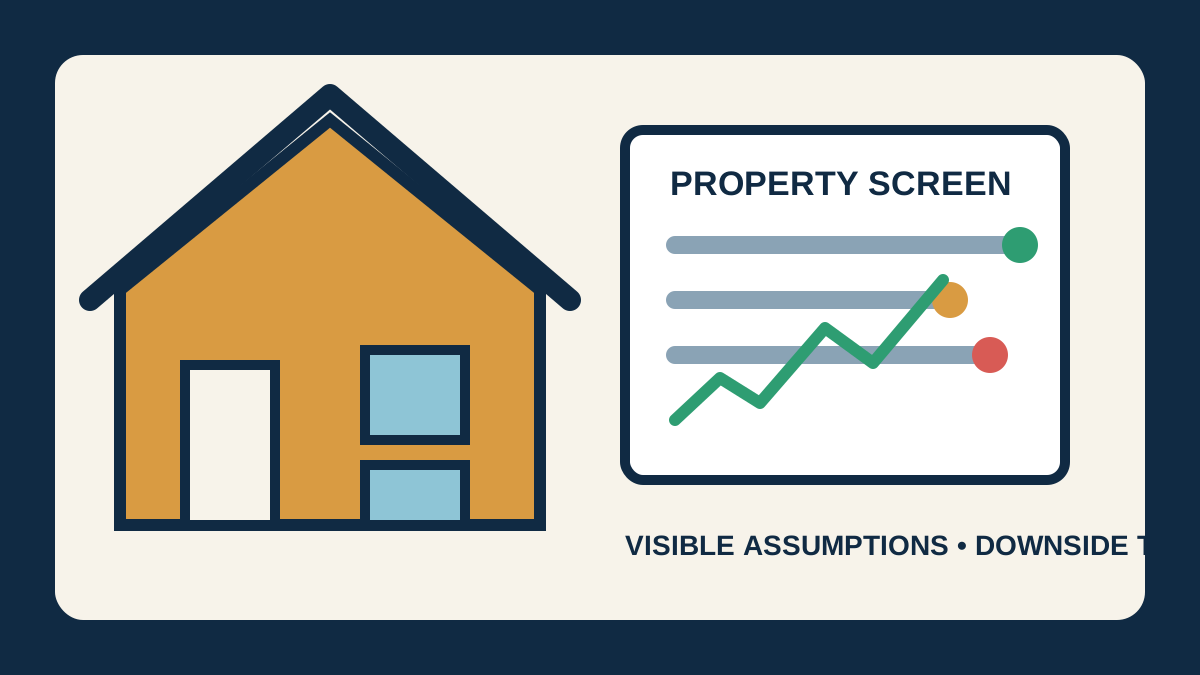
Image credit: Images source: Wealthyiam teamSources / Further reading.
Five practical lessons for screening a property
1. Begin with the property, not the story
Listings often emphasize location, renovation potential, or an attractive projected return. Those details may matter, but they are not the same as verified operating performance. Begin with what the property is expected to do as an asset: rent collected, recurring costs, debt service, capital needs, and the work required to operate it.
Ask:
- What is the realistic rent range, and what evidence supports it?
- Which costs recur monthly or annually?
- What expenses are irregular but foreseeable, such as replacements or major repairs?
- Who will handle tenants, maintenance, compliance, and emergencies?
- What would make the property less attractive than it appears today?
Practical step: Write a one-page property brief before calculating a return. Include the market, property type, expected use, purchase price, financing assumption, rent assumption, major costs, and three risks. If a number is unknown, mark it “unknown” rather than silently treating it as zero.
2. Separate operating income from financing and personal cash flow
A property can have positive operating performance and still be a poor fit for the buyer’s household budget. Operating income is what remains after property-level operating expenses, before considering the owner’s personal finances. Debt service is the payment required by the loan. Personal cash flow includes the owner’s other income, obligations, reserves, and goals.
Keeping those layers separate prevents a common mistake: using an optimistic rent estimate to justify a payment that leaves no room for vacancy or repairs.
Practical step: Prepare two views. First, estimate property operations without assuming appreciation or a future refinance. Second, test whether the required deposit, closing costs, reserves, and possible shortfalls fit your finances without relying on a guaranteed raise, immediate tenant, or rising property value.
3. Make every assumption visible and test the downside
A forecast is a set of assumptions, not a promise. Rent, vacancy, maintenance, insurance, taxes, interest rates, and resale prices can differ from the initial plan. A downside case is not a prediction; it is a way to see what happens if several reasonable assumptions become less favorable.
For a hypothetical screen, compare a base case with a case involving a longer vacancy, a higher repair bill, or a more expensive loan. Label the scenario clearly. Do not treat the result as a forecast or use a made-up example to imply that any property will achieve a particular return.
Practical step: Create three columns—base, downside, and unknown. Put the assumption beside each number. Ask: “If this estimate is wrong, how much cash and time could the error consume?” The answer may be more useful than a single projected percentage.
4. Price risk, not only potential return
Return describes a possible outcome; risk includes the ways the outcome can disappoint and the consequences if it does. Real-estate risk can include concentrated exposure to one neighborhood, leverage, illiquidity, poor construction, tenant turnover, regulatory changes, and the owner’s limited experience.
Leverage means using borrowed money to control an asset. It can magnify gains and losses. Illiquidity means an asset may take time and transaction cost to convert into cash. Those terms matter because a property is not a savings account: selling quickly may be difficult, and a vacant or damaged property may require cash before it produces income.
Practical step: Write down the maximum tolerable monthly shortfall and the amount of liquid reserves you would want before closing. If you cannot define those limits, pause the analysis. A projected return cannot tell you whether you can withstand the path to that return.
5. Treat management as part of the investment
Owning a property is not automatically passive. A landlord may need to find and communicate with tenants, coordinate repairs, keep records, monitor expenses, and comply with local obligations. Hiring a manager can reduce some work, but it adds a cost and does not transfer every responsibility or decision.
The book’s broad relevance includes managing investments, not merely acquiring them. That matters because a property whose numbers work only when the owner provides unpaid labor may not work for an owner with a full-time job, limited local knowledge, or a different risk tolerance.
Practical step: Decide before purchase who will do each recurring task, how quickly problems must be handled, and what evidence would show that the arrangement is working. Include management costs—even if you plan to self-manage—so you can compare the investment with alternatives honestly.
A 30-minute property-screening workflow
Use this as an organizing tool, not a substitute for inspection, professional review, or local due diligence.
- Describe the asset. Record property type, location, intended use, purchase price, and the reason it might serve the tenant or buyer.
- List income assumptions. Note expected rent or other income and the basis for each estimate. Separate observed information from guesses.
- List operating costs. Include known recurring costs, financing, management, utilities, insurance, taxes where applicable, maintenance, vacancy, and reserves for replacements.
- Build a downside case. Change one or more important assumptions and observe the effect on cash needs. Label the scenario hypothetical.
- Identify the value drivers. Choose three to five factors that most affect the decision, such as rent durability, financing cost, condition, location, or management burden.
- Name the decision-changing fact. Write one piece of information—an inspection finding, verified rent evidence, loan term, insurance quote, or legal restriction—that could make you reject or revise the opportunity.
- Set a pause rule. Do not advance because of urgency, a seller’s deadline, or fear of missing out. Advance only when your key unknowns have been investigated and the remaining risk is acceptable for your situation.
Mistakes to avoid
Counting appreciation as current income
A future sale price is uncertain and does not pay today’s bills. Keep operating cash flow separate from a possible change in market value.
Treating a spreadsheet as evidence
A polished model can still contain invented rent, missing costs, or unrealistic vacancy assumptions. Use documents, inspections, comparable evidence, and professional review where appropriate.
Ignoring concentration and liquidity
A property can become a large share of your net worth. It may also be difficult to sell quickly without price concessions and transaction costs.
Assuming self-management is free
Your time has value. Even if you choose to manage personally, include the work in your comparison and make a plan for illness, travel, or emergencies.
Borrowing because the payment fits today
A payment that fits only under current income, rate, occupancy, or insurance conditions may not remain comfortable. Review the full commitment and preserve a cash buffer.
Frequently asked questions
Is The Real Estate Investor’s Handbook beginner-friendly?
The catalog record describes it as a guide to evaluating, financing, acquiring, and managing property. That makes it potentially relevant to a beginner, but the available record does not establish the book’s full level of detail or whether its examples match your market. Use it as a framework for questions, then verify local facts independently.
Does buying rental property guarantee passive income?
No. Rental income and property values are uncertain, and ownership can require substantial management. Financing, vacancies, repairs, taxes, insurance, regulation, and selling costs can affect results.
What should I check before making an offer?
Check the property’s condition, realistic income evidence, operating expenses, financing terms, insurance availability, local requirements, tenant or occupancy assumptions, reserves, and the downside case. Appropriate professional advice may be necessary for your jurisdiction and circumstances.
Can a property with positive cash flow still be a bad investment?
Yes. Cash flow is only one part of the decision. Concentration, leverage, time burden, legal or physical risks, opportunity cost, and the owner’s ability to absorb a loss also matter.
Wealthy I AM application: make the decision repeatable
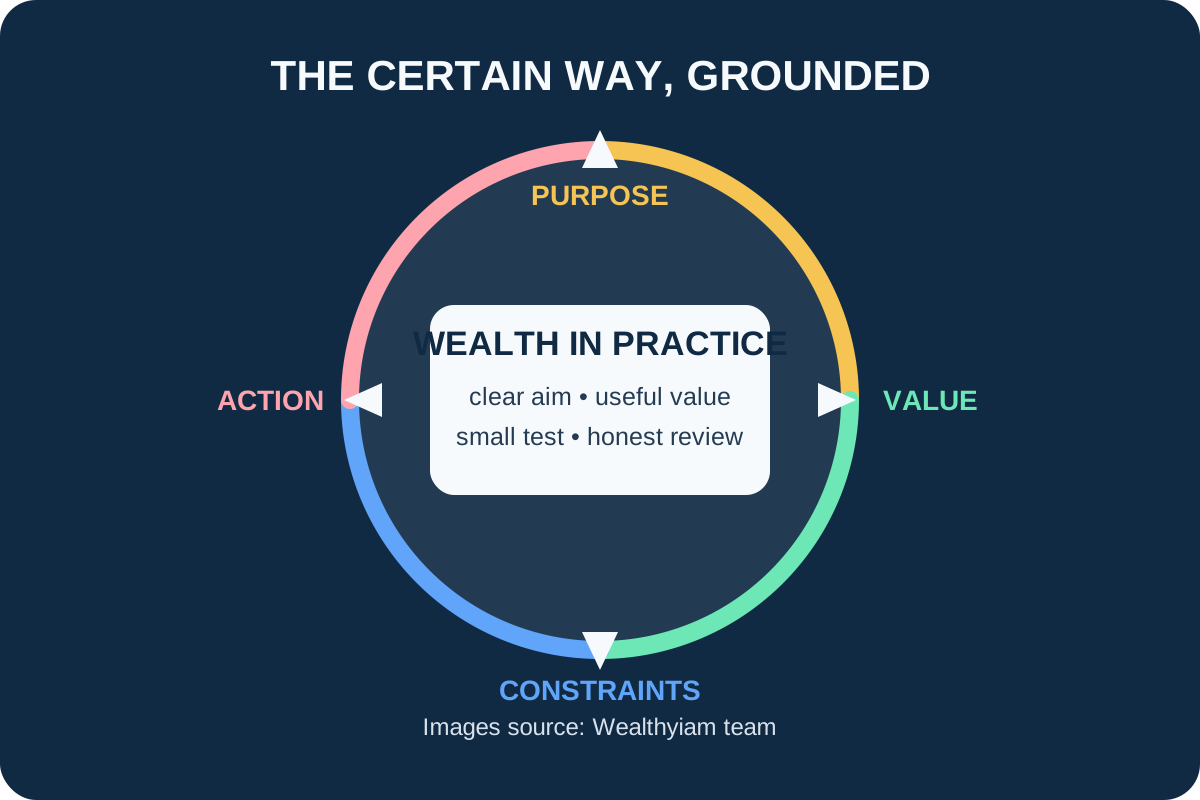
The book idea and the Wealthy I AM advice should remain distinct. The book’s documented inventory theme is a systematic approach to property investment. The application here is a repeatable review: write the assumptions, verify the important ones, test a downside case, and define a stop rule before emotion takes over.
For a current property, your next low-risk step is not to make an offer. It is to create the one-page property brief and identify the single fact that would most change your view. If that fact cannot be verified, the correct decision may be to wait.
Conclusion: screen for resilience before chasing returns
A real-estate investment is a bundle of operating work, financing obligations, physical assets, local conditions, and uncertain future outcomes. The Real Estate Investor’s Handbook is useful here as a prompt to evaluate the whole investment process rather than a listing’s headline promise. The practical takeaway is simple: make assumptions visible, include the costs of ownership, test what could go wrong, and protect your ability to keep going.
Before reviewing another listing, create a simple property-screening worksheet and complete it with one real opportunity. Do not proceed until the unknowns, downside case, and reserve requirement are written down.
<a id="sources-further-reading"></a>Sources / Further reading
- Open Library work record for The Real Estate Investor’s Handbook — inventory source and title/author identity reference.
- Open Library Covers API image — cover provenance; reuse rights should be checked before publication.
- Financial, tax, legal, insurance, lending, and property-condition claims should be verified with current authoritative sources and qualified professionals in the relevant jurisdiction.
This article is general education, not individualized financial, tax, legal, insurance, lending, or investment advice. Hypothetical scenarios do not guarantee any financial result.