A business can look efficient while its operating system lives almost entirely in the owner’s memory. A customer question, sales handoff, invoice, or routine delivery may all depend on one person remembering what happens next. When that person is unavailable, work slows, quality varies, and improvement becomes guesswork.
The practical starting point is not documenting everything. Choose one recurring, high-friction workflow, define its desired result, write the smallest workable procedure, and review whether it helps. That is the lens this article applies to SYSTEMology: Create Time, Reduce Errors and Scale Your Profits with Proven Business Systems by David Jenyns.
What SYSTEMology is about—and the evidence boundary
Open Library identifies SYSTEMology as a 2020 work by David Jenyns with the subtitle “Create time, reduce errors and scale your profits with proven business systems.” The title and catalog record establish the book’s subject and identity, but the available public record does not provide a complete chapter-by-chapter description.
The seven lessons below are therefore a Wealthy I AM editorial synthesis of the book’s broad business-systems premise. They are not presented as the author’s exact numbered framework, nor as a substitute for reading the complete book. A system here means a repeatable way of producing a defined result: a checklist, decision rule, handoff, template, or short procedure.
This article is general business education. A procedure cannot guarantee profit or replace qualified accounting, legal, employment, safety, privacy, or industry-specific advice.
Image credit: Open Library Covers API. Provenance and reuse caveat appear in Sources / Further reading.
Seven practical lessons for making work more repeatable
1. Treat recurring work as an asset worth designing
A repeated task already has a process, visible or not. An invisible process consumes attention and makes mistakes harder to diagnose. Making it visible creates something the team can review, teach, and improve.
Try this: List recurring work and mark the items that cause rework, delays, customer confusion, or owner interruptions. Start with one rather than creating a documentation library.
2. Start with the outcome, not a long manual
“Handle new customers” is vague. “Each new customer has a confirmed next step and an owner” is more testable, subject to the business’s own commitments. A clear outcome gives a procedure a purpose and makes it easier to tell whether it worked.
Try this: Write the desired result, trigger, and next owner in one sentence. Avoid promising a service time unless the business can meet it reliably.
3. Capture the real workflow before polishing it
A polished procedure can hide shortcuts and bottlenecks. Observing the person doing the work may reveal missing information, duplicate entry, or unclear ownership. The aim is not to preserve every habit; it is to understand the actual path before deciding what to change.
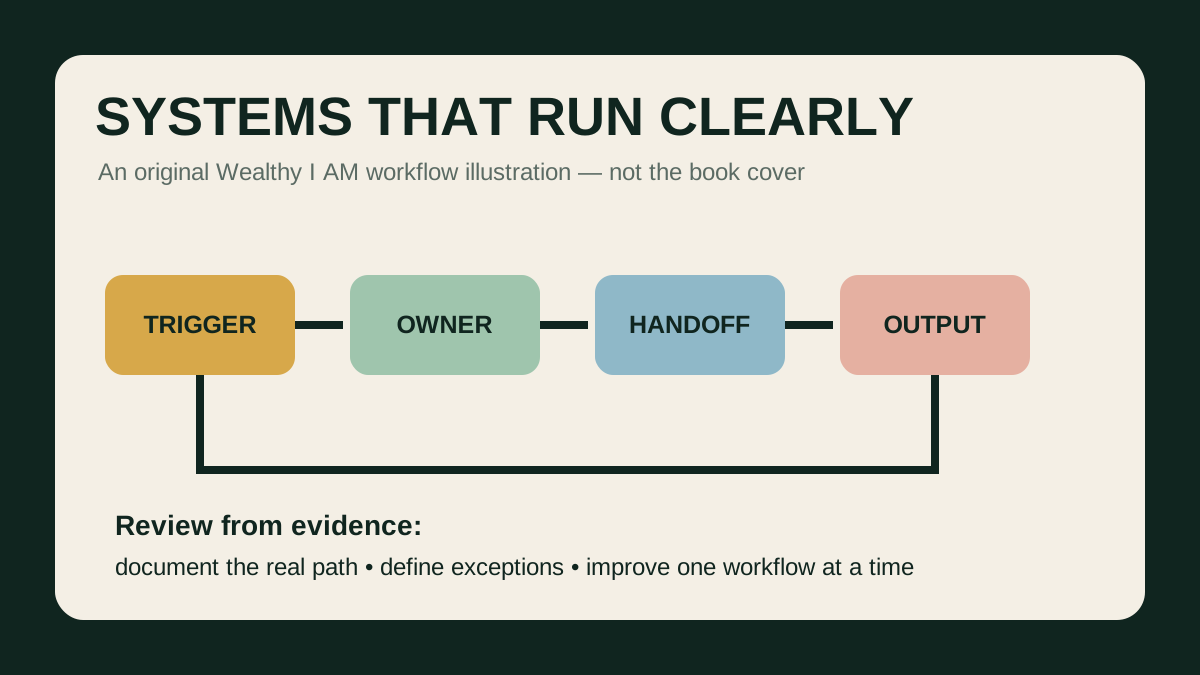
Try this: Record the trigger, inputs, steps, decisions, and output. Label assumptions separately from observations, and do not make one unusual case a universal rule.
4. Standardize repetition while leaving room for exceptions
Consistency can create a predictable baseline, but not every decision belongs in a rigid script. A useful procedure says what normally happens and when a person must stop or escalate.
Try this: Add an “escalate when” section for missing information, safety concerns, conflicts, unusual contract terms, or requests outside the operator’s authority. Obtain qualified advice where appropriate.
5. Design handoffs as carefully as tasks
Work often fails between steps. A completed task can still produce a stalled customer or unpaid invoice if no one owns the next action.
Try this: For each handoff, specify the sender, receiver, required information, acceptance condition, and record location. Test the procedure with someone who did not create it.
6. Improve the system from errors instead of hiding them
A recurring error may signal an unclear instruction, missing check, unrealistic workload, or training gap. Blaming a person alone may leave the condition unchanged. The useful question is what in the workflow made the error likely or difficult to catch.
Try this: Keep an issue log with the date, workflow, failure, likely cause, and proposed change. Review it periodically, and do not claim improvement until it has been observed.
7. Protect the owner’s time for work that cannot be standardized
The point is not to make every interaction mechanical. It is to reduce avoidable repetition so the owner can focus on decisions, relationships, product improvement, and learning. Some work should remain flexible because it depends on judgment or trust.
Try this: Decide what to delegate, automate, schedule, or retain as owner-only work. Revisit that choice when the business, tools, rules, or customers change.
A 30-minute systems audit for a small business
This is an original Wealthy I AM application, not a quoted method from the book.
- Choose one workflow: Select a recurring process that creates visible friction.
- Define done: State the output and who can verify it.
- Map the current path: Write the trigger, inputs, steps, decisions, handoff, and output.
- Find the failure point: Identify the likely source of delay, rework, missing information, or owner interruption.
- Draft one page: Include the purpose, owner, steps, exceptions, and record location.
- Run a safe test: Use it on the next suitable case, not on unreviewed safety-critical or legally sensitive work.
- Review: Ask what was unclear or unnecessary, then record the next revision.
Hypothetical example: an invoice handoff
Imagine a consulting business where invoicing is delayed because project completion is communicated informally. A basic system could define the trigger as approved work, require the project owner to record approval and billing details in one location, assign invoice preparation to a named role, and escalate missing purchase-order information.
This is hypothetical. It does not establish an accounting control, tax treatment, payment time, or profit outcome. It simply shows how a vague responsibility can become a sequence with an owner, input, output, and exception path.
Mistakes to avoid when systemizing work
Documenting everything before fixing the bottleneck
A large library can create maintenance work without solving the problem consuming the most time. Start with a workflow whose improvement would be observable.
Confusing a checklist with competence
A checklist cannot replace training, judgment, or required supervision. High-risk work needs appropriate controls and qualified review.
Copying a process without checking context
A process may not transfer across teams, software, customers, legal environments, or obligations. Adapt it to the real context.
Measuring activity instead of the outcome
Completed forms can reward busyness. Check whether ownership became clearer, rework fell, or resolution improved—and do not claim change before observing it.
Automating first
Automation can scale a bad process. Clarify the work and exceptions first, then assess whether a tool is useful, secure, affordable, and maintainable.
Frequently asked questions
What is the main idea of SYSTEMology?
The book’s title and catalog identity present it as a business-systems guide focused on creating time, reducing errors, and supporting profitable scaling. This article applies that broad premise to one workflow rather than claiming to summarize the full book.
Is systemization only for larger companies?
No. A solo operator can use a clear checklist or handoff note. The scale should match the work; a one-page procedure may be more useful than a complex platform.
Does documenting processes guarantee higher profits?
No. Results also depend on markets, offers, costs, people, execution, and other conditions. Financial outcomes are uncertain.
Should every process be automated?
No. Some work is better handled with a checklist, template, training, or clear decision owner.
How should exceptions be handled?
Define common exceptions and an escalation route, then review unusual cases. For legal, tax, safety, employment, privacy, or regulated matters, consult an appropriately qualified professional.
Wealthy I AM application: build a business that is clearer, not merely busier
The business-systems idea is useful when it makes responsible work easier to repeat, not when it is turned into an unsupported promise of effortless income. Start with one recurring problem, make ownership visible, test the smallest useful procedure, and record what changed.
Conclusion: make one valuable workflow easier to repeat
SYSTEMology points toward a useful question: which recurring activity consumes attention because its process is invisible? Define its outcome, document the real path, clarify handoffs, allow exceptions, and improve from evidence.
Choose one weekly workflow and write its trigger, owner, output, and escalation condition. If it helps the next suitable case move more clearly, revise it. That is a practical beginning—not a guarantee of wealth, but a way to build a business with fewer avoidable dependencies.
Sources / Further reading Open Library: SYSTEMology catalog record — identity, author, subtitle, publication, and edition context. Open Library Covers API image — image source and provenance; reuse rights should be checked before publication. The seven lessons, audit, and example are original Wealthy I AM applications, not verbatim book content. General education only; not individualized financial, legal, tax, employment, safety, privacy, or accounting advice.