Many would-be property investors assume the main obstacle is not knowing enough about real estate. Often, the harder problem is mistaking a financing idea for a sound investment. Borrowing, partnering, or negotiating a creative structure can reduce the cash needed at closing, but it does not remove vacancy, repairs, interest, legal obligations, market risk, or the need for a deal that works on its own terms.
Early answer: limited cash should change how you screen a property, not lower your standards. Start with the property’s economics, identify every source of risk, then decide whether a partnership or financing structure is appropriate. This article gives seven Wealthy I AM–synthesized lessons from Brandon Turner’s The Book on Investing in Real Estate with No (and Low) Money Down: Real Life Strategies for Investing in Real Estate Using Other People’s Money. The inventory describes the book as a guide to partnerships, private money, and creative deal structures, with an emphasis on analysis and risk management. The seven lessons below are an editorial application of that description—not a claim that they reproduce the author’s exact chapter framework.
This is general education, not individualized financial, tax, legal, lending, or real-estate advice. Rules, financing terms, landlord duties, and tax treatment vary by location and situation. Verify material details with qualified local professionals before committing money or signing an agreement.
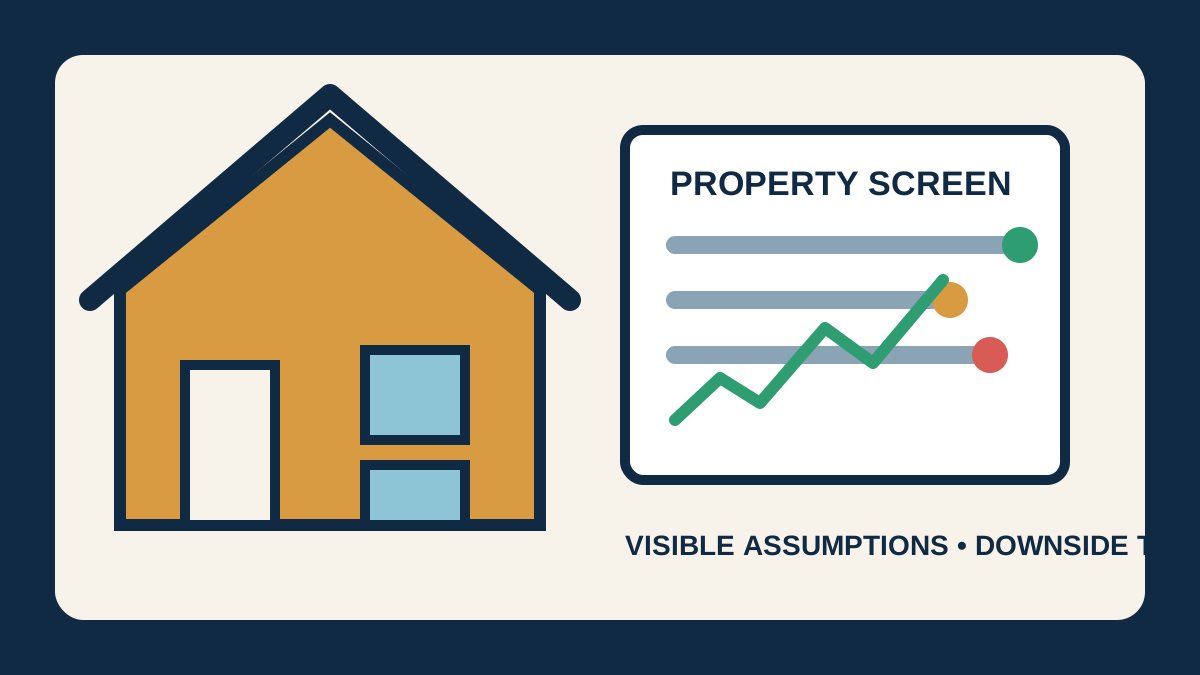
Image credit: Images source: Wealthyiam teamSources / Further reading.
What this book is useful for—and what it cannot prove
Turner’s book is relevant to a common search intent: how can someone think about real-estate investing when personal capital is limited? Its broad premise is that deals may be funded through partnerships, private money, and other structures rather than only the investor’s own cash. That is a financing perspective, not evidence that any particular property will produce income or that leverage is suitable for every reader.
A useful distinction is capital access versus investment quality. Capital access asks, “Where could the money come from?” Investment quality asks, “Does this asset justify the price and the risks?” A clever answer to the first question cannot rescue a weak answer to the second.
The seven lessons for screening a limited-cash deal
1. Begin with value creation, not with the financing trick
The first question should be what useful outcome the property can support. That might involve improving operations, solving a tenant need, repositioning an underused space, or buying an asset at a price that leaves room for uncertainty. “No money down” is not itself a value proposition; it is a description of a funding arrangement.
Practical step: write a one-page property thesis before discussing financing. State the asset type, the customer or tenant need, the work required, the main income drivers, and why the opportunity may be mispriced or under-managed. If the thesis is only “someone else supplies the cash,” pause.
2. Underwrite the property before you underwrite the story
Underwriting means testing the financial assumptions behind a deal. At minimum, separate expected income from expenses, financing costs, reserves, taxes, insurance, maintenance, management, and periods when the property may not generate rent. A property can look attractive on a headline yield while becoming fragile after realistic costs.
Hypothetical illustration: imagine a small rental whose advertised rent appears to cover a loan payment. A cautious screen would still ask what happens during vacancy, after a major repair, if insurance rises, or if management costs more than expected. The illustration is not a forecast and does not establish a return.
Practical step: create base, downside, and “unknown” columns. For each assumption, record its source, confidence level, and the fact that would change your view. Do not hide uncertainty inside a single optimistic estimate.
3. Treat leverage as an obligation, not free money
Leverage means using borrowed money to control an asset. It can increase purchasing capacity, but it also creates scheduled obligations and can magnify losses. Debt may remain payable even when a property is vacant, a renovation runs late, or a sale takes longer than expected. Interest-rate changes, refinancing risk, personal guarantees, and lender covenants may matter as much as the initial down payment.
Practical step: list every obligation separately: principal and interest, fees, reserves, guarantees, deadlines, collateral, and what happens after a missed payment. Then ask whether you could meet the obligations without relying on a best-case sale or rent increase. If not, the structure may be too fragile.
4. Make the partner relationship part of the investment analysis
A partnership can combine money, knowledge, labor, credit, or access. It also introduces coordination risk. Partners may disagree about renovations, distributions, refinancing, a sale, or the amount of time each person should contribute. A verbal understanding is not a complete operating plan.
Practical step: before committing, write down contributions, ownership, decision rights, compensation, reporting, reserves, dispute procedures, transfer rules, and exit options. Ask who can approve new borrowing and what happens if one partner cannot contribute more. Have the agreement reviewed under the relevant law; the details are not interchangeable across jurisdictions.
The book’s partnership-oriented premise is best applied as a reason to clarify incentives, not as a reason to bring in a partner at any price. Giving away economics or control can be more expensive than waiting and saving more capital.
5. Match the funding source to the project’s risk and timeline
Different capital sources carry different expectations. A private lender may care about repayment and security. An equity partner may care about long-term upside and control. A short-term loan may fit a defined project only if the timeline and exit are credible. The least expensive-looking money can become costly if its terms are mismatched to the asset.
Practical step: prepare a capital map with four lines: amount needed, intended use, expected duration, and repayment or return mechanism. Add the failure case: what if the project takes longer, costs more, or cannot refinance? Do not describe capital as “cheap” without considering fees, control, guarantees, and risk.
6. Preserve a margin for surprises
A reserve is money set aside for foreseeable uncertainty. Real estate can involve repairs, vacancies, legal disputes, permitting delays, insurance changes, and market shifts. A deal that uses every available dollar at closing may leave no room for ordinary problems.
Practical step: define a reserve policy before making an offer. The policy should identify which costs the reserve covers, who replenishes it, and when distributions pause. The right amount depends on the property, financing, local conditions, and the investor’s circumstances; there is no universal reserve figure in this article.
This is where “low money down” can be misunderstood. Less cash invested at the start does not mean less cash required over the life of ownership.
7. Design the exit before you enter
An exit is the planned way an investor could repay capital, refinance, sell, or continue holding an asset. It is not a guarantee that a buyer or lender will be available. A plan dependent on one favorable market outcome is a concentration of risk.
Practical step: write at least two plausible paths and one stop condition. For example, a hold strategy may depend on sustainable operating income; a sale strategy may depend on a buyer and transaction costs; a refinance strategy may depend on future lending terms. The stop condition should identify a fact that would make you renegotiate, pause, or walk away.
A 30-minute limited-cash deal screen
Use this as a learning worksheet, not as a recommendation to buy any property.
- Describe the asset in plain language. What is it, who uses it, and what must go right?
- List three to five value drivers. Examples include occupancy, price, operating costs, condition, location, or a documented improvement opportunity. Label each as verified, estimated, or unknown.
- Build a downside view. Include lower income, higher costs, delays, and a longer hold or sale period. Do not assume all risks happen at once, but do not omit material ones.
- Map the capital. Identify personal cash, debt, partner funds, lender fees, reserves, and any guarantee or security interest.
- State what the current price requires. Does the deal depend on rent growth, rapid renovation, cheap refinancing, or a quick sale? Write the dependency plainly.
- Name one fact that would change your mind. This could be an inspection finding, a financing term, a legal restriction, or evidence that demand is weaker than assumed.
- Choose the next reversible action. That might be requesting documents, speaking with a local professional, comparing another property, or declining to proceed.
The output should be a short business description, a small set of drivers, a downside case, a capital map, and a decision boundary—not a confident return forecast.
Mistakes to avoid
Confusing control with ownership
Controlling a property through debt or an agreement can expose you to obligations without giving you the same economics or rights as direct ownership. Read the documents and identify who bears losses.
Assuming creative financing means risk-free financing
A structure can be creative and still be expensive, restrictive, or vulnerable to default. Compare the full obligations with a simpler alternative.
Using projected appreciation to cover operating weakness
A rising future price is uncertain. A property should not require appreciation to conceal poor cash management.
Skipping independent review
A lender, partner, broker, or seller may have a legitimate interest in closing. Independent legal, tax, inspection, and financial review can surface issues that a promotional summary will not.
Treating a book’s framework as a universal rule
Turner’s broad financing perspective may help readers ask better questions. It does not replace local law, current loan terms, property-specific due diligence, or a reader’s own risk capacity.
FAQs
Can someone invest in real estate with little or no personal cash?
Some deals may use partners, private capital, or other financing structures, but “little cash” does not mean little risk or no future funding need. The feasibility depends on the property, terms, skills, reserves, legal structure, and local market.
Is no-money-down real estate investing safe for beginners?
There is no general safety conclusion. Borrowing and partnership structures can increase complexity and obligations. A beginner should first learn to evaluate the asset, the documents, the downside, and the exit rather than starting with the financing slogan.
What is the main lesson of The Book on Investing in Real Estate with No (and Low) Money Down?
Based on the inventory’s reliable description, the book focuses on finding and financing real-estate opportunities with limited personal capital through partnerships, private money, and creative structures. The practical Wealthy I AM synthesis is to keep deal quality and risk analysis ahead of capital structure.
Should I use a private lender or an equity partner?
That depends on the project, terms, control, repayment capacity, legal structure, and the parties’ objectives. Compare the complete arrangement and have the documents reviewed by appropriate professionals; this article cannot select one for an individual deal.
What should I do before making an offer?
Document the property thesis, verify income and expenses, test downside assumptions, identify all obligations, confirm legal and physical due diligence, map the capital, and write an exit and stop condition. If important facts remain unknown, treat that uncertainty as a reason to investigate or wait.
A cautious next step
If limited cash is the reason you are exploring real estate, do not begin by searching for a way around the down payment. Begin by choosing one property, writing a plain-language thesis, and completing the seven-part screen above. If the deal still makes sense after realistic costs, obligations, reserves, and exit risks are visible, seek qualified local review. If it does not, learning that before committing capital is a useful result.
Conclusion
The practical value of The Book on Investing in Real Estate with No (and Low) Money Down is the question it raises: how can capital, relationships, and deal structure expand what an investor can consider? The safer application is to answer that question only after testing the asset itself.
Limited cash may lead to partnerships or financing, but neither replaces disciplined analysis. Protect reserves, document incentives, match funding to the project, and define what would make you walk away. Real estate can be one possible wealth-building vehicle; it is not a guaranteed path, and a reader’s decision should reflect their own objectives, obligations, and capacity for loss.
Sources / Further reading
Book record: Open Library — *The Book on Investing in Real Estate with No (and Low) Money Down* (title, author, and work identity).
Image source: Open Library Covers API — cover ID 8538298.
Editorial boundary: The article’s seven lessons, worksheet, hypothetical illustration, and practical recommendations are Wealthy I AM synthesis. They should not be read as a verbatim reconstruction of the book or as individualized advice.
—