If you are working hard but still cannot explain how your effort becomes durable wealth, the missing piece may be ownership—not another productivity trick. How to Get Rich by Felix Dennis is an entrepreneurial memoir and argument about value, ownership, risk, money, and the trade-offs that can accompany financial success.
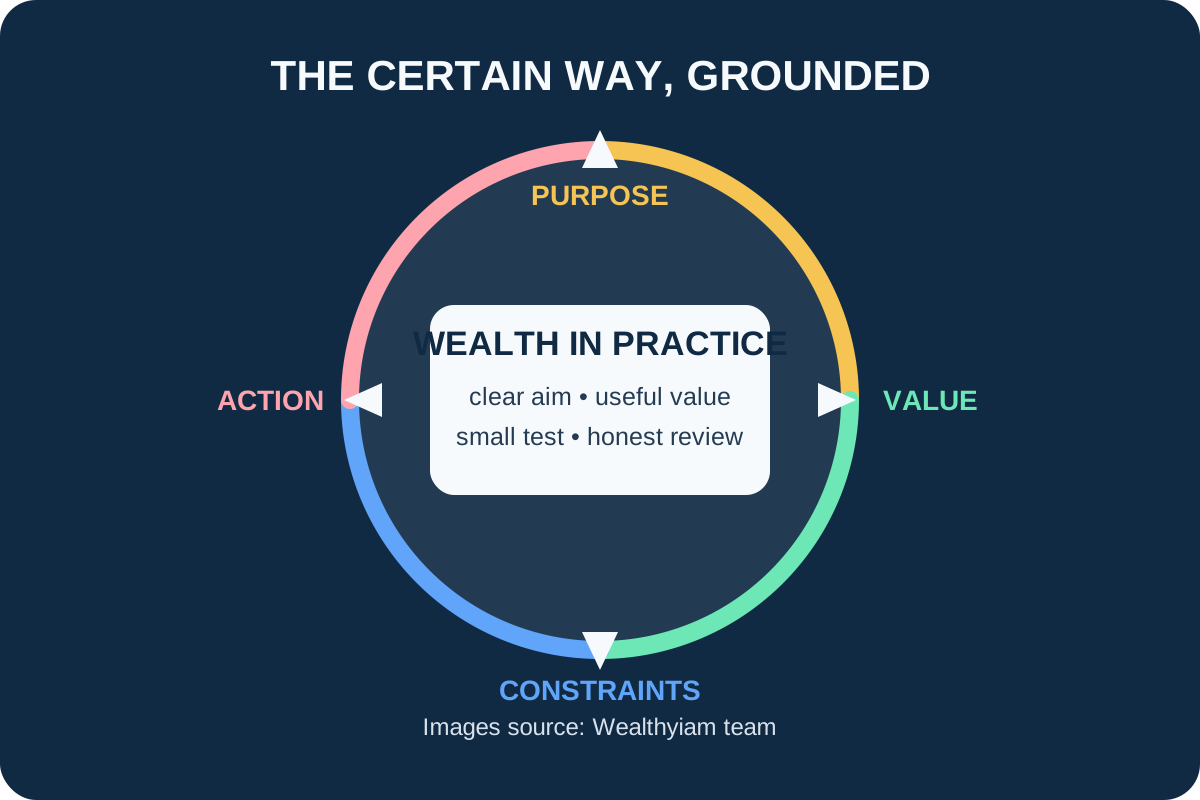
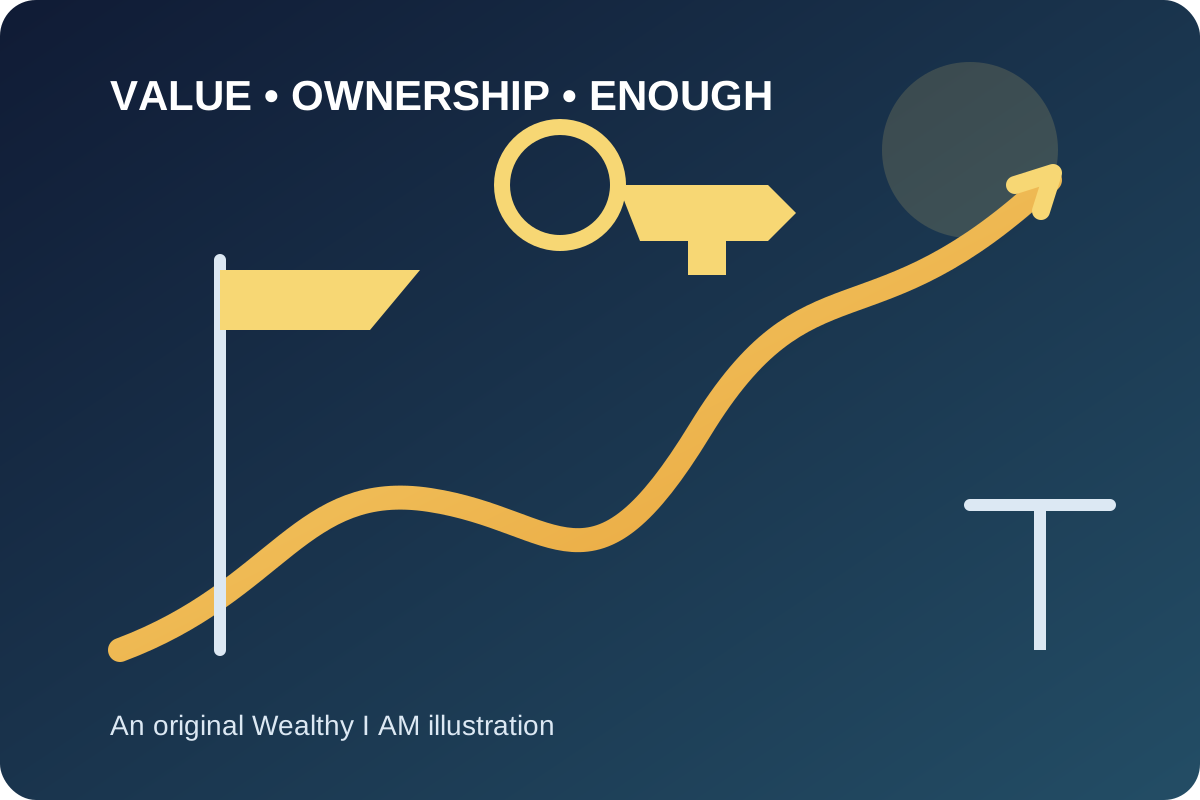
Short answer: the book is most useful as a wealth-building lens: create something people value, understand who owns the resulting economics, measure downside before scaling, learn from evidence, and define what “enough” means to you. These seven lessons are a Wealthy I AM synthesis of the available catalogued description and work record, not a reconstruction of Dennis’s exact chapter structure or a promise that his path will work for every reader.
Image provenance: exact-title cover asset from the Open Library Covers API, cover ID 69947, matched to Open Library work OL5756579W. The publisher must confirm reuse rights or choose a rights-cleared replacement before publication.
What is How to Get Rich about?
The Open Library record describes Dennis as an entrepreneur sharing lessons from his experience and identifies the work as part memoir and part contrarian manual about entrepreneurship and wealth. That public catalog description confirms the book’s identity and broad subject, but it is not a substitute for reading the complete book. The practical applications below are editorial interpretations, not quotations or guarantees from Dennis.
The book is most relevant to an entrepreneur, creator, or employee considering an ownership path. It is less useful as a personal investing plan, tax guide, or universal prescription. A business can fail, ownership can be diluted or illiquid, and business income is not the same as safe, spendable wealth.
The seven practical lessons—and how to use them cautiously
1. Separate income from ownership
A paycheck is compensation for work. Ownership is a claim on an asset or enterprise that may continue to have value beyond a single hour worked. This distinction can help explain why two people with similar incomes may build very different balance sheets.
That does not mean employment is inferior or that every reader should start a company. Ownership carries uncertainty and often concentrates risk in one venture. Ask instead: Which part of my work creates an asset, repeatable process, intellectual property, customer relationship, or business equity—and who receives the long-term benefit?
Try this: list your three largest sources of economic value at work. Mark each as labor, an owned asset, or a mixture. Then choose one realistic way to improve your bargaining position: develop a scarce skill, document a repeatable process, negotiate a bonus structure, or test a small customer-funded project.
2. Create value before you chase wealth
“Get rich” is an outcome, not an operating system. A more durable starting point is to solve a problem for a defined group, deliver the solution reliably, and understand whether the revenue left after costs is real.
For example, suppose a designer notices that local clinics need a simpler way to explain appointment preparation. The designer could interview potential users, prototype a paid template, track whether anyone uses it, and calculate delivery costs. This is not a forecast of success; it is a small test of whether value exists before spending heavily.
Action step: write one sentence using this structure: “I help [specific person] make progress on [specific problem] by [specific deliverable].” Ask five potential users about their current workaround. Do not pitch first. Record what they already do, what it costs them, and whether the problem is important enough to pay to improve.
3. Treat equity as a risk-bearing claim, not free money
Equity means an ownership interest. It may provide upside if an enterprise grows, but it can also be difficult to sell, diluted by later financing, or reduced to zero. Ownership does not remove the need for revenue, cash controls, or a viable product.
Before valuing a percentage, ask “percentage of what, under which terms, and after which obligations?” A founder, employee, or investor may need to understand vesting, dilution, voting rights, liquidity, debt, and tax consequences through qualified professional advice. The details differ by country and agreement.
Action step: before accepting or buying an ownership interest, make a one-page risk memo: what you own, what could dilute it, how it could become liquid, what you could lose, and which documents require review. If you cannot explain the arrangement in plain language, pause.
4. Use leverage only when you understand the downside
Leverage means using a resource—people, software, capital, distribution, or media—to increase the effect of an input. It can make a sound model more productive, but it can also magnify losses, obligations, and reputational damage.
The safer interpretation is not “borrow more” or “automate everything.” It is “find repeatability, then scale it in measured steps.” A business with one profitable, repeatable service may be able to use a documented process or software tool. A business with uncertain demand may simply be multiplying uncertainty.
Try this decision test: before adding debt, fixed payroll, or a large marketing commitment, write the assumption it depends on, the cash outflow, the earliest warning signal, and the exit plan. Include a downside case that you could actually survive.
5. Persistence is useful only when paired with learning
Persistence can keep a worthwhile project alive, but stubbornly repeating an untested plan is not disciplined perseverance. A more useful loop is: act, observe, learn, adjust, and decide whether to continue.
For a small venture, useful signals might include repeat purchases, referrals, delivery time, customer retention, or contribution margin—the money left after costs directly tied to delivery. None is a guarantee. These are simply better decision inputs than enthusiasm alone.
Weekly review: write down one assumption tested, one piece of evidence collected, one change made, and one reason to stop or continue. This keeps commitment connected to reality rather than to the emotional cost of time already invested.
6. Count the personal price of a wealth strategy
A plan can be financially attractive and still be a poor fit if it consumes health, relationships, autonomy, or all available time. A memoir about wealth-building is useful partly because it invites readers to examine not only the money, but also the trade-offs behind it.
This is not a health diagnosis or a claim that any particular sacrifice caused any particular result. It is a planning principle. Before taking on a venture, define boundaries around sleep, caregiving, safety, debt, and time away from people who depend on you. If a plan requires ignoring serious health or legal concerns, it needs redesign, not more motivation.
Use a trade-off ledger: for each major wealth goal, record the hoped-for upside, the risks, the time requirement, the relationships affected, and the conditions under which you would stop. Revisit it monthly.
7. Define “enough” before success defines it for you
More money can increase options, but “rich” is not a complete financial target. A useful definition includes a spending level, a margin for uncertainty, obligations to others, and the freedom the money is meant to support.
For one person, enough may mean a reliable emergency reserve and lower debt. For another, it may mean the ability to work fewer hours. Neither definition is universal, and neither is guaranteed by business ownership.
Write an enough statement: “I am building wealth to fund ___, protect ___, and make ___ possible. I will consider the plan successful when ___ is true, not merely when a headline number appears.” This turns wealth from an endless score into a decision framework.
A low-risk 30-minute application
If you want to apply the book without making a dramatic financial move, use this worksheet:
- Name the value: What problem could you solve, and for whom?
- Name the asset: What would remain after the work—a skill, process, customer relationship, content library, or ownership interest?
- Name the economics: What would the customer pay, what would delivery cost, and what obligations would remain?
- Name the downside: What cash, time, reputation, or opportunity cost could you lose?
- Name the boundary: What health, safety, family, legal, or financial limit is non-negotiable?
- Name the test: What small, reversible experiment could produce evidence within two weeks?
- Name the exit rule: What result would make you modify, pause, or stop?
This is an educational decision aid, not individualized financial, tax, legal, or business advice. A regulated professional may be appropriate for securities, contracts, tax, debt, or entity questions.
Mistakes to avoid when applying the book
- Copying the author’s biography: One person’s experience includes timing, skills, context, and luck that may not transfer.
- Confusing revenue with wealth: Sales can rise while cash falls if costs, debt, or working-capital needs rise faster.
- Assuming equity is liquid: Ownership may be hard to sell and may lose value.
- Using debt to cover an untested idea: Leverage can turn a business experiment into a personal obligation.
- Ignoring concentration risk: A job, house, and business in one local economy can expose a household to the same shock.
- Treating sacrifice as proof: Exhaustion is not evidence that a strategy works.
- Skipping professional review: Contracts, securities, tax, and employment rules vary by jurisdiction.
Is How to Get Rich worth reading?
It may be worth reading if you want an entrepreneurial case study and are willing to separate memoir from general advice. Read it critically if you are looking for a diversified investing plan, a step-by-step personal budget, or a guaranteed route to financial independence. Its value lies in the questions it raises about value, ownership, risk, and trade-offs—not in a promise that the same path will produce the same result for everyone.
Frequently asked questions
Is How to Get Rich a personal-finance guide?
Not in the narrow sense of a budgeting, tax, or portfolio manual. It is better approached as an entrepreneurial memoir and argument about building wealth, ownership, and the costs of pursuing money.
Does the book say that entrepreneurship is the only way to get rich?
The available catalog evidence does not establish an absolute claim of that kind. Entrepreneurship is one possible path; employment, saving, investing, and professional skill-building may also matter depending on a person’s goals and constraints.
What is the safest lesson for a beginner?
Start with a small, reversible test of a real problem. Avoid debt, large fixed commitments, or concentrated investments until you understand the downside and can afford the loss.
Can ownership guarantee financial freedom?
No. Ownership can create upside, but it can also be illiquid, diluted, volatile, or worthless. Outcomes depend on the asset, terms, execution, market conditions, and risks that cannot be known in advance.
Conclusion
How to Get Rich is most useful as a challenge to think beyond earned income: create value, understand ownership, measure downside, learn from evidence, and count the personal cost. Its memoir cannot become your forecast. Use these seven lessons as questions, not guarantees. Start with one reversible test and one explicit boundary; then let evidence—not excitement—decide what comes next.
Sources and image provenance
- Open Library work record: How to Get Rich by Felix Dennis — used for title, author, work identity, and broad catalogued description. It is not treated as a substitute for the complete book.
- Open Library Covers API, cover ID 69947 — source for the exact-title cover asset stored as `how-to-get-rich-cover.jpg`. Reuse rights must be confirmed before publication.
- General educational content only; current financial, legal, tax, and business questions should be checked against authoritative sources for the relevant jurisdiction.