If investing feels like a language you were expected to know already, the hardest part may not be choosing a fund or account. It may be knowing what question to ask first. A beginner can jump from a vague goal to a product, follow a confident headline, or take more risk than they understand.
Short answer: Investing for Dummies by Eric Tyson is most useful as a foundation for turning investing into a sequence: define the goal, understand the account and investment, match risk to time, diversify, control costs, and review the plan without reacting to every market move. It is a starting map, not a personalized recommendation or a promise of returns.
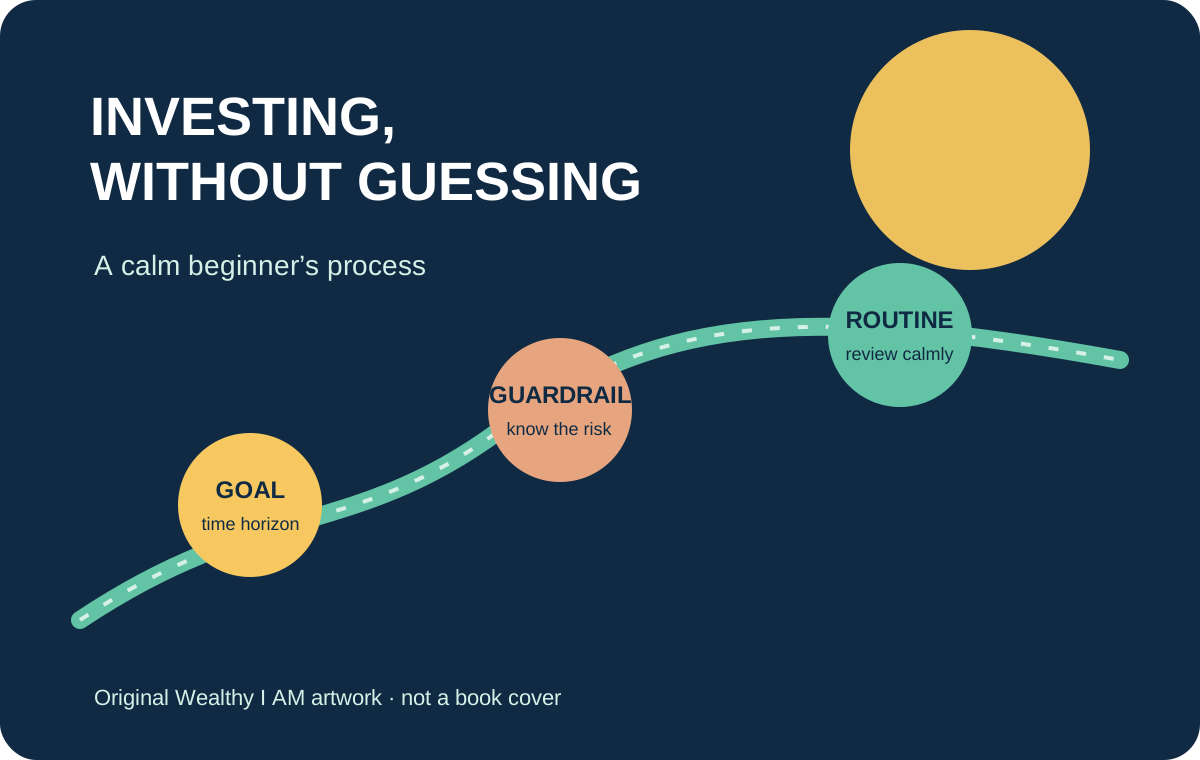
This article explains the book’s beginner-oriented themes, then separates them from a Wealthy I AM application: a simple Goal–Guardrail–Routine process for making the next investing decision more deliberately. The seven lessons below are a practical reading of those themes, not a claim that Tyson presents this exact numbered framework.
Who this book is for—and what it cannot do
Tyson’s book is aimed at readers who need investing concepts explained in accessible language. That makes it a useful orientation tool for someone comparing savings, bonds, shares, funds, retirement accounts, or other vehicles for the first time. The benefit is not that it supplies one universally correct portfolio. The benefit is that it encourages the reader to understand the building blocks before acting.
The Open Library work record identifies the book as a finance and investment guide and describes topics including investment options, risks and returns, mutual funds, bonds, brokerage firms, retirement accounts, and real estate. Editions can differ, and the catalog description is not a substitute for reading the edition you own.
The book is not a substitute for current account rules, tax guidance, a prospectus, or advice based on your own circumstances. Financial products, laws, fees, and available accounts differ by country and can change. Read current official documents before opening an account or investing money.
The central lesson: investing is a process, not a tip
A tip asks, “What should I buy?” A process asks, “What am I trying to accomplish, what could go wrong, and how will I behave when conditions change?” Tyson’s beginner-oriented approach is valuable because it moves attention from prediction to preparation.
A sound process cannot remove market loss, inflation, taxes, or uncertainty. It can make it easier to notice when an investment does not fit the goal, when a cost is unclear, or when an emotional reaction is about to replace a plan.
7 practical lessons from Investing for Dummies
1. Start with the goal and time horizon
The same investment may be unsuitable for a near-term need and reasonable for a goal many years away. Begin by naming the purpose of the money, the approximate date it may be needed, and how much loss you could tolerate without abandoning the plan.
Try this: write one sentence: “This money is for ___, I may need it around ___, and a temporary fall would make me feel ___.” If the money is needed soon, preserving access and stability may matter more than seeking growth.
2. Learn the difference between saving and investing
Saving generally emphasizes access and stability; investing accepts uncertainty in pursuit of longer-term growth or income. Neither is automatically better. The decision depends on the goal, the time available, and your capacity to absorb loss.
A cash reserve can serve a different job from a diversified investment portfolio. Treating every dollar as if it has the same job is a common source of confusion.
3. Understand what you own
A share represents an ownership interest in a company. A bond is a loan to an issuer, with risks that include credit and interest-rate risk. A fund pools assets and may make diversification easier, but it still has costs, risks, and a specific mandate. An account is the container; the investments inside it are the contents.
Before buying, answer in plain language: What does this own or lend to? How can it lose value? What does it cost? How easily can I sell it? What taxes or rules apply? If you cannot answer, pause.
4. Diversification is a risk-management tool, not a guarantee
Diversification spreads exposure across investments rather than depending on one company, sector, issuer, or outcome. It can reduce the damage from one holding performing poorly, but it cannot prevent losses across a whole market. A portfolio can be diversified and still decline.
Practical step: list your major exposures by asset type, geography, and employer or industry concentration. Concentration can hide inside several funds that own many of the same companies.
5. Costs deserve attention because they are certain when charged
Investment costs can include fund expenses, trading charges, account fees, spreads, advice fees, and taxes. The exact effect depends on the product, balance, time, and jurisdiction. The general principle is simpler: understand every recurring or transaction cost before committing.
Do not compare a product only by its advertised return or label. Compare its role, risk, access, and total cost with plausible alternatives.
6. Risk is more than price movement
Market volatility is visible, but other risks may be less obvious: losing purchasing power, being unable to access funds, relying on one income source, using leverage, or misunderstanding a tax rule. A high-return possibility is not the same as a suitable choice.
Ask which risk you are accepting and why. If the answer is only “because someone online said it was safe,” the research is not finished.
7. A written plan can protect you from future reactions
Investors often make decisions at the moment they feel most uncertain. A written plan can state the target allocation, contribution routine, review date, and conditions that would justify a change. It can also state what will not justify a change, such as a dramatic headline alone.
This does not mean ignoring new information. It means deciding in advance how new information will be evaluated.
A Wealthy I AM application: the Goal–Guardrail–Routine process
The following is a Wealthy I AM synthesis, not a named framework from Tyson’s book. Use it to turn general education into a cautious next step.
Step 1: Define the job of the money
Write the goal, time horizon, liquidity need, and consequence of a loss. Separate emergency cash, near-term spending, long-term investing, and money you can afford to place at higher risk. If high-cost debt or an essential reserve changes the priority, account for that before investing.
Step 2: Set guardrails before researching products
Choose boundaries such as “I will not buy what I cannot explain,” “I will check the current fee schedule,” and “I will not use borrowed money for a decision I do not understand.” These are behavior rules, not performance forecasts.
For a fund or account, record the provider, objective, holdings or exposure, fees, access rules, tax treatment to verify, and main risks. Keep the source documents with your notes.
Step 3: Automate a sustainable routine—only if appropriate
If the goal, cash flow, and account fit support it, a regular contribution schedule can reduce the need to make a fresh decision every week. Automation does not eliminate risk and should not override changing bills, reserves, or other obligations. Review it when your circumstances change.
Step 4: Review on a calendar, not in a panic
Set a reasonable review interval and inspect the plan against the goal. Ask whether the time horizon, cash needs, risk capacity, costs, and investments still match. A review is a diagnostic, not an instruction to trade. Consider qualified advice where the decision involves substantial money, complex taxes, retirement rules, or legal arrangements.
A hypothetical example: from product-first to process-first
Imagine Maya has money she expects to need for a home repair next year and separate money intended for a much later goal. A product-first approach might put both sums into the same investment because it is popular. A process-first approach gives each sum a job, checks access and stability for the repair reserve, and evaluates longer-term investments against time horizon, diversification, and cost. The example is hypothetical; it does not predict a result or recommend a product.
The important change is not a magic asset choice. It is the order of operations: goal, guardrail, then routine.
Mistakes to avoid
- Treating a beginner book as current product advice. Verify rates, fees, rules, and tax treatment using current official sources.
- Confusing diversification with safety. Several holdings can fall together.
- Ignoring liquidity. Money needed soon should not be exposed to a risk you cannot tolerate.
- Chasing a past winner. Historical performance is not a reliable promise of future results.
- Using leverage casually. Borrowing can magnify losses and introduce repayment risk.
- Changing the plan because of one headline. Investigate the facts and compare them with written guardrails.
- Skipping professional help on complex matters. Education is not individualized financial, tax, or legal advice.
FAQs
Is Investing for Dummies good for complete beginners?
It can be a useful orientation resource because it introduces terminology and basic categories. Pair it with current primary documents and treat older editions or general explanations as a starting point rather than final authority.
Does the book tell me what stocks or funds to buy?
A general guide cannot determine what is suitable for every reader. Product discussions should be checked against current information, fees, risks, access needs, tax rules, and your circumstances.
How much money should a beginner invest?
There is no responsible universal amount. Consider essential expenses, high-cost debt, emergency savings, income stability, time horizon, and the possibility of loss. A qualified adviser can help with circumstances requiring individualized analysis.
Is investing guaranteed to build wealth?
No. Investing involves uncertainty and possible loss of principal. Diversification and a long-term process may manage some risks, but they do not guarantee a positive outcome.
What should I do first after reading the book?
Write down one financial goal and its time horizon, then complete the four Goal–Guardrail–Routine steps without buying anything. The purpose of the first session is clarity, not speed.
A careful next step
Set a 30-minute learning appointment. Choose one real goal, gather current account or product documents, and fill in the Goal–Guardrail–Routine notes. If you still cannot explain the investment, leave the money uncommitted while you research or seek qualified advice. You do not need a prediction to take a careful next step.
Conclusion
The practical value of Investing for Dummies by Eric Tyson is its invitation to replace intimidation with a process. Define the job of the money, understand what you own, spread risk thoughtfully, check costs and access, and decide how you will review the plan before markets or headlines test your patience.
That process is not a shortcut to guaranteed wealth. It is a way to make financial decisions more legible, more deliberate, and better connected to the life the money is meant to support.
Sources / Further reading
- Book identity and catalog record: Open Library work record for Investing for Dummies. The record lists Eric Tyson and subjects including investments, business, and finance.
- Cover image: Open Library Covers API, cover ID 812314. Provenance: catalogued cover associated with the selected work/edition; reuse terms should be checked before publication.
- For current investment, tax, and account information, consult relevant regulator, provider documents, and a qualified professional in your jurisdiction.