A business can report attractive profits while its industry is quietly attracting too much capital. New factories, new competitors, aggressive lenders, or a rush of investor enthusiasm can eventually pressure prices and returns. The reverse can also happen: an unpopular industry may be cutting capacity and strengthening its economics before the improvement is obvious in recent results.
Short answer: Capital Returns, edited by Edward Chancellor, is best read as a collection of analyses about how investment, competition, supply, demand, and capital allocation shape future industry returns. Its useful question is not simply “Is this company profitable?” but “What is happening to the amount of capital chasing this opportunity, and what might that do to future returns?”
The book does not provide a guaranteed market-timing formula. The practical framework below is a Wealthy I AM synthesis of the available bibliographic and inventory evidence—not a claim that Chancellor presents these exact numbered lessons.
Who this is for: Readers who want a plain-language introduction to capital-cycle thinking and a cautious way to use it in investment research. This is general education, not individualized investment advice.
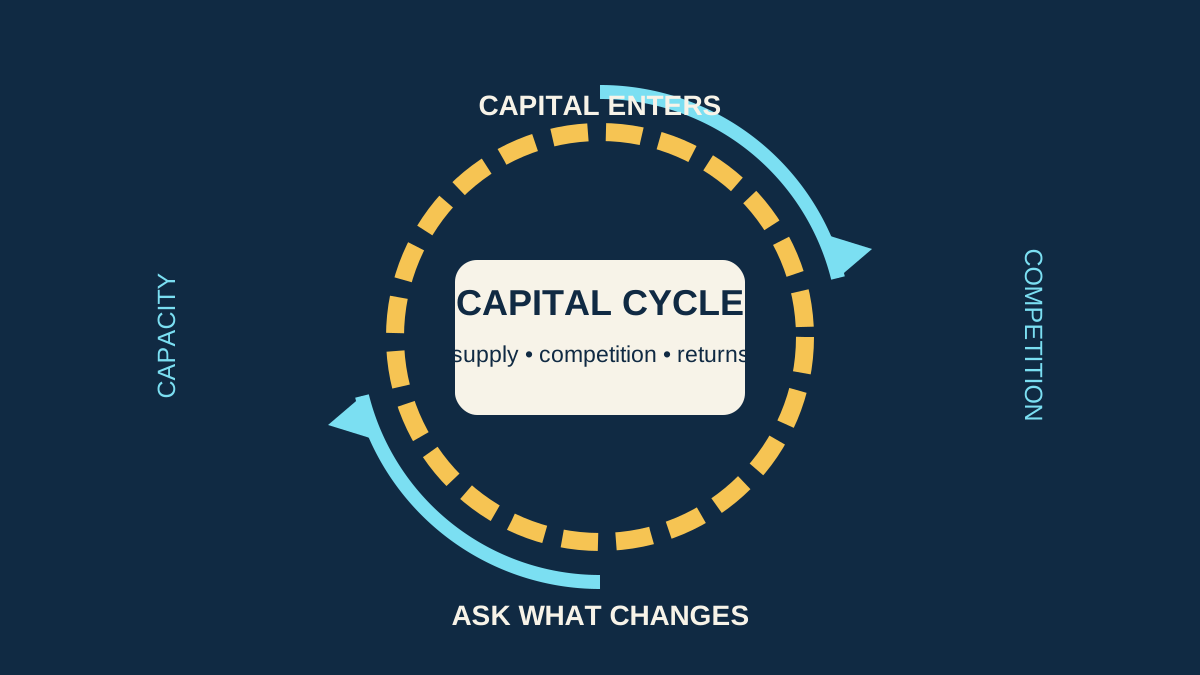
Image credit: Open Library Covers API, catalogued cover associated with Capital Returns: Investing Through the Capital Cycle. Source: Open Library cover record. Reuse terms should be checked before publication.
What the capital-cycle idea means
The capital cycle describes how investment decisions change the supply of products or services and, in turn, influence competition and returns. When an industry appears highly profitable, management teams, competitors, lenders, and investors may commit more resources to it. That can expand supply or intensify competition. When returns disappoint, investment may slow, weaker operators may exit, and supply can become more constrained.
A useful mental model is: capital attracts competition; scarce capital can create breathing room. The timing and degree are uncertain. This is an industry-level lens, not a rule that every company in a growing industry is weak or every neglected industry is attractive.
Seven practical lessons from Capital Returns
The following lessons are an editorial synthesis for readers. They explain how to apply the central idea without presenting this list as the book’s exact framework.
1. Study the industry’s capital cycle, not only the company’s income statement
When an industry is profitable, ask what capital is doing around the company. Capacity, competitors, financing, and acquisitions may be increasing, stable, or declining. Those changes can affect future pricing and returns even when the company’s latest results look strong.
Practical step: Record each observation as verified, uncertain, or unknown. Link important facts to a filing, regulator, company disclosure, or other authoritative source.
2. Treat past returns as evidence, not a promise
Historical margins and return on capital describe what happened. They do not by themselves establish what will happen next. A period of high returns may have reflected limited competition, unusually favorable prices, temporary scarcity, or disciplined investment. If those conditions change, the historical number can become a poor guide.
Ask: What protected this return, and what could remove that protection? The answers should be specific enough to investigate.
3. Supply responses can matter more than demand stories
Investors often begin with a demand forecast: a market is growing, a product is popular, or a long-term trend looks promising. But demand growth can be competed away if supply expands even faster. Conversely, modest demand in an industry with disciplined supply can sometimes support better economics than an exciting growth story suggests.
This does not mean ignoring customers or innovation. It means examining the relationship between demand and the resources committed to serve it.
Hypothetical illustration: Imagine two industries with similar demand growth. In Industry A, many well-funded entrants are building capacity. In Industry B, firms are closing capacity and new investment is difficult. Neither comparison predicts an investment outcome, but the supply response creates different questions about pricing and competition.
4. Capital allocation is a management decision with industry consequences
Capital allocation means deciding where cash and financing go: maintenance, expansion, acquisitions, debt reduction, dividends, or other uses. These decisions affect one company’s future and can sometimes alter the structure of an entire industry.
A management team that expands aggressively into an already crowded market may increase its own risk and contribute to excess capacity. A team that resists fashionable expansion may protect flexibility, although caution can also become underinvestment. Examine the decision and its opportunity cost rather than praising or condemning a policy in the abstract.
Research prompt: For each major investment, record its stated purpose, required resources, expected timing, competitive response it may invite, and what would make management change course.
5. Competition is dynamic, so look for second-order effects
A new entrant can pressure prices directly, but the effects may be broader: customers may gain bargaining power, employees may move, suppliers may consolidate, or lenders may change terms. Likewise, an industry exit can improve conditions for survivors while creating new risks if remaining firms become complacent.
After every important fact in your notes, add: Who else is likely to respond, and how might that response change returns? Keep the answers as hypotheses until supported by evidence.
6. Valuation still matters when the industry thesis is persuasive
A favorable capital-cycle setup does not make any price reasonable. Valuation is an estimate of what an asset may be worth under assumptions about cash flows, growth, risk, and time. If the market price already assumes a major improvement, the potential benefit may be reflected before the industry turns.
Use the cycle to improve assumptions, not to replace them. Review a base case, a weaker case, and a case where the anticipated industry change takes longer than expected. These are scenarios, not forecasts or promises.
For a beginner, record the business description, three to five value drivers, the assumptions most likely to change, what the current price appears to require, and one fact that would change your view.
7. Patience is part of the thesis—and a source of risk
Capital-cycle adjustments can take time. New capacity may take years to build; closures may be slow; debt contracts may delay change. A thesis can be directionally sensible and still be mistimed or wrong. Waiting does not remove uncertainty, and a long waiting period may not suit an investor’s liquidity needs.
Before acting, define what evidence would confirm, weaken, or invalidate the thesis, and decide how much loss or illiquidity you can tolerate. Do not use borrowed money or concentrated exposure merely because a cycle appears attractive.
A 30-minute capital-cycle screen
- Describe the industry. What does it sell, and who pays?
- Map capital. Is capacity, debt, venture funding, or acquisition activity rising or falling?
- Check competition. Who can enter, and what barriers actually matter?
- Separate facts from interpretations. Link each important claim to a filing, regulator, company disclosure, or other authoritative source.
- Write three scenarios. Include a delay or downside case; do not attach invented probabilities.
- Name the disconfirming fact. Decide what would make you stop researching or revise the thesis.
- Review fit. Consider diversification, liquidity, fees, taxes, and risk tolerance before any decision.
This process is an organizing tool created for this article. It is not a recommendation to buy or sell a security.
Mistakes to avoid
- Confusing a popular theme with a favorable capital cycle. A large addressable market can attract capital and competition. Investigate supply responses instead of stopping at a trend headline.
- Treating one company’s discipline as an industry guarantee. A careful operator can still face suppliers, customers, regulators, or competitors it cannot control.
- Turning a cycle into a precise timing signal. The framework can improve questions; it cannot establish an exact turning point.
- Ignoring valuation and liquidity. A good business or industry thesis can be a poor fit at an excessive price or when the money may be needed soon.
- Presenting a hypothetical case as evidence. Use illustrations to explain mechanics. Label them clearly and do not imply a predicted result.
FAQs
Is Capital Returns a book about stock picking?
It is better understood as a collection focused on capital cycles, industry conditions, and investment analysis. The framework can inform research, but it is not a guaranteed stock-selection system.
What is a capital cycle in plain language?
It is the feedback loop in which attractive returns draw in investment and competition, while weak returns can reduce investment and capacity. The effects vary by industry and can take time.
Can beginners use this idea?
Yes, as a question-asking tool. Beginners should start with industries and businesses they can understand, use primary sources where possible, diversify appropriately, and avoid acting on a summary alone.
Does a favorable cycle mean future returns will be high?
No. Price, execution, demand, regulation, financing, and unexpected events still matter. A cycle observation is an uncertain input, not a guarantee.
Separate Wealthy I AM application
The book idea is the capital-cycle lens. Wealthy I AM’s application is the process: slow down, label evidence, write a downside case, protect liquidity, and define what would change your mind. Keeping those separate helps readers benefit from the idea without treating an editorial synthesis as the author’s exact method or as personal financial advice.
Conclusion: ask what new capital will change
The most useful takeaway from Capital Returns is a change in sequence. Before celebrating a company’s past profitability, ask how capital is entering or leaving its industry, how competitors may respond, and what the current price already assumes. Then test the idea against valuation, downside scenarios, liquidity needs, and disconfirming evidence.
Your next low-risk step is to choose one understandable industry and complete the seven-part screen without making a transaction. Better questions are progress; they are not a promise of wealth.
Sources / Further reading
- Open Library work record for Capital Returns: Investing Through the Capital Cycle — book identity and catalog record.
- Google Books search for Capital Returns — additional bibliographic lookup.
- Open Library Covers API image source — cover credit and provenance.
- For current investment, tax, and account information, consult relevant regulator, provider documents, and a qualified professional in your jurisdiction.