A full calendar can hide a poor allocation of time. You can work longer without improving the results that matter—useful output, income, savings capacity, customer trust, or progress toward a valuable skill.
Richard Koch’s The 80/20 Individual applies the 80/20 principle to individual choices, work, relationships, and strengths. Its practical invitation is to look for uneven results: Which small number of activities appear to create an outsized share of the value?
This article is a Wealthy I AM synthesis inspired by that premise, not a reconstruction of Koch’s chapters or exact framework. The 80/20 split is a pattern to investigate, not a law that guarantees every person, job, or business will divide neatly into those proportions.
The central idea—and its limit
The 80/20 lens asks you to compare inputs with outcomes. A few customers may account for much of a company’s profit. One skill may improve several parts of your job. A small number of decisions may shape most of a project’s result.
Finding concentration can help you allocate attention. It cannot prove that a particular activity will make you wealthy. Results also depend on demand, execution, competition, health, timing, capital, and luck. Some essential work—caregiving, recovery, maintenance, documentation, safety, and compliance—protects value without producing an immediate visible return.
For financial decisions, treat this article as general education rather than individualized advice. Liquidity, fees, taxes, diversification, concentration risk, and potential loss still matter.
Seven practical lessons for finding higher-value work
The following lessons are an editorial application of the book’s broad 80/20 premise. They are not presented as Koch’s exact numbered lessons.
1. Measure outcomes before cutting activities
Start with evidence from the last four to eight weeks. List meaningful outcomes: completed work, retained customers, qualified leads, skills practiced, money saved, errors prevented, or decisions improved. Then list the activities connected to them.
Do not remove an activity just because its benefit is indirect. Ask what it creates, enables, or protects. Administrative work may preserve compliance. Recovery may sustain judgment. A customer conversation may prevent expensive rework.
2. Look for concentration, not a perfect ratio
Choose one goal and rank activities against it. You might discover that a few projects generate most useful referrals, or that one skill makes several tasks easier. You might also find no clear concentration. That is useful information too.
The purpose is not to force your records into a 20/80 pattern. It is to notice whether results are uneven enough to justify a change.
3. Connect a strength to a real need
A strength becomes economically valuable when it solves a problem that someone cares about. Being fast at a task is not enough if demand is weak or speed reduces quality.
Test the overlap among capability, reliability, and need. You could improve one part of an existing service, interview a few customers, or make a small offer to relevant prospects. Compliments and positive feedback are encouraging, but they do not establish commercial demand until people choose the offer under real conditions.
4. Protect important work from low-value urgency
Reserve a realistic block of time for the activity you are testing, and define what “done” means before you begin. A protected block can make trade-offs visible; it does not justify ignoring family, customers, colleagues, legal duties, or safety obligations.
If the block repeatedly fails, investigate why. The task may be vague, scheduled at the wrong time, dependent on someone else, or less important than you assumed.
5. Filter opportunities by value and downside
Before accepting a new commitment, ask three questions:
- Does it use a demonstrated strength?
- Does it serve a specific need?
- Is the likely value worth the time, money, and downside?
Then ask what you would stop doing to make room. This is not a command to avoid uncertainty. It is a way to see opportunity cost—the value of the best alternative you give up—and the fragility that can come from relying too heavily on one customer, skill, or investment.
6. Invest in relationships without treating people as transactions
Some professional relationships support learning, trust, referrals, accountability, or collaboration. Strengthen them through reciprocity, useful help, clear requests, and dependable follow-through.
Do not reduce a relationship to its financial output. Its value may include perspective, belonging, better decisions, or support during difficult periods.
7. Review and revise your ranking
A high-value activity can lose relevance as markets, customers, skills, and personal priorities change. Once a month, ask:
- What produced a useful result?
- What consumed resources without a corresponding benefit?
- Which assumptions were wrong?
- What should I protect, reduce, or test next?
This is a feedback loop, not a verdict on your worth.
A 30-minute work-and-wealth audit
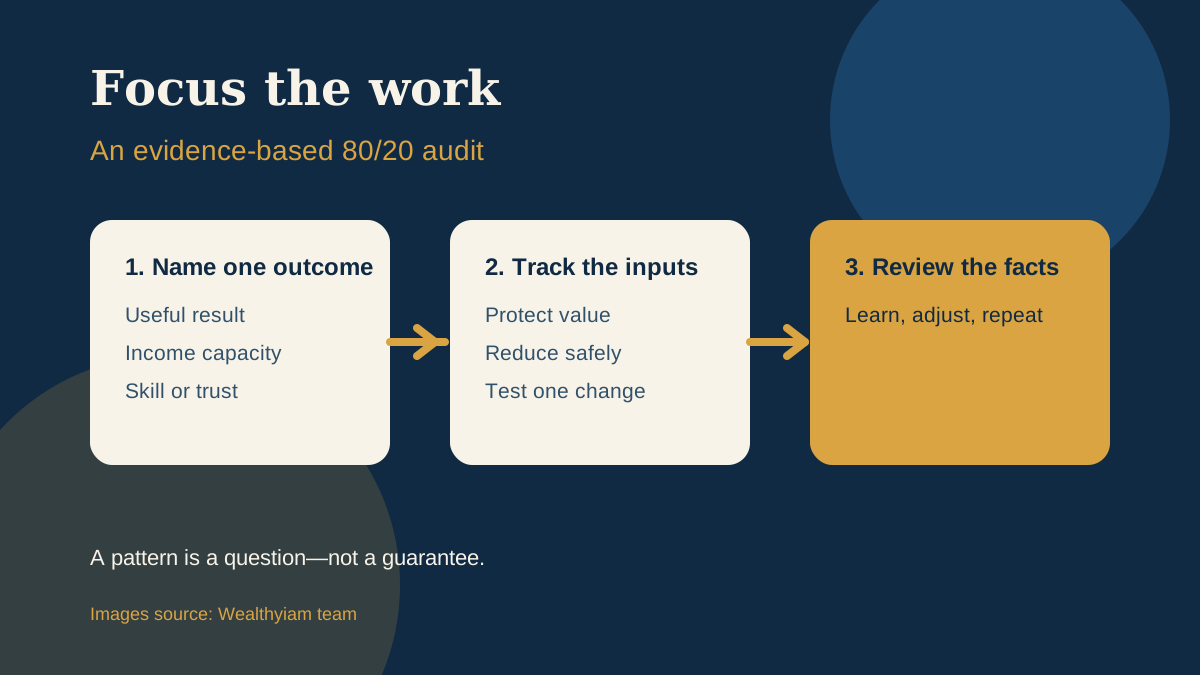
Use this exercise to turn the principle into a small, testable decision.
- Name one outcome. “Improve a service,” “increase savings capacity,” “complete a credential,” or “reduce avoidable spending” is more measurable than “get rich.”
- List ten inputs. Include projects, recurring tasks, conversations, expenses, maintenance, and recovery.
- Score the evidence. For each input, record the result, resources used, and your confidence that the input contributed to the result. Separate observation from assumption.
- Choose one protect, one reduce, and one test. Redesign or reduce only what is safe to change.
- Review after two to four weeks. A weak result is a reason to learn, adjust, or stop—not to force the theory.
A hypothetical example
Suppose a freelance designer’s records suggest that two project types generate repeat inquiries while several small assignments consume similar time without repeat demand. That pattern does not prove the two project types will produce higher income.
A cautious test would be to clarify one offer, contact a small number of relevant prospects, track responses, and keep existing obligations covered. The designer could then compare actual demand, delivery effort, profit, and customer fit. This example illustrates a process; it is not a forecast.
Mistakes to avoid
- Forcing a 20/80 ratio instead of testing for a pattern.
- Confusing revenue with profit, quality, or durable value.
- Cutting essential work because its benefit is indirect.
- Treating an anecdote as general evidence.
- Ignoring the risk created by concentrated customers, skills, or investments.
- Changing too many variables at once to learn what helped.
- Treating a book-inspired exercise as personal tax, legal, health, or investment advice.
Frequently asked questions
Is the principle the same as doing only 20 percent of your work?
No. It is a prompt to investigate uneven contributions. Necessary tasks may not create immediate visible output, and the relevant proportion may be different.
Does the book identify an investment I should buy?
No. The 80/20 lens does not provide individualized security selection or guaranteed returns. Your goals, time horizon, diversification, fees, taxes, liquidity needs, and capacity for loss all matter.
How often should I run the audit?
Monthly is a reasonable starting point for work allocation. Review sooner when your role, health, obligations, or market conditions change.
What if my records show no concentration?
Improve the measurement, narrow the outcome, or accept that the work is distributed more evenly. The principle is useful only when it improves judgment.
A cautious next step
Choose one outcome and run the audit this week. Protect one activity only after you can explain why it matters. Reduce another only after checking what value or protection it provides. Test one change at a time so you can learn from the result.
Conclusion
The 80/20 Individual offers a useful lens for a common problem: effort is not always distributed according to impact. Its premise can prompt better questions about strengths, customers, commitments, and opportunity cost.
But a lens is not a forecast, and concentrated results are not automatically safe or repeatable. Observe your evidence, account for essential indirect work, and revise your choices when the facts change. The aim is not to imitate a ratio. It is to use time, money, and attention more deliberately.
Sources and further reading
<small><strong>Book record:</strong> <a href="https://openlibrary.org/works/OL5929436W">Open Library work record for <em>The 80/20 Individual</em></a>.<br><strong>Edition record:</strong> <a href="https://openlibrary.org/books/OL7440929M">Open Library edition record for the 2003 Currency edition</a>.<br><strong>Image credit:</strong> <a href="https://covers.openlibrary.org/b/id/242543-L.jpg?default=false">Open Library Covers API</a>. The cover matches the title and author but displays alternate promotional wording; the publisher must confirm permitted reuse before publication.</small>