When hard work is not solving the real problem
You can finish a busy day with a full task list and still feel that nothing important moved. The problem may not be a lack of effort. It may be that your attention, priorities, and work methods are spread across too many demands.
Great at Work: How Top Performers Do Less, Work Better, and Achieve More by Morten T. Hansen examines why some people perform better at work than others. Hansen’s official book page describes a five-year study of more than 5,000 managers and employees and says the book develops seven “work smarter” practices. Its broad promise is not that effort is irrelevant, but that selecting fewer activities and applying targeted effort can matter more than simply extending the workday.
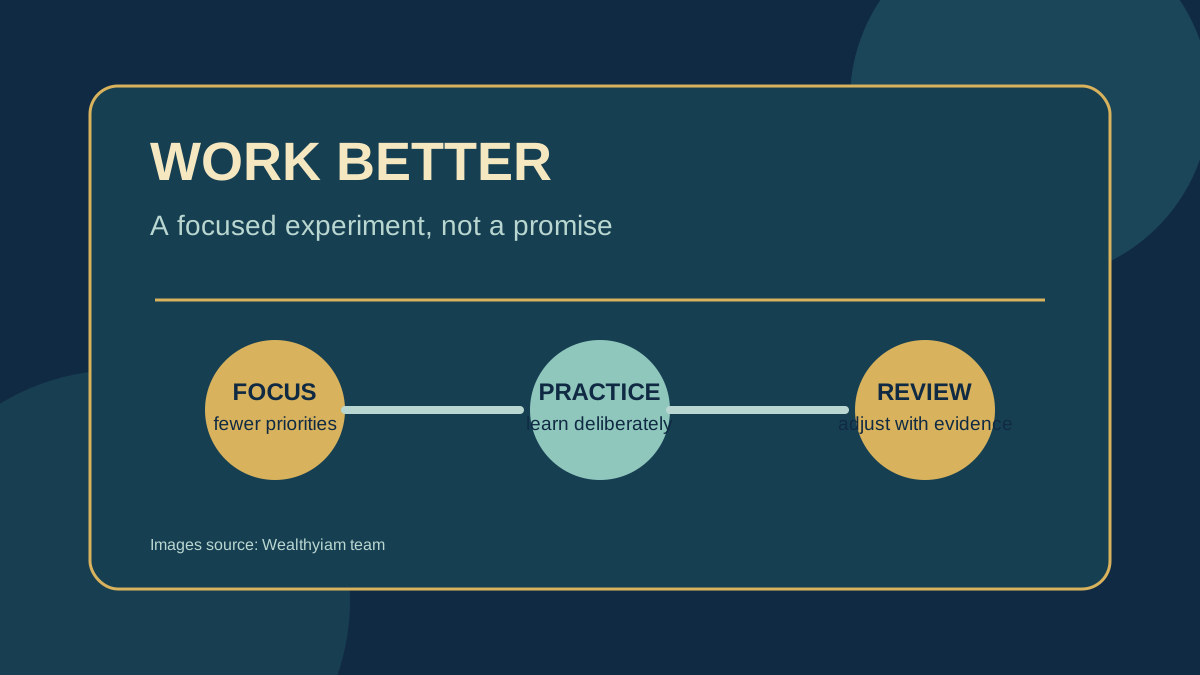
The practical answer: improve the quality and direction of work before trying to increase its quantity. Choose fewer important outcomes, protect the attention needed for them, learn deliberately, and review whether your effort is producing useful value.
The seven sections below are a Wealthy I AM application of that broad premise, not a reproduction of Hansen’s seven named “Work Smarter Practices” or chapter structure. They are designed as cautious, low-risk experiments—not as a promise that one method works for every job, personality, or financial situation.
The seven practical lessons in this summary
- Aim effort at a small number of valuable outcomes. Activity is not the same as progress.
- Make focus a design choice. Reduce avoidable switching and protect time for demanding work.
- Learn through deliberate practice. Improvement requires feedback and a specific skill target.
- Use constraints as a prioritization tool. Limits can force clearer decisions about what matters.
- Build cooperation into the work. Results often depend on making it easier for other people to contribute.
- Balance persistence with adjustment. Continue a useful approach, but change course when evidence shows it is not working.
- Measure value, not busyness. Review outputs and learning rather than counting hours alone.
1. Aim effort at a small number of valuable outcomes
A crowded schedule can hide weak priorities. If every request is urgent, your most important work receives the leftovers. The book’s broad emphasis on focusing effort can be applied as a simple question: Which result would make the greatest difference if it improved this week?
For a professional, that might be a client deliverable, a skill that affects future opportunities, or a process that removes repeated errors. For a business owner, it might be clarifying one customer problem rather than launching several disconnected offers. These are applications, not guaranteed prescriptions from the book.
Try this: write down your current commitments, group similar ones, and select one primary outcome for the next seven days. Keep the other commitments visible, but do not let them silently become equal priorities.
2. Make focus a design choice
Focus is easier when the environment supports it. Notifications, open-ended messaging, and constant task switching can fragment attention even when each interruption appears small. A focused block does not need to begin at an extreme hour or follow a universal routine. It can be a protected period that fits your job, health, caregiving responsibilities, and sleep needs.
A practical experiment: choose two or three blocks this week, define the one output each block should produce, close nonessential tabs, and tell relevant colleagues when you will respond. At the end, record what was completed and what interrupted you. If the experiment harms sleep, health, or required responsiveness, modify or stop it.
This is not a claim that concentration automatically creates wealth. Focus is useful only when directed toward work people value and when the surrounding business or career context supports that value.
3. Learn through deliberate practice
Learning is more useful when it targets a specific weakness. “Get better at sales” is broad. “Practice asking one clear discovery question and review the response after each call” is testable.
A simple practice loop is:
- Choose one skill that affects an important outcome.
- Define what competent performance looks like.
- Practice a small part of the skill.
- Seek feedback from a credible source or inspect the result.
- Adjust the next attempt.
A hypothetical example: a freelance designer who wants more repeat work might practice writing clearer project scopes, then compare whether clients ask fewer clarification questions. That example is illustrative, not a reported result from Hansen’s book.
4. Use constraints to clarify priorities
Time, money, energy, and attention are limited. Pretending otherwise encourages overcommitment. A constraint can become a decision rule: no new project until the current client handoff is complete, no paid tool until a genuine need is documented, or no meeting without a stated decision or learning goal.
Constraints should be realistic rather than punitive. They are not proof of discipline, and they should not override legal, safety, health, or contractual duties. Their purpose is to make trade-offs visible.
5. Build cooperation into the work
Individual performance is rarely isolated. A strong idea can stall when its handoff is unclear, when collaborators do not know the decision they own, or when incentives point in different directions. If your work depends on other people, improve the interface between tasks.
Before handing work over, state the desired outcome, the decision needed, the deadline, and the information that is still uncertain. Ask the recipient what would make the handoff easier. This is a Wealthy I AM application of the book’s emphasis on better performance, not a claim that the source prescribes this exact script.
6. Balance persistence with adjustment
Persistence helps only when the underlying direction remains sensible. Continuing a failing process solely because time has already been spent can compound waste. On the other hand, changing direction at every setback prevents learning.
Set a review point before beginning a meaningful experiment. Decide what you will inspect: customer response, error rate, completion quality, cash required, or another relevant signal. Then ask whether the evidence supports continuing, modifying, or ending the approach. Do not convert a short-term result into a forecast of income.
7. Measure value, not busyness
Hours can be a useful capacity measure, but they do not tell you whether your work solved a problem. A better review connects effort to an observable output: a completed analysis, a clearer proposal, a resolved customer issue, a tested skill, or a documented process.
Use a weekly scorecard with three lines:
- Outcome: What useful result was produced?
- Learning: What did the work reveal about the problem or process?
- Next adjustment: What will be done differently?
This approach is deliberately modest. Measurement cannot remove uncertainty, and a good week does not guarantee a better financial outcome. It simply gives you better information for the next decision.
A 30-minute work-quality reset
If you want to apply the ideas without redesigning your life, set a timer for 30 minutes:
Minutes 1–10: Name the bottleneck
Write the one work result that matters most and the main reason it is not moving. Is the obstacle unclear scope, missing skill, too many interruptions, a delayed handoff, or insufficient resources?
Minutes 11–20: Design one small test
Choose one change that is reversible and low risk. Examples include a protected focus block, a clearer handoff note, one practice repetition, or a shorter list of active priorities.
Minutes 21–30: Define the review
Choose a date and a signal. State what would count as useful evidence, what would prompt a modification, and what would tell you to stop. Avoid using a specific income target as proof that a method works; income depends on many factors beyond personal effort.
Mistakes to avoid
Mistaking busyness for value
A packed calendar can still protect the wrong work. Review outcomes and trade-offs, not just activity.
Copying a top performer without checking context
A method that fits one role, team, health situation, or market may not fit yours. Test the underlying principle rather than imitating a visible routine.
Turning focus into overwork
The goal is better-directed effort, not exhaustion. Protect recovery, sleep, and responsibilities that keep work sustainable.
Treating a hypothetical example as evidence
Illustrations show how a process might work. They do not prove that it will improve revenue, promotion, or investment results.
Making career or financial decisions from one book
A book can offer a lens, not a complete financial plan. Consider your obligations, risk capacity, local rules, and qualified professional advice where appropriate.
Who should read Great at Work?
It may be useful for professionals, managers, founders, and independent workers who feel that more hours are not fixing a priority or execution problem. Readers looking for a quick productivity slogan may find the strongest value in translating the broad ideas into a small personal experiment.
It may be less useful as a standalone answer for readers facing structural barriers, unsafe workloads, inadequate staffing, health limitations, or a business model that does not create enough customer value. Better work methods cannot solve every external constraint.
Frequently asked questions
What is Great at Work about?
Hansen’s official book page describes a research-based guide to working smarter instead of simply working harder. This article applies that broad premise while clearly labeling its seven practical lessons as Wealthy I AM synthesis rather than Hansen’s exact named framework.
Is the book a promise of higher income?
No. Improving focus or work quality may support better decisions, but income and wealth depend on skills, demand, opportunity, compensation, ownership, risk, timing, and other factors. No outcome is guaranteed.
What is the best first step for a beginner?
Choose one important work outcome, protect a realistic focus block, and set a review date. Start with a reversible test rather than changing every habit at once.
Does working fewer hours always produce better results?
No. The point is not a universal hour target. Some jobs require specific coverage or time, and some problems require sustained effort. The useful question is whether additional effort is producing valuable progress.
How is this different from Wealthy I AM advice?
The book supplies the topic and broad performance lens. Wealthy I AM advice is the cautious practical application: test one change, account for context, protect health and responsibilities, and avoid treating productivity as a financial guarantee.
A grounded next step
Before adding another productivity tactic, identify one result that matters, remove one avoidable source of friction, and review what changed. If the experiment helps, keep the smallest version that is sustainable. If it does not, treat the information as useful and adjust.
Great at Work is best approached as an invitation to work with greater selectivity—not as proof that every person can achieve more by following the same routine. Better wealth decisions begin with better information, honest trade-offs, and a process you can actually maintain.
Sources / Further reading
- Morten T. Hansen’s official page for Great at Work</a> (research scope and broad book premise).
- Open Library record for Great at Work</a> (title, author, editions, and publication record).
- Open Library editions data for Great at Work</a> (subtitle and cover-edition relationship).
- Image credit: Original Wealthy I AM artwork. Images source: Wealthyiam team.