Why wealth decisions feel harder than they should
Money choices often arrive as isolated questions: Should I change careers? Is this business worth starting? Why did a price rise? Is a market opportunity real, or merely popular? Without a wider framework, every headline can feel like a new rule.
A useful starting point from Robert L. Heilbroner’s The Worldly Philosophers is to study the ideas behind economic life—not to search for a timeless prediction. The book surveys major economic thinkers and places their ideas in the social and historical conditions that shaped them. This article turns that broad history into six Wealthy I AM lessons for clearer reasoning. The six lessons are an editorial synthesis, not the book’s official numbered framework.
You will learn how to separate incentives from intentions, distinguish value creation from distribution, test assumptions against changing conditions, and make a low-risk decision map before acting. This summary is for readers who want a practical introduction to economic reasoning; it is not a substitute for the book or for current, decision-specific research.
> Important: This is general education, not individualized financial, tax, legal, or investment advice. Economic history does not predict a specific asset’s future performance. Consider your circumstances, risk capacity, and current authoritative information before making a material decision.
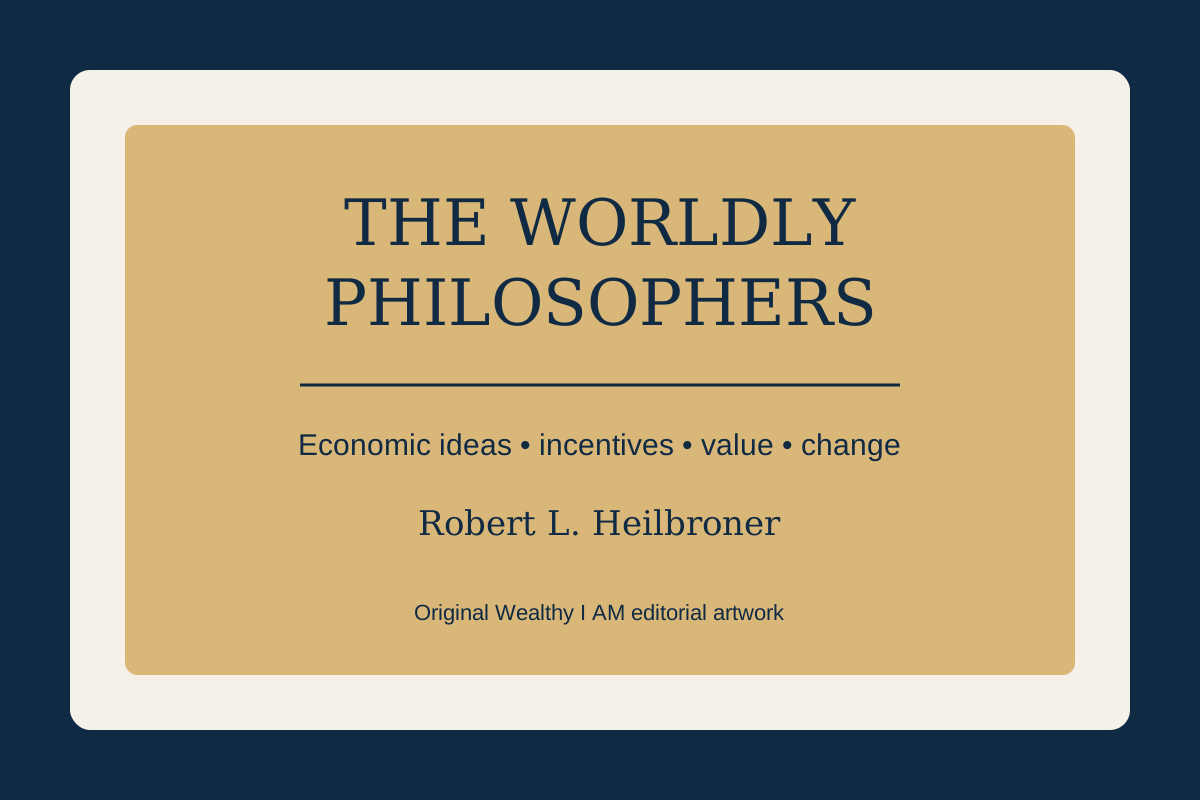
Book-cover source: Open Library Covers API. Full provenance and publication requirements are recorded in the editorial review.
What is The Worldly Philosophers about?
Heilbroner presents the lives and ideas of influential economists, including Adam Smith and Karl Marx, and explains how their thinking developed alongside changing societies and economic systems. The book is not a personal-finance checklist. Its usefulness for a wealth reader is that it makes economic concepts less abstract: markets, labor, capital, growth, competition, and distribution affect real choices made by households, workers, owners, and governments.
The central benefit is context. A business decision may look like a spreadsheet problem, but it also involves incentives, institutions, power, scarcity, and expectations. Context does not remove uncertainty. It helps you ask better questions before you commit time or money.
Six practical lessons for better wealth decisions
1. Ask what problem an economic idea was trying to solve
An economic theory is not just a slogan. It is an attempt to explain a problem under particular conditions. A view formed during rapid industrial change may illuminate some questions while fitting poorly in a different setting.
Wealthy I AM application: Before borrowing an idea from a book, podcast, or market commentator, write down the problem it addresses, the assumptions it makes, and the conditions under which it may stop being useful. This prevents a historical concept from becoming an automatic rule.
Action: Keep a “framework card” with three lines: problem, assumptions, limits.
2. Follow incentives instead of relying on stated intentions
An incentive is a factor that changes the rewards or costs of a choice. People can act with good intentions while responding to compensation, deadlines, status, ownership, regulation, or fear of loss.
For example, a seller may describe an opportunity enthusiastically because selling is part of the seller’s role. That does not prove deception; it does mean the incentive belongs in your analysis.
Wealthy I AM application: When evaluating a job, business partnership, investment product, or customer offer, ask who benefits if you say yes, who bears the downside, and what behavior the arrangement rewards.
Action: Add an “incentives” row to every important decision note. Record the incentives of each party and any conflict you need to investigate.
3. Separate creating value from dividing value
Value creation means producing something people choose to support because it solves a problem or provides a benefit. Distribution concerns how the resulting income, ownership, bargaining power, or opportunity is divided.
These are related but not identical. A growing market can create more value while still distributing gains unevenly. A profitable business can be valuable to customers while its employees, suppliers, owners, and community experience the outcome differently.
Wealthy I AM application: If you want to increase earning power or build a business, ask two separate questions: What useful result can I create? How will the value and risks be allocated among the people involved?
Action: Describe your work or business idea in one sentence, then identify the customer benefit, the cost of delivering it, and who receives the remaining economic value. Do not assume revenue automatically equals durable profit.
4. Treat markets as systems, not magic
A market is a system in which people exchange goods, services, or claims under rules and constraints. Prices can communicate information, but a price is not a complete explanation of quality, fairness, or future success.
Supply, demand, competition, financing, expectations, and rules can all influence outcomes. A price can move even when the underlying facts are unclear. A popular product can still have weak economics; an unpopular sector can still contain serious risks.
Wealthy I AM application: Replace “the market says this is valuable” with a system map. Identify the buyer, supplier, competitor, source of funding, constraint, and rule that could change the outcome.
Action: Draw six boxes around a decision: customers, suppliers, competitors, capital, constraints, and rules. Mark which boxes you understand and which require research.
5. Expect economic change to alter the usefulness of a strategy
Economic conditions change. Technology, demographics, institutions, competition, and access to capital can alter which skills, business models, or assets are attractive. A strategy that worked in one period can become less effective when its environment changes.
This does not mean abandoning long-term thinking whenever a headline appears. It means distinguishing a durable principle from a temporary circumstance.
Wealthy I AM application: Review the assumptions underneath a plan rather than reacting to every short-term movement. If the customer, cost structure, financing, or legal environment changes materially, update the plan deliberately.
Action: Write one “if this changes” trigger for your main income or business plan and one for your investment process. A trigger is a reason to review, not an instruction to trade or make a rushed move.
6. Use history to widen judgment, not to manufacture certainty
Historical examples can reveal recurring tensions: growth versus distribution, competition versus concentration, innovation versus disruption, and individual choice versus institutional structure. But history is not a guarantee that the same outcome will repeat.
Survivorship bias matters: we often notice the thinkers, companies, and fortunes that remained visible while overlooking paths that failed or disappeared. A compelling historical story can teach a question without supplying a forecast.
Wealthy I AM application: Use history as a challenge to your confidence. Ask what evidence would weaken your interpretation, whose experience is missing, and what differs between then and now.
Action: End every major conclusion with a disconfirming question: “What would I expect to see if this explanation were wrong?”
A practical economic decision map
Consider a hypothetical person deciding whether to spend six months building a small service business. This is an illustration, not a forecast.
- Problem: What customer problem might the service solve?
- Incentives: Who is rewarded for the sale, and who carries the delivery risk?
- Value: What useful result is created, and what does it cost to provide?
- System: Which customers, competitors, suppliers, financing needs, and rules matter?
- Change: Which assumption would cause the plan to be reviewed?
- Evidence: What observation would disconfirm the person’s belief that demand exists?
The map does not tell the person whether to proceed. It makes the reasoning visible and gives learning a place to enter before a large commitment.
Mistakes to avoid
Turning an economist’s idea into a slogan
A short phrase can erase the assumptions and historical setting behind it. Read the idea in context before applying it.
Confusing a market price with intrinsic certainty
A price is an observation, not a promise. Investigate what supports it and what could change it.
Treating one historical case as universal evidence
Cases clarify mechanisms, but they do not automatically prove that your situation is comparable.
Ignoring distribution and power
A plan can create value while placing costs or bargaining power unevenly. Ask who gains, who pays, and who can change the terms.
Mistaking a review trigger for a prediction
A trigger tells you when to examine an assumption. It does not tell you what an asset, business, or economy will do next.
Frequently asked questions
Is The Worldly Philosophers a personal-finance book?
No. It is an accessible history of economic ideas and thinkers. Readers looking for budgeting, portfolio construction, or tax instructions will need more specialized and current sources.
What is the main lesson for someone building wealth?
Economic decisions make more sense when you examine the system around them: incentives, value creation, constraints, institutions, and change. That improves questions; it does not guarantee outcomes.
Does economic history help with investing?
It can provide context for markets, competition, labor, capital, and distribution. It should complement—not replace—current research, diversification appropriate to the individual, cost awareness, and professional advice where needed.
How can I apply the book without studying every economist?
Choose one live decision and complete the six-part map: problem, incentives, value, system, change, and evidence. The goal is disciplined thinking, not memorizing names.
What should I do first?
Take one important decision and write the assumptions behind it in plain language. Then identify one fact that would change your view. If the decision has material financial or legal consequences, seek appropriately qualified advice.
Keep the book idea separate from Wealthy I AM advice
Book idea: Economic thinkers and their historical settings can help readers understand how markets, work, capital, growth, and distribution interact.
Wealthy I AM application: Use a six-part decision map to examine incentives, value, systems, changing conditions, and disconfirming evidence before committing resources. This is an editorial framework, not the author’s official sequence, a forecast, or individualized advice.
Sources and further reading
- [Open Library work record for The Worldly Philosophers](https://openlibrary.org/works/OL1847023W/The_worldly_philosophers) — bibliographic identity, editions, subjects, and book-jacket description.
- [Open Library title and author search](https://openlibrary.org/search.json?title=The%20Worldly%20Philosophers&author=Robert%20L.%20Heilbroner) — title, author, and first-publication cross-check.
- [Open Library Covers API image](https://covers.openlibrary.org/b/id/15106531-L.jpg?default=false) — source for the featured cover; the publisher must confirm edition and reuse terms before publication.
Conclusion
The Worldly Philosophers is useful because it slows down automatic explanations. Before chasing a market story, copying a business model, or making a large career decision, ask what problem is being solved, which incentives are operating, how value is created and divided, what system constraints matter, and what evidence could prove you wrong.
Start with one decision map today. It will not eliminate uncertainty, but it can turn a vague money question into a set of questions you can investigate responsibly.