If your income has improved but you still feel behind, the problem may not be a lack of effort. You may be comparing today with an ideal future instead of comparing today with where you began. That comparison can make genuine progress feel like failure and quietly weaken the motivation needed for patient wealth-building.
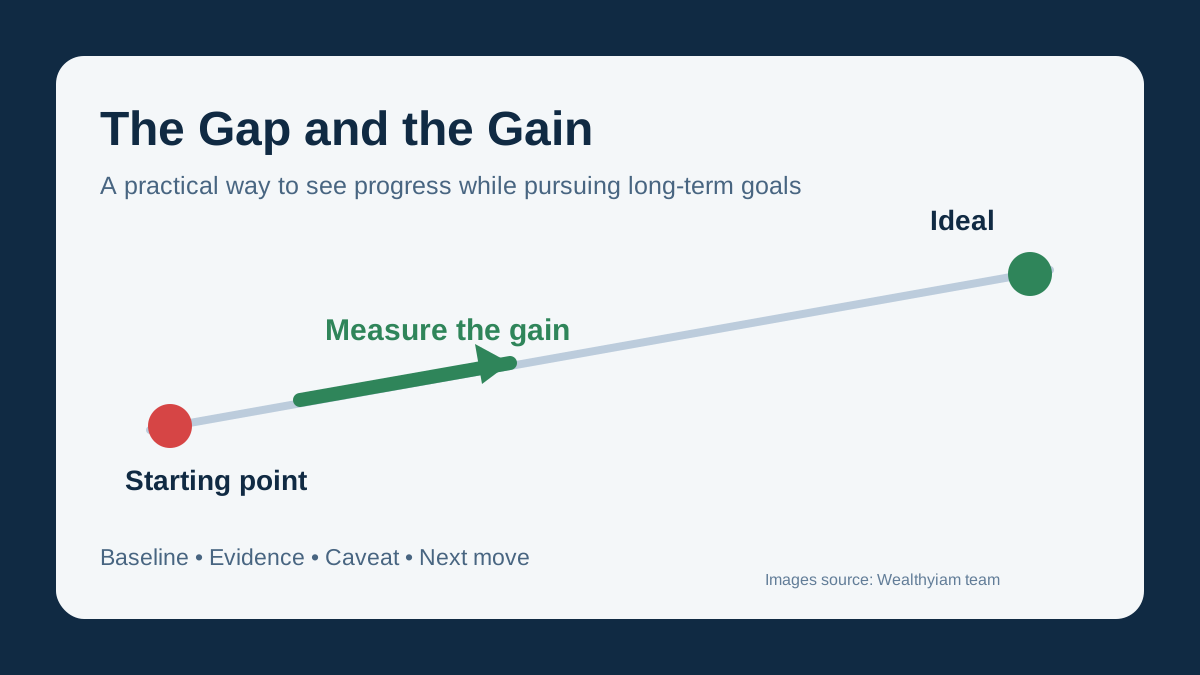
The central idea in The Gap and the Gain is to measure progress against your starting point—the gain—instead of measuring it only against an imagined ideal—the gap. This does not make every result good, remove the need for better decisions, or guarantee financial success. It offers a more useful way to review effort, learn from evidence, and choose the next step.
This summary covers the book’s broad idea and then develops a Wealthy I AM application for work, business, and long-term money goals. The seven lessons and five-step review below are an editorial synthesis, not the authors’ official numbered framework.
<small>Book-cover image: Open Library Covers API. The publisher must confirm edition and use rights before publication.</small>
Why wealth goals can feel like failure even when you are moving forward
Many money goals are stated as destinations: a certain income, a debt-free balance sheet, a business of a certain size, or enough invested assets to make work optional. A destination can help with direction, but it is a poor daily measuring stick when it is distant, uncertain, or constantly revised.
The gap is the distance between current reality and an ideal. If the ideal is the only reference point, a person can save more, learn a valuable skill, improve a business process, or reduce expensive debt and still conclude that nothing meaningful happened.
The gain is the distance traveled from the starting point. It asks different questions: What changed? What did I learn? Which decision improved my position? What remains unfinished? This is not permission to celebrate without scrutiny. It is a way to make review more accurate.
What The Gap and the Gain argues, in plain language
The book, by Dan Sullivan and Dr. Benjamin Hardy, distinguishes two ways of evaluating progress: measuring against an ideal and measuring against the past. Its premise is that measuring backward can support confidence, gratitude, and continued action, while measuring only against an ideal can keep achievement psychologically out of reach.
The idea is useful, but it has boundaries. A feeling of progress is not the same as financial progress. A higher balance can result from luck, temporary income, leverage, or an unrecognized risk. The gain should therefore include evidence and learning, not only a positive mood.
For Wealthy I AM readers, the practical translation is simple: keep the long-term direction, but review the distance traveled with enough honesty to improve the next decision.
Seven practical lessons for using the gain without losing ambition
1. Record the starting point before judging the result
A gain cannot be seen clearly if the starting point was never written down. At the beginning of a month, project, job search, or business experiment, record a small baseline: cash-flow pressure, debt obligations, current skill, revenue process, savings habit, or another measure relevant to the decision.
This does not require a complex dashboard. A dated note with three facts can be enough. Without a baseline, memory can compare an imperfect present with a polished story about the past.
Try this: Write down where you are, what you are trying to change, and one observable sign that would count as progress. Do not choose a measure merely because it makes you look good.
2. Turn an ideal into a direction, not a verdict
An ideal can help answer where you want to go. It becomes harmful when it is used as a daily verdict on your worth or competence. A business can be far from its ambition and still have learned something important. An investor can be far from a target and still have improved diversification or reduced avoidable costs.
The gain does not replace standards. It changes the review question from “Why am I not there?” to “What evidence shows that I am closer, better prepared, or wiser than I was?”
Try this: Keep one long-range statement, then pair it with a short review of gains, unresolved risks, and the next controllable action.
3. Separate progress from proof of future success
A gain is evidence of movement, not a guarantee of continuation. Finishing a course does not prove that income will rise. Increasing sales for one period does not prove a durable business model. A favorable investment result does not prove skill; luck may have contributed.
This distinction matters because overconfidence can be as costly as discouragement. Review what changed, then ask what would need to remain true for the change to continue.
Try this: After naming a gain, add one sentence beginning with “This does not yet prove…” That sentence is a guardrail against turning a useful result into a prediction.
4. Measure learning as well as outcomes
Some decisions produce useful information before they produce money. A customer interview may show that an offer is unclear. A budget review may reveal that irregular expenses, not daily coffee, are driving shortfalls. A rejected job application may identify a missing portfolio example.
Learning is not automatically valuable. It becomes valuable when it changes what you do next. The test is whether the lesson is specific enough to affect a future decision.
Try this: Log one outcome, one explanation you currently believe, and one action that will test that explanation. Treat the explanation as provisional.
5. Use small gains to protect consistency
Long-term wealth generally depends on repeated behavior: earning, spending, saving, investing, learning, and reviewing. The book’s progress lens can make repetition easier to sustain because it gives effort a visible history.
A small gain is not a reason to take larger financial risks. It can be a reason to repeat a sound process. For example, a person who has finally made a complete monthly cash-flow review may have gained a decision tool, even if the review reveals difficult trade-offs.
Try this: Create a weekly or monthly gain log with three lines: improved, learned, next. Keep the next action small enough to complete without relying on optimism.
6. Compare like with like
Progress measures become misleading when the comparison changes. Comparing a quiet month with a peak month, personal finances with someone else’s highlight reel, or a new business with an established company can create either needless discouragement or false confidence.
Use the same time period, definition, and scope where possible. If the measure changed, say so. A higher revenue number with much higher costs is not automatically an improvement; a larger portfolio balance with greater concentration risk is not automatically safer.
Try this: Before celebrating a gain, write “compared with what?” and “what else changed?” Those two questions often reveal the part of the story that needs attention.
7. Let the gain improve the next decision
The point of a progress review is not to create a flattering archive. It is to make the next decision better. A useful gain review ends with a choice: continue, adjust, pause, or stop.
This is where the Wealthy I AM application adds a practical boundary: preserve the evidence, the downside, and the alternatives. A positive review should not erase emergency needs, debt costs, taxes, fees, liquidity constraints, or the possibility that an experiment should be discontinued.
Try this: Choose one next action and one stop condition. For example, continue a low-cost business test until a defined date unless it creates an unacceptable financial or legal exposure.
A five-step gain review for money, work, or business
Use this worksheet once a month or after a meaningful decision.
- Baseline: What was true at the start? Record the date and a few observable facts.
- Gain: What is measurably different now? Include skills, systems, relationships, cash flow, or risk reduction where relevant.
- Cause: What may have produced the change? Distinguish evidence from your current interpretation.
- Caveat: What could make the result temporary, misleading, or unsafe to extend?
- Next move: What is the smallest sensible action, and what condition would make you modify or stop it?
Consider a hypothetical example. Someone starts with no regular review of irregular household bills. After one month, they have listed annual obligations, identified a timing problem, and set a reminder. That is a real gain in visibility and process. It is not a forecast of a particular savings amount. The next move is to test whether the new process works for another cycle.
How to apply the idea to long-term investing without overclaiming
The gap-and-gain lens can improve investing behavior, but it cannot select suitable investments or predict returns. Use it to review process rather than judge yourself by a market outcome.
Ask whether you followed your stated allocation, understood the reason for a purchase, considered concentration and liquidity, and recorded what would change your view. Diversification—spreading exposure across investments—can reduce the effect of one holding’s poor result, but it cannot remove market loss. Risk capacity also depends on circumstances, not motivation alone.
A disciplined review might conclude that the gain was better documentation, fewer impulsive changes, or a clearer emergency reserve. Those are process improvements, not guarantees of performance. For individualized investment, tax, or retirement decisions, consult a qualified professional who can consider your circumstances and jurisdiction.
Mistakes to avoid
Treating positive emotion as financial evidence
Feeling encouraged can help you continue, but it does not establish affordability, profitability, suitability, or safety. Check the underlying numbers and obligations separately.
Using the gain to excuse a weak plan
A small gain can coexist with a bad strategy. If debt is becoming more expensive, a business test is consuming essential cash, or an investment is not understood, optimism should not override the risk review.
Comparing yourself with someone else’s visible result
Other people’s income, homes, portfolios, or business stories rarely show their starting point, support, debt, timing, or setbacks. Use comparisons to learn specific methods, not to issue a verdict on your progress.
Counting activity instead of useful change
More hours, more apps, and more research are not automatically gains. Ask what changed in capability, clarity, cash flow, resilience, or decision quality.
Turning the book’s idea into a guarantee
The framework may support a healthier review habit. It cannot guarantee happiness, wealth, business success, investment returns, or career outcomes. Results depend on decisions, resources, markets, health, relationships, and circumstances beyond one person’s control.
Who should read this book?
The book may appeal to people who are ambitious but chronically dissatisfied, founders reviewing an uncertain path, professionals building skills, and readers who want a more constructive way to evaluate progress. It may be less useful if you want a technical investing manual, a debt-repayment plan, or individualized financial advice. Its broad mindset framework needs to be paired with concrete financial records and risk controls.
Frequently asked questions
Is The Gap and the Gain a personal-finance book?
Not primarily. It is a personal-growth and goal-setting book. Its progress-measuring idea can be applied to money, but it does not replace budgeting, investment research, tax planning, or professional advice.
What is the difference between the gap and the gain?
The gap is the distance between your present position and an ideal or desired future. The gain is the progress from your starting point to your present position. Both perspectives can be informative; the gain is often more useful for recognizing movement while the ideal remains a direction.
Can measuring gains make someone complacent?
It can if gains are treated as proof that no change is needed. A safer approach is to pair every gain with a caveat and a next decision. Progress should improve judgment, not suspend it.
How often should I do a gain review?
A monthly review is a reasonable starting experiment for many goals. Use a shorter interval for a fast-moving project and a longer interval for slow-changing goals. Modify the schedule if it creates anxiety, consumes more time than it saves, or encourages you to chase noisy short-term measures.
Does the gain prove that my financial strategy is working?
No. It may show that a process improved or that a result changed, but it does not prove that the strategy is suitable, durable, or profitable. Review costs, risks, alternatives, and the evidence behind your conclusion.
A useful next step
Before the next month begins, write three lines: where you started, what has changed, and what you will test next. Then add one risk or uncertainty that the gain does not resolve. This takes little time and creates a record that is more informative than a vague feeling of being behind.
Sources and further reading
<ul> <li>Official <em>The Gap and the Gain</em> website — author and concept context.</li> <li>Open Library edition record for <em>The Gap and the Gain</em> — title, author, publisher, edition, and cover context.</li> <li>Open Library Covers API image — cover source; the publisher must confirm edition and use rights before publication.</li> </ul> <p>The sources support the book’s identity and broad premise. The seven lessons and worksheet are a Wealthy I AM synthesis, not a claim that the authors present this exact numbered framework. This article is general education, not individualized financial, tax, legal, or investment advice.</p>