If your career looks ordinary on paper, your path does not have to be
Many people make money decisions by comparing themselves with an imagined average person: the average worker, career path, investor, or business owner. A benchmark can be useful context, but it becomes dangerous when it is treated as an instruction. It can push you toward credentials, jobs, business models, or spending patterns that do not fit your strengths, obligations, or risk capacity.
Todd Rose’s The End of Average: How We Succeed in a World That Values Sameness argues that averages are poor tools for understanding individuals. The book’s public jacket description identifies three principles of individuality: jaggedness, context, and pathways. This article explains those verified ideas, then applies them to career, business, and wealth decisions through seven practical lessons.
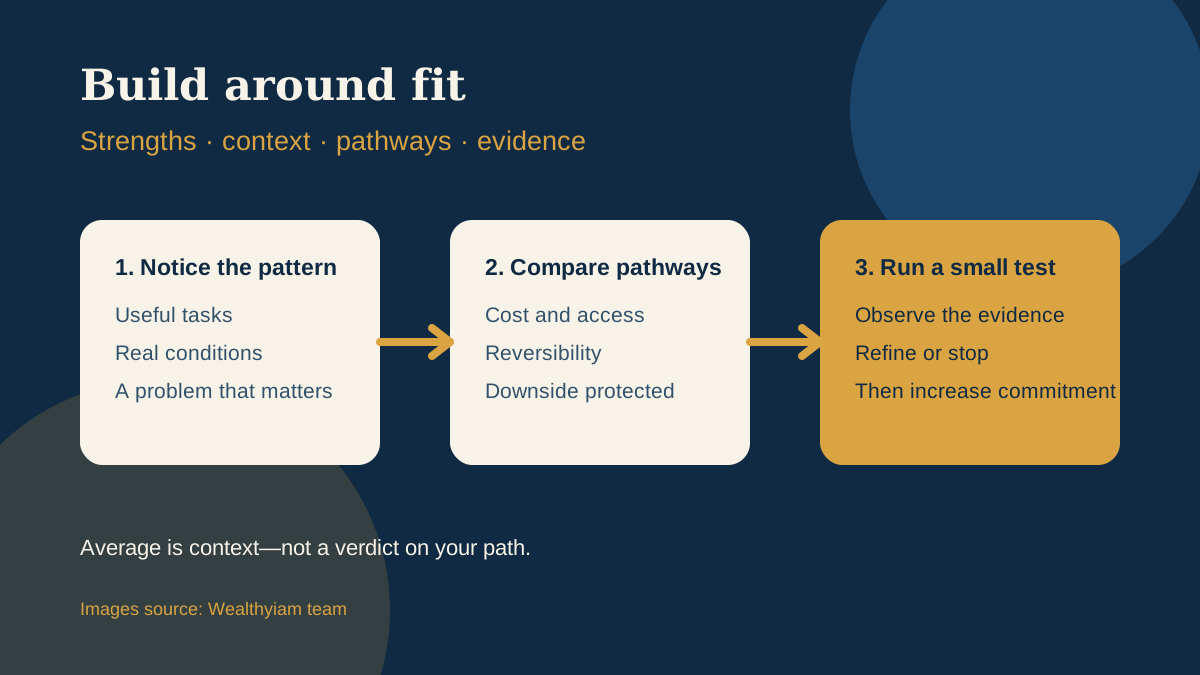
Short answer: Do not ask only how you compare with a typical person. Identify the combination of abilities you use well, the conditions that help you perform, and the paths available within your real constraints. Then test that fit through small, reversible decisions before making a costly commitment.
<small>Image source: Open Library Covers API, cover ID 10534850. The cover matches the title, subtitle, and author. Open Library’s catalog association does not establish commercial reuse rights.</small>
What The End of Average is about
Rose challenges systems that evaluate individuals against group averages. The public descriptions connect this critique to education, hiring, performance reviews, and other institutions that can flatten meaningful differences between people.
The book’s alternative is organized around three principles:
- Jaggedness: talent is not one-dimensional. A person can be strong in one part of a task and ordinary or weak in another, so a single score can conceal the pattern that matters.
- Context: behavior and ability can change with the situation. A trait label may not predict how someone performs across different environments.
- Pathways: there is not one normal route to competence or success. People can reach useful outcomes through different sequences and at different speeds.
Those ideas do not guarantee higher income. Earnings and wealth also depend on labor markets, health, location, caregiving, access to capital, discrimination, luck, and other structural conditions. An individualized lens can improve a decision process; it cannot promise a salary, business result, or investment return.
Seven practical lessons for escaping average-based money decisions
The seven lessons below are a Wealthy I AM application of the book’s verified three-principle framework. They are not presented as Rose’s exact numbered lessons.
1. Treat an average as a reference point, not an identity
An average summarizes a group. It cannot decide what you should do. A salary guide, spending benchmark, or typical business model may describe a range, but it cannot tell you whether a role fits your energy, skills, obligations, or goals.
Try this: When you use a benchmark, write down what it measures, what population it describes, and what it leaves out. Use it as one input rather than a verdict on your potential.
2. Look for a jagged combination of strengths
People often search for one defining advantage: communication, technical ability, sales skill, or discipline. In practice, value can come from a combination. Someone who understands a technical workflow and can explain it clearly to nontechnical buyers may solve a problem that neither skill addresses alone.
The useful question is not “Am I exceptional?” It is “Which combination of abilities helps someone make a better decision, save time, reduce risk, or create something useful?”
Try this: List three tasks you perform reliably. Break each task into parts—analysis, communication, speed, judgment, organization, or relationship-building—and look for the combination behind the result.
3. Examine context before judging capability
A poor fit can look like poor ability. A workplace with constant interruptions may hide deep-focus skill. A sales role with no authority to solve customer problems may hide relationship skill. Before drawing a permanent conclusion about yourself, examine the environment.
Try this: Compare one task across two settings. Note what changed: pace, autonomy, audience, tools, feedback, stakes, or type of problem. This does not excuse every weak result, but it can reveal a condition worth testing.
4. Expect more than one workable pathway
A conventional sequence—degree, entry-level role, promotion, management—can work, but it is not the only route to valuable work. A portfolio project, apprenticeship, lateral move, certification, contract assignment, or small paid pilot may produce evidence that a résumé alone cannot.
An unconventional route is not automatically better. It still needs to fit the field’s legal requirements, customer expectations, economics, and your available time and money.
Try this: Name the outcome you want, then identify three possible routes. Compare their cost, reversibility, evidence value, eligibility requirements, and downside.
5. Design experiments before making identity-level decisions
You do not need to quit a job or invest heavily in a business to test a hypothesis. A small project, customer interview, paid pilot, portfolio sample, or limited assignment can produce evidence.
Use a reversible experiment:
- State the hypothesis: “I may be useful to this audience because I can solve this problem.”
- Choose a low-cost test with a defined time limit.
- Record observable evidence, such as completed work, qualified responses, or a request to continue.
- Decide whether to refine, stop, or run a second test.
Evidence is not certainty, but it is stronger than a story about what you might be capable of.
6. Turn distinctiveness into a clear offer
Being unusual is not automatically an economic advantage. Wealth-building relevance appears when your differences connect to a problem that an employer, client, or customer values.
A useful offer has three parts: a specific audience, a costly or frustrating problem, and a credible result you can help produce without promising what you cannot control. Avoid claims such as “guaranteed income.” Explain the work, boundaries, price or compensation, and evidence another person can evaluate.
Try this: Complete the sentence: “I help [specific audience] address [specific problem] by [work you can demonstrate].” Then test whether the audience recognizes the problem and values the proposed help.
7. Fit ambition to constraints and protect your downside
An attractive path may be wrong if it requires capital, schedule flexibility, health, legal permission, or risk capacity you do not have. A fit audit must include cash reserves, debt payments, caregiving, benefits, time, and the consequences of failure.
This is especially important in entrepreneurship and investing. Leverage means using borrowed money or fixed commitments to increase exposure; it can magnify losses as well as gains. Individualized planning should make the downside visible before the upside becomes emotionally persuasive.
Try this: Before increasing commitment, define the maximum money and time you can lose, the obligations you must protect, and the signal that would make you stop.
A 30-minute personal fit audit
This framework is an original Wealthy I AM application, not a quoted framework from Rose.
Step 1: Name the work that creates value
Write three tasks where you reliably produce something useful. Use verbs: diagnose, simplify, sell, design, repair, teach, organize, negotiate, analyze, or build. Do not list personality labels alone.
Step 2: Identify the conditions
For each task, note the conditions that help: quiet time, collaboration, urgency, autonomy, structure, a particular customer group, or a specific tool. Also note conditions that reliably reduce your performance.
Step 3: Connect the task to a real need
Who benefits? What problem is reduced? What evidence would show that the work helped? If you cannot answer, the idea may still be interesting, but it is not yet a tested economic opportunity.
Step 4: Compare possible pathways
List at least three ways to test or develop the opportunity. Include the conventional path rather than rejecting it automatically. Compare cost, time, reversibility, access requirements, and the quality of evidence each route could produce.
Step 5: Run the smallest ethical test
Choose a test that protects your essential cash needs and reputation. Do not misrepresent credentials, collect sensitive data without an appropriate reason and consent, or make financial, legal, health, or safety promises beyond your competence.
After the test, record what happened, what surprised you, what it cost, and what would make you stop. Treat a disappointing result as information about the offer, audience, timing, pathway, or setting—not automatically as a verdict on your worth.
Mistakes to avoid
- Turning individuality into a superiority story: Difference matters economically only when it helps create value.
- Using a personality test as a financial plan: A label is not evidence of demand, suitability, or risk capacity.
- Rejecting all benchmarks: Averages can provide useful group-level context; the mistake is treating them as complete instructions for an individual.
- Making a large bet to prove commitment: Consistent small actions can test commitment with less downside.
- Ignoring structural constraints: A strategy that works for one person may be inaccessible or unsafe for another.
- Confusing a successful outcome with a sound decision: Luck and timing can produce a good result from a weak process.
- Presenting this application as the book’s exact advice: Rose’s three principles supply the lens; the wealth exercises here are editorial extensions.
Frequently asked questions
Is The End of Average a personal-finance book?
No. Its verified public descriptions focus on individuality, averages, and systems such as education and employment. Wealthy I AM applies that lens to career, business, and money decisions; this application is not a financial plan supplied by the book.
Does the book say everyone should become an entrepreneur?
The available sources do not establish that claim, and this article does not make it. Entrepreneurship has financial, legal, operational, and personal risks. A better-fitting role inside an existing organization may be the more suitable path.
How can I find a valuable strength if I do not feel exceptional?
Start with repeated usefulness, not exceptionalism. Ask which tasks you perform reliably, which conditions improve the result, which problems you understand, and where others already ask for your help. Then test whether that usefulness matters to a defined audience.
Can this approach tell me which investment to buy?
No. A personal fit exercise cannot replace research into an investment’s risks, costs, valuation, liquidity, tax treatment, or suitability. Consider qualified professional advice for decisions that materially affect your finances.
What is the safest first step?
Run a small, time-limited experiment connected to a real problem while preserving your essential cash needs. Review the evidence before increasing commitment.
Sources and evidence boundary
<small>
- <a href="https://openlibrary.org/books/OL26428776M">Open Library edition record for <em>The End of Average</em></a> — title, subtitle, publication year, edition identifiers, cover association, and public jacket description.<br>
- <a href="https://openlibrary.org/works/OL17842326W">Open Library work record for <em>The End of Average</em></a> — work identity, subjects, author-record associations, cover association, and public description.<br>
- <a href="https://openlibrary.org/search.json?title=The%20End%20of%20Average&author=Todd%20Rose">Open Library title-and-author search</a> — supporting bibliographic lookup.<br>
- Image: <a href="https://covers.openlibrary.org/b/id/10534850-L.jpg">Open Library Covers API, cover ID 10534850</a>. Catalog association does not establish commercial reuse permission.
</small>
The edition description identifies the three principles and provides broad jacket-copy context. These public records do not verify every chapter, case study, research citation, or detailed prescription in the full book. The seven lessons and fit audit in this article are clearly labeled Wealthy I AM applications.
Build around evidence, not comparison
The central lesson is not that everyone has a hidden talent waiting to make them rich. It is that a group average can conceal an individual pattern of strengths, contexts, and possible pathways. A more durable approach is to notice where you create useful outcomes, test that observation carefully, and increase commitment only when the evidence and downside make sense.
Start with one 30-minute fit audit this week. Choose one low-cost experiment, define what you will observe, and write down the condition that would make you stop or change direction. That is a practical way to build a path around reality rather than comparison.