Search intent and the short answer
If your business attracts attention but struggles to earn repeat customers, the problem may be the experience after the first click, purchase, or conversation. The Customer of the Future by Blake Morgan is a useful prompt for thinking about changing expectations and the systems that make a business easier—or harder—to trust. The practical lesson is not that customer experience guarantees growth. It is that a business can examine where its promises, processes, and customer outcomes stop matching.
This is a concise, source-bounded overview, not a chapter-by-chapter summary. Open Library confirms the work, Blake Morgan’s authorship, the 2019 first-publication record, and the associated cover. The available catalog record does not expose the book’s full text or its ten principles. The ten lessons below are therefore a Wealthy I AM synthesis, not a claim that Morgan presents this exact numbered framework.
What problem does a future-focused customer strategy solve?
Businesses often treat customer experience as decoration: a nicer interface, a faster reply, or a loyalty offer added after the business model is set. A more useful question is: where does the customer experience create or destroy value? A confusing quote process can consume selling time. An unclear handoff can create rework. A technically impressive feature may matter less than whether a customer can understand, adopt, and trust it.
Who this overview is for
This overview is for founders, service businesses, marketers, and managers who want to connect customer experience with sustainable business value. It is not a substitute for customer research, financial controls, accessibility testing, privacy review, or legal advice.
Ten lessons translated into a usable framework
1. Start with the customer’s job, not your feature list
Ask what the customer is trying to accomplish, then look for obstacles between the need and the outcome. Try it: write one sentence beginning, “A customer comes to us to…” and list the three steps that most often slow that job down.
2. Treat convenience as part of value
Convenience can affect whether a customer completes an action, returns, or recommends a service. It must not override safety, informed consent, accessibility, or appropriate verification. Observe one process from discovery to support and simplify it only where clarity and customer control remain intact.
3. Use technology to remove friction, not to perform innovation theater
A tool is not a customer benefit by itself. Automation that produces incorrect answers or blocks escalation can reduce trust. Before adopting a tool, define the customer problem, the human fallback, the data required, and the signal that tells you the tool has failed.
4. Personalize with permission and restraint
Personalization can make a relevant choice easier, but it can feel intrusive when customers do not understand how their data is used. Start with transparency and a useful reason for collecting information. Offer a clear preference choice, explain its benefit, and provide a way to correct or reset it.
5. Build trust at every handoff
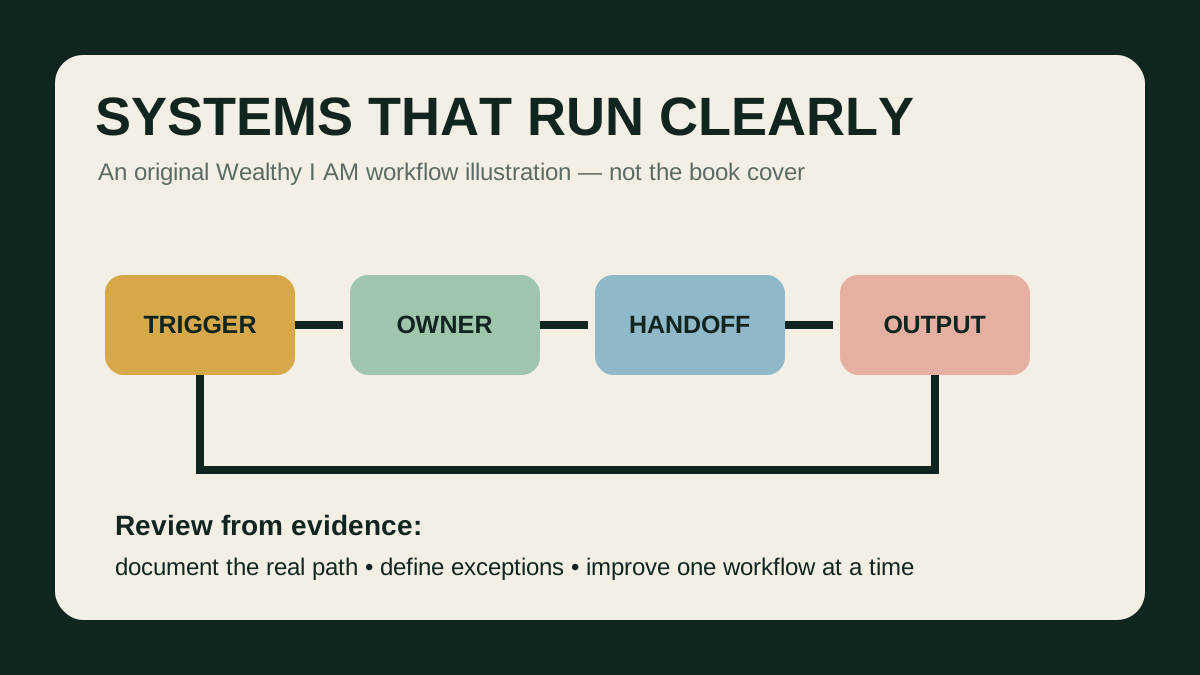
A promise made in marketing must survive checkout, delivery, onboarding, billing, and support. Map one journey and record the promise made, the evidence supplied, and the person accountable for the next step.
6. Design for the relationship after the first transaction
Retention is not the same as locking a customer in. It means making continued use worthwhile through useful education, honest support, and a product that keeps solving the customer’s problem. Ask existing customers what made a second interaction easier or harder; treat their answers as evidence to investigate, not universal facts.
7. Make the experience consistent without making it impersonal
Consistency helps customers know what to expect. It should not force every person through an identical path when needs differ. Define a dependable baseline, then identify where staff may use judgment or offer an accessible alternative.
8. Measure customer outcomes beside business outcomes
Revenue, conversion, and cost matter, but they do not explain the whole experience. A short-term conversion gain may be followed by returns, complaints, or mistrust. Choose one business measure and one customer-outcome measure for the same journey and review them together.
9. Learn continuously because expectations change
A process that works today may become less useful as technology, competition, or customer circumstances change. Run a small experiment with a defined audience, time window, success condition, and stop condition. Do not generalize from one anecdote.
10. Protect trust when growth creates pressure
Growth can expose weak service capacity, unclear ownership, or promises the team cannot keep. Before a launch, stress-test support volume, delivery capacity, refund handling, data practices, and escalation routes. Do not sell an experience the business cannot reliably deliver.
A five-step customer-value audit you can run this week
This audit is an original Wealthy I AM application, not a framework attributed to the book.
- Choose one journey. Pick a specific path, such as requesting a quote, starting a subscription, or seeking support.
- Write the promise. Record what the customer is told and what they can reasonably expect.
- Find the friction. Use support questions, observation, and direct customer conversations. Do not assume a metric explains why something happened.
- Select one low-risk change. Reduce a step, clarify a message, or improve a handoff while preserving privacy, safety, accessibility, and choice.
- Review both sides. Compare one business signal and one customer signal after a defined period. Keep, modify, or stop the change based on evidence.
The point is not to guarantee higher lifetime value. It is to make the relationship between customer experience and business decisions more visible.
Mistakes to avoid
- Copying a competitor’s experience when your customers and economics differ.
- Calling every new tool customer-centric.
- Using personalization without permission or clear disclosure.
- Optimizing only for conversion.
- Treating one complaint as a complete diagnosis.
- Promising more than operations can deliver.
- Presenting this synthesis as the book’s verified ten-principle framework.
- Treating customer-experience work as a guarantee of revenue, profit, or wealth.
Frequently asked questions
Is this a marketing book or a business strategy book?
This overview treats customer experience as a bridge between the two. Marketing makes a promise, while product, operations, technology, and support must fulfill it. Readers seeking the book’s exact ten principles should consult the book itself rather than treating this source-bounded synthesis as a substitute.
Can a small business use these ideas without expensive technology?
Yes. A small business can begin with observation, clearer communication, better handoffs, and a limited process test. Sophisticated software is not required to ask what customers are trying to accomplish.
Does customer experience automatically increase profit?
No. Improvements involve costs, trade-offs, and uncertain results. Evaluate a change in the context of the business model, capacity, customer needs, and evidence from a defined test.
What should a founder do first?
Choose one journey and document the customer goal, promise, friction, and one reversible improvement. Avoid redesigning the entire business before learning from a focused test.
Sources and evidence boundary
- Open Library work record for Customer of the Future</a> (work identity, subject, author-record association, and cover association).
- Open Library author record for Blake Morgan</a> (author identity).
- Open Library exact-title and author search</a> (title, author, first-publication-year record, and cover ID).
- Image credit: Open Library Covers API cover ID 12399921</a>. The cover itself supplies the visible subtitle; reuse permission remains a publisher verification step.
These public records establish bibliographic identity and cover association, not the book’s complete argument, research base, chapter contents, or exact ten principles. The practical framework in this article should be read as an editorial application inspired by the book’s customer-management subject—not as a replacement for the full text.
A disciplined next step
Do not begin with a complete rebrand or costly platform migration. Pick one journey, observe relevant customers, and run one reversible improvement with a clear stop condition. The goal is better evidence and a more trustworthy experience, not a guaranteed business outcome.
Conclusion
A business does not need to predict the future perfectly to improve how it serves customers. It can start by understanding one customer goal, locating one meaningful friction point, protecting customer choice, and measuring what happens after a careful change. That is a more reliable path to learning than chasing novelty or assuming growth will follow automatically.