# The Millionaire Maker’s Guide to Wealth Cycle Investing: 7 Questions to Ask Before You Commit Cash
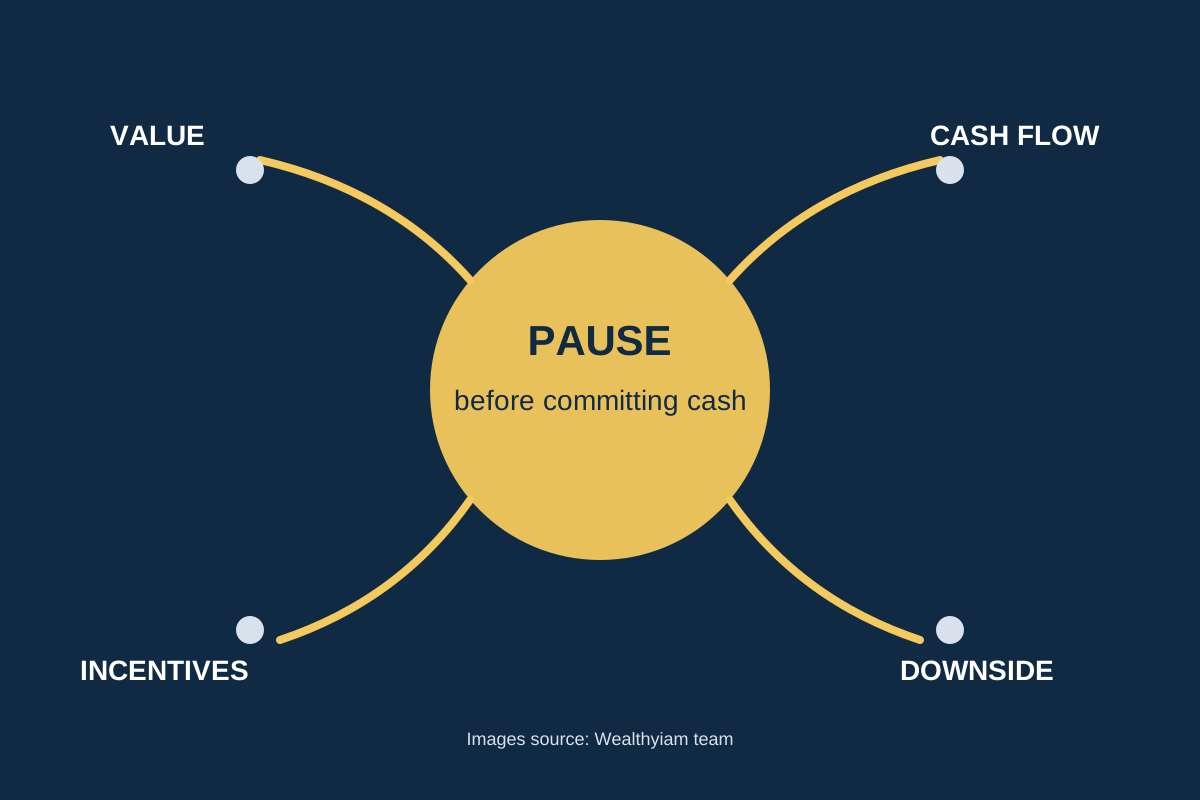
A property, side business, or investment can sound persuasive before you answer the questions that matter: What creates value? How does cash move? Who carries the downside? What evidence would change your mind?
The short answer is to use a decision process before you use your money. The Millionaire Maker’s Guide to Wealth Cycle Investing by Loral Langemeier is catalogued as a personal-finance and investing book about wealth and entrepreneurship. Its cover promises to help readers “build your assets into a lifetime of financial freedom.” That is an ambitious promise, not a guaranteed result.
The public sources used here verify the book’s identity, author, publication details, subject categories, and cover. They do not expose enough of the text to confirm a chapter-by-chapter framework. For that reason, the seven questions below are Wealthy I AM’s cautious application to the book’s documented subject, not a claim that Langemeier presents this exact list.
What the public record establishes
Open Library identifies the work as The Millionaire Maker’s Guide to Wealth Cycle Investing by Loral Langemeier. Its edition record lists McGraw-Hill as publisher, September 26, 2006 as the publication date, and 240 pages. The catalog subjects include personal finance, investing, small business, entrepreneurship, investments, and wealth.
Those records support a limited conclusion: this is a wealth-and-investing book with an entrepreneurial angle. They do not prove that a particular strategy will produce financial freedom, suit every reader, or work in every market. They also do not verify any detailed method beyond what appears in the title, cover, and catalog data.
That evidence boundary matters. A useful application can still be built around a careful question: before committing capital to a wealth opportunity, how can you examine value, cash flow, incentives, financing, changing conditions, and downside?
Seven questions for evaluating a wealth opportunity
1. What creates value besides a higher future price?
Start with the person on the other side of the transaction. Does the opportunity provide housing, save time, solve an operational problem, or meet a repeated need? “The market will rise” is a price theory, not a complete value proposition.
Write one sentence: “A customer, tenant, or buyer pays because this opportunity ______.” If the blank remains vague, pause before forecasting returns.
This question does not eliminate market risk. It forces you to identify the activity that is supposed to support demand rather than treating optimism as evidence.
2. How does cash actually move?
An asset can sound valuable while producing weak or irregular cash flow. Cash flow means the money entering and leaving over time. It is not the same as an estimated resale value, accounting profit, or a persuasive story.
List expected inflows, recurring expenses, one-time costs, taxes, financing payments, reserves, and timing. Mark every number as documented, estimated, or unknown.
For a rental property, relevant categories may include rent, vacancy, maintenance, insurance, taxes, management, financing, and closing costs. These are items to investigate—not assumed outcomes. If the plan works only after an optimistic sale price, make that dependence explicit.
3. Who benefits, who decides, and who absorbs losses?
Every participant has an incentive. A seller may value speed, a lender repayment, an operator control, and a partner income or an exit. Those interests can overlap, but they can also conflict.
Create a simple participant map with four columns:
- What does this person or organization gain?
- What risk do they carry?
- What decisions can they control?
- What happens to them if the plan underperforms?
Pay particular attention to fees, commissions, guarantees, repayment priority, information access, and control rights. A deal may be attractive to an intermediary even when it is unsuitable for you. This exercise is a decision aid, not a substitute for contracts or qualified legal advice.
4. What does financing amplify?
Borrowing can let you control a larger asset with less cash upfront, but it also creates fixed obligations. Leverage magnifies exposure: favorable outcomes may improve, while losses and cash pressure may also become more severe.
Run at least three versions of the plan:
- a base case using documented assumptions;
- a less-favorable case with delayed revenue or higher costs;
- a severe-but-plausible case in which several pressures occur together.
Do not invent precise probabilities merely to make the spreadsheet look scientific. Instead, state which assumptions changed and whether you could still meet essential obligations without relying on a quick sale or expensive emergency borrowing.
5. Which changing condition could break the plan?
A plan built for one interest rate, demand level, rent level, supplier price, or resale environment can be fragile. Choose the three assumptions that matter most and vary them one at a time.
Ask what happens to liquidity, required payments, operating capacity, and your ability to continue. Then consider whether two adverse changes could occur together. A modest decline in revenue may be manageable on its own, while the same decline combined with a repair, vacancy, or financing reset may not be.
Sensitivity analysis does not predict the future. It shows which assumptions carry the plan and where more evidence or a larger safety margin may be needed.
6. Which terms protect you if the story is wrong?
Price is only one part of a transaction. Inspection rights, contingencies, payment timing, responsibilities, information access, warranties, and remedies can alter the risk.
Before negotiating, prepare three lists:
- Must have: protections or facts required to proceed.
- Prefer: terms that improve the opportunity but are negotiable.
- Walk away: conditions that make the risk unacceptable.
Urgency is not evidence. If key information cannot be checked before a deadline, delaying or passing may be the responsible decision. For a significant transaction, use qualified legal, tax, and financial review appropriate to your circumstances and jurisdiction.
7. Can your finances survive a failed experiment?
A wealth plan should not depend on every attempt succeeding. If one deal can eliminate your emergency reserve, disrupt essential needs, damage your credit, or force high-cost borrowing, it may be too large for your current position.
Set maximum exposure before negotiation changes your emotions. Identify:
- cash and assets that remain untouchable;
- the most time, credit, or reputation you will expose;
- evidence required before each new commitment;
- the stop condition that ends the experiment;
- the smallest reversible step that can buy useful information.
Risk capacity is personal. It depends on essential expenses, income stability, debt, caregiving duties, liquidity, time, and the consequences of loss. There is no universal safe amount.
A 30-minute pre-commitment worksheet
Use this for a hypothetical opportunity or one you are considering:
- Opportunity: What is being offered, and what problem does it solve?
- Mechanism: How does money enter, and which costs are paid first?
- People: Who provides capital, performs work, controls decisions, and bears losses?
- Evidence: Which claims are documented, estimated, or unknown?
- Stress test: What if revenue is delayed, costs rise, financing changes, or the exit is unavailable?
- Limits: What cash, time, credit, or reputation are you willing to expose?
- Next step: What small, reversible action can test the most important assumption?
A reader considering a small rental property, for example, might first verify local operating costs, financing terms, legal requirements, and the property’s condition. That work may reveal more than a forecast based mainly on future appreciation. This is an illustration, not an investment recommendation or prediction.
Common mistakes to avoid
Treating a forecast as due diligence
A spreadsheet organizes assumptions; it does not turn them into facts. Record the source and date of each important input, and distinguish verified figures from estimates.
Ignoring who gets paid first
Understand repayment priority, fees, commissions, guarantees, control rights, and responsibilities. Attractive projected returns do not tell you how risk is distributed.
Using leverage without liquidity
Debt payments continue when income does not. Keep circumstances-appropriate reserves and understand the consequences of missed payments before borrowing.
Confusing diversification with complexity
More projects, entities, or strategies do not automatically reduce risk. Complexity can add fees, administration, dependencies, and failure points.
Letting momentum replace verification
Time already spent does not make the next commitment wise. Return to your evidence requirements and walk-away conditions whenever new information changes the case.
Frequently asked questions
Is Wealth Cycle Investing a guaranteed path to wealth?
No. The book’s cover makes an aspirational financial-freedom promise, but the public records reviewed here do not establish guaranteed outcomes. Results can depend on pricing, execution, financing, markets, legal obligations, taxes, and personal circumstances.
Is the book only for real-estate investors?
The catalog classifies it across personal finance, investing, wealth, small business, and entrepreneurship. That suggests a broader scope than real estate alone. Detailed recommendations should still be checked against the book itself before attributing them to Langemeier.
Does a positive cash-flow estimate make an investment safe?
No. An estimate may omit vacancy, repairs, taxes, financing changes, delays, fraud, legal problems, or other risks. Review the assumptions and test less-favorable conditions.
What should I verify before signing?
Depending on the transaction, verification may include ownership, condition, financial records, fees, obligations, financing terms, regulatory requirements, insurance, taxes, decision rights, and exit conditions. Qualified professionals can address transaction-specific legal, tax, and financial questions.
How much money should I risk?
There is no universal amount. Consider essential expenses, emergency savings, debt, income stability, liquidity, time capacity, and the consequences of losing the amount committed. General education cannot determine an appropriate exposure for an individual.
A cautious next step
Choose one opportunity and complete the worksheet without committing money. Circle every unknown, identify who can verify it, and write the condition that would make you walk away.
The practical lesson is not that every entrepreneurial or investment opportunity should be pursued. It is that opportunity, cash flow, incentives, financing, changing conditions, and downside should be considered together. If you cannot explain the value mechanism and the loss scenario in plain language, you are not ready to decide.
General education is not individualized financial, investment, tax, or legal advice.
Sources
- Open Library work record: The Millionaire Maker’s Guide to Wealth Cycle Investing — title, author association, subjects, and cover ID.
- Open Library editions record — publisher, publication date, ISBN, page count, subjects, and edition data.
- Open Library author record: Loral Langemeier — author identity.
- Open Library Covers API, cover ID 60893 — exact-title cover image source; reuse rights are not established by catalog availability.