Knowing the rule is not the same as following it
You can understand that investing should be patient and still feel pulled toward an exciting fund, an urgent market headline, or a purchase that promises a quick emotional lift. That gap is not necessarily a lack of intelligence. Money decisions are made by a human brain responding to attention, reward, uncertainty, emotion, and habit.
Jason Zweig’s Your Money and Your Brain: How the New Science of Neuroeconomics Can Help Make You Rich explores investing and decision-making through neuroeconomics—the intersection of brain science and economic choice. A useful application is not to demand perfect rationality from yourself, but to build a process that makes a pause possible.
The short answer: move important money choices out of the heat of the moment. Set rules in advance, reduce avoidable prompts, write down your reason before acting, and review the quality of the process instead of judging yourself by one outcome.
The seven lessons below are a Wealthy I AM synthesis inspired by the book’s documented subjects, which include neuroeconomics, investment psychology, and decision-making. They are not presented as Zweig’s official numbered framework, and the practical exercises are general educational suggestions—not promises of superior returns.
Seven lessons for making money choices with less impulse
1. Treat the decision environment as part of the decision
A money choice does not happen in a vacuum. A notification, a dramatic price move, a limited-time offer, or a conversation with an enthusiastic friend can change what feels urgent. Improving the environment around a decision may be more reliable than demanding constant willpower.
Try this: list the prompts that most often trigger unplanned spending or trading. Turn off nonessential alerts, remove saved payment details where appropriate, and create a cooling-off period for decisions above a threshold you choose. The aim is not to eliminate every enjoyable purchase. It is to add time between stimulus and commitment.
2. Separate excitement from evidence
Reward and anticipation can make an attractive possibility feel like a well-supported one. But excitement is an emotion, not evidence of value, affordability, or suitability. A compelling story about a company or asset can coexist with substantial uncertainty.
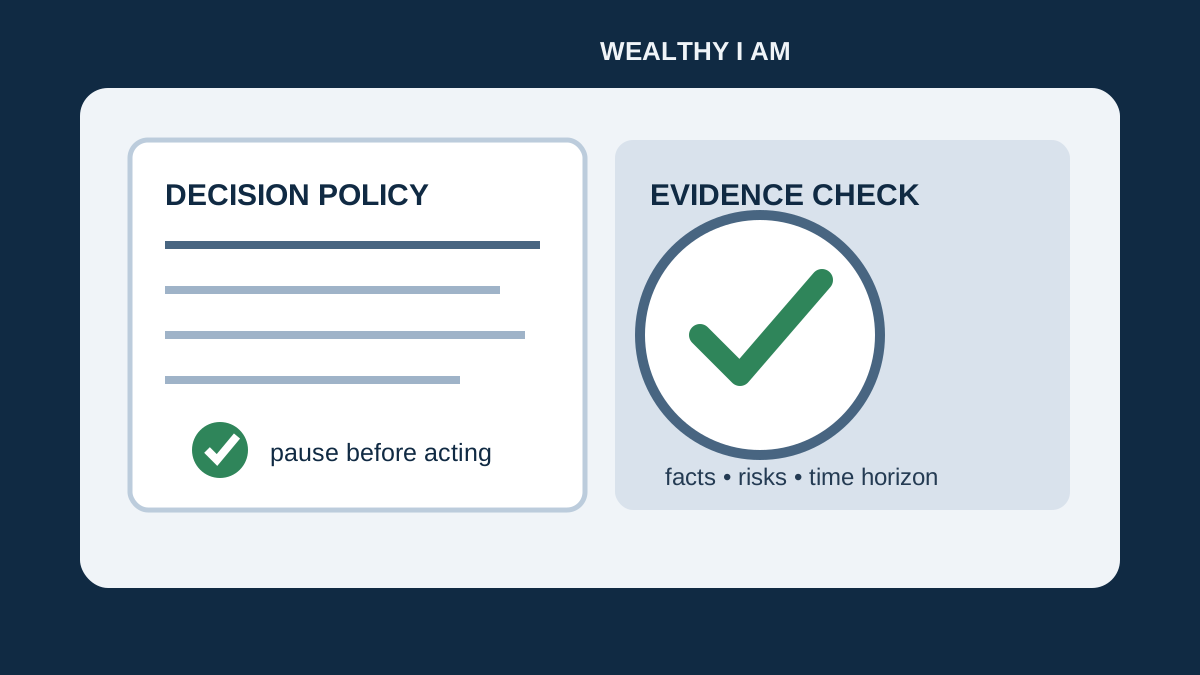
Before investing, write three short statements: what you believe, what evidence supports it, and what evidence would change your mind. Define unfamiliar terms before relying on them. If you cannot explain the asset, its risks, and how it fits your time horizon in plain language, postponing the decision is reasonable.
Wealthy I AM application: use a “boring-by-design” checklist. Ask about purpose, time horizon, diversification, fees, liquidity, downside, and whether you are acting because the idea is popular. This is a process check, not a recommendation to buy or sell anything.
3. Build friction before a high-stakes choice
Friction is a small obstacle that makes an automatic action less automatic. For spending, it might be a 24-hour pause. For investing, it might be a written thesis and a second review. Friction can feel inconvenient, but inconvenience is useful when the alternative is an irreversible or expensive decision.
A simple two-stage process works for many households: capture the idea today; decide only during a scheduled review. If the decision concerns debt, taxes, insurance, or a significant investment, check the relevant documents and consider advice from an appropriately qualified professional.
Hypothetical example: imagine a reader sees an investment promoted online and wants to commit $500 immediately. A pause does not prove the investment is bad. It creates time to check the product, costs, risks, and whether the money is needed for near-term obligations. The $500 amount is illustrative, not a forecast or recommendation.
4. Make the desired behavior the easy default
A process that depends on remembering every month is fragile. A process that happens by default can be easier to maintain. That might mean scheduling a transfer to savings after confirming it will not cause an overdraft, keeping a simple spending review, or using a written investing policy for long-term accounts.
Defaults still need supervision. Automatic transfers can be wrong for changing income, variable expenses, or emergency needs. Review them when circumstances change, and keep accessible cash appropriate to your situation. Automation is a tool, not a substitute for judgment.
5. Measure the process, not just the result
A good decision can have a disappointing outcome, and a careless decision can occasionally work out. If you judge yourself only by the result, luck can teach the wrong lesson. A better review asks: Did I follow my criteria? Did I understand the downside? Did I act within my plan? Did important new evidence appear?
Keep a short decision journal. Record the date, action considered, reason, uncertainty, and review date. For spending, note the need the purchase was meant to serve. For investing, record the role the asset is supposed to play rather than a hoped-for return. This record can expose recurring triggers without turning one mistake into a permanent identity.
6. Use a pre-mortem to make risk visible
When a choice feels attractive, it is easy to focus on the desirable outcome. A pre-mortem reverses the direction: assume the decision went badly, then write down plausible reasons. This does not predict the future. It widens the range of possibilities you consider before committing.
For a business investment, ask: What if revenue is slower than expected? What if costs rise? What if I cannot sell when I need cash? What assumption am I treating as certain? For a purchase, ask what future obligation it creates and whether a lower-cost option would meet the same need.
Do not use a pre-mortem to create paralysis. Use it to identify one safeguard, such as a smaller test, a limit on exposure, or a clear stop condition.
7. Design for your actual self, not an imaginary rational investor
A plan that looks excellent on paper can fail if it conflicts with your cash needs, temperament, knowledge, responsibilities, or tolerance for loss. The point of behavioral finance is not to shame normal human reactions. It is to account for them.
Ask yourself:
- When markets fall, am I likely to sell in fear?
- When money is tight, can this contribution be reduced safely?
- Do I understand the product well enough to explain it?
- Would this decision still make sense without a headline or social-media prompt?
A diversified, lower-complexity approach may be easier for some people to maintain, while others may need a different structure. Suitability depends on individual circumstances. A regulated adviser can help with personalized recommendations; this article cannot.
A 30-minute money-decision reset
Use this as a repeatable exercise, not as a test you must pass.
- Name the decision. Write the exact action, amount, and deadline.
- Name the purpose. Is the money for security, a planned goal, learning, enjoyment, or speculation?
- List the emotional pull. Excitement, fear, envy, urgency, relief, and avoidance can all be information—but none is proof.
- Write the downside. Include loss of money, illiquidity, debt cost, fees, taxes to investigate, and opportunity cost where relevant.
- Choose a pause. Set a review time that protects the decision without delaying a genuinely necessary payment.
- Record the rule. State what would make you proceed, reduce the amount, seek advice, or walk away.
- Review later. Evaluate whether the process was followed. Do not rewrite the past using the outcome alone.
Mistakes to avoid
- Calling every emotional response irrational. Emotions can signal needs or risk; examine them rather than automatically obeying or dismissing them.
- Turning a behavioral insight into a stock tip. An idea about decision-making does not identify a suitable security or guarantee an outcome.
- Over-automating. Defaults must be reviewed when income, expenses, goals, or obligations change.
- Confusing more research with better research. Endless information can become another form of avoidance. Define the decision and the evidence you actually need.
- Using shame as a financial system. A mistake is information for improving a process, not proof that you are incapable of managing money.
Is Your Money and Your Brain worth reading?
It may be useful for readers who want to explore why familiar money rules can be difficult to follow under pressure. The practical value of its subject is a shift from “I need perfect discipline” to “I can improve the conditions around my decisions.” Readers seeking individualized investment, tax, debt, or legal guidance will need more specific and current sources.
Frequently asked questions
What is Your Money and Your Brain about?
The book connects neuroeconomics, investment psychology, and decision-making. It examines how the brain and psychological forces relate to financial choices.
Does the book guarantee better investment returns?
No guarantee should be inferred. Better awareness may improve a decision process, but investment outcomes remain uncertain and depend on the asset, price, diversification, costs, time horizon, and personal circumstances.
What is the simplest idea to apply today?
Add a pause to one recurring decision and write down your reason before acting. Start with a choice important enough to matter but not so urgent that a delay could cause harm.
Is this financial advice?
No. This is general educational content and a practical editorial application of the book’s documented subject. For advice tailored to your situation, consult an appropriately qualified professional.
Sources and image provenance
- Open Library work record: Your Money and Your Brain — title, subtitle, author linkage, first-publication date, cover ID, and subjects.
- Open Library edition record — 2007 Simon & Schuster hardcover edition and bibliographic details.
Conclusion: make the pause part of the plan
Better money decisions do not require pretending to be emotionless. They require noticing how attention, reward, fear, and habit can shape a choice, then building a process that gives longer-term goals a voice.
Choose one decision that repeatedly catches you off guard. Add a pause, write down its purpose and downside, and schedule a review. Keep what helps, change what does not, and avoid treating one result as proof that the system—or you—will always succeed or fail.
A calmer process cannot remove uncertainty. It can make your next decision more deliberate.