A business can be intelligent on paper and unhealthy in practice. It may have a good product, capable employees, and a workable financial model, yet still lose energy to politics, mixed messages, and leadership decisions that never become shared commitments.
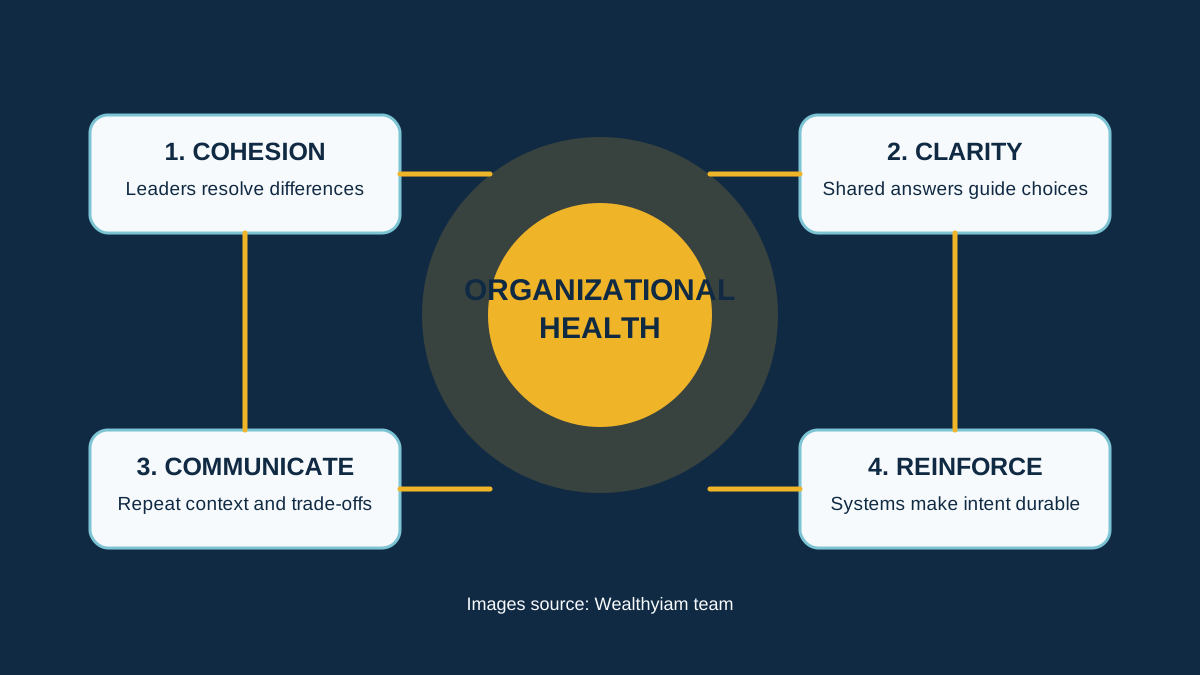
Patrick Lencioni’s The Four Obsessions of an Extraordinary Executive: A Leadership Fable approaches that problem through a deliberately different format: a leadership fable. Rather than presenting organizational health only as a set of management instructions, the book uses a business story to make the executive’s responsibility concrete. The official Table Group description calls organizational health “the linchpin of sustained success” and presents four disciplines: build a cohesive leadership team, create clarity, overcommunicate clarity, and reinforce clarity.
That framing gives the book a useful reading question: not “Which management trick should I install?” but “What would employees experience if leaders were unified, clear, repetitive, and consistent in the systems they use?”
This is a summary and practical interpretation, not a chapter-by-chapter account. The official book page verifies the leadership-fable format and the four-discipline model; it does not provide a full plot or character guide. For that reason, this article does not invent character names, dialogue, or plot events.
Why the fable format matters
A list of principles can make leadership look tidy. A fable can show why principles become difficult when real people must act on them. Executives have different information, incentives, histories, and fears. Employees interpret what leaders do, not only what leaders announce. A leadership decision therefore has two lives: the decision as the executive team understands it, and the decision as the organization experiences it.
That is the distinctive promise of this book. Its subject is not merely executive technique; it is the health of the organization around the executive. The Table Group distinguishes “smart” organizations—those with thoughtful strategies, solid products, and financial infrastructure—from “healthy” organizations, which are unified rather than splintered by politics and infighting. The distinction is important because intelligence does not automatically produce coordination.
Read the fable as a diagnostic. When a decision keeps changing, ask what the story would reveal: Is the leadership team avoiding a conflict? Has it failed to answer a basic question? Has it communicated the answer once instead of repeatedly? Or do the company’s systems reward behavior that contradicts the stated answer?
The four obsessions, read as a sequence
The four disciplines are easy to memorize, but they are more useful as a sequence than as four independent slogans.
1. Build a cohesive leadership team
The official model places cohesion first and describes it as the most critical step in a healthy organization. Cohesion does not mean identical personalities or permanent agreement. It means a leadership team is committed to doing the ongoing work of becoming a high-performing team.
The practical implication is that clarity cannot be outsourced to a memo. Leaders must be able to put competing interpretations on the table, resolve the issue, and support the resulting decision. If they do not, employees receive a political map rather than a clear direction.
Application: Before a major announcement, ask each executive to state the decision, its reason, and its most important trade-off. Compare the answers privately. Differences are not proof of failure; hidden differences that reach employees as contradictory instructions are the risk.
2. Create clarity
The Table Group says executive-level clarity comes from answering six critical questions. The accessible product description does not reproduce those questions, so this article will not pretend to quote or reconstruct them as official wording. The reliable principle is that leaders need a shared set of answers about the organization and its current direction.
For a practical exercise, create a clearly labeled working document with six prompts of your own: purpose, principal customer, current priority, key behavior, competitive approach, and decision boundaries. Treat the document as a Wealthy I AM application, not as a verbatim transcription from Lencioni’s book. The test is whether leaders answer consistently enough for employees to make better decisions without repeatedly escalating basic questions.
Clarity is not the same as certainty. A leadership team can make a provisional choice, name its assumptions, and set a review date. That is more useful than using vague language to avoid responsibility.
3. Overcommunicate clarity
Once leaders are cohesive and have established clarity, the official model says they must communicate the answers “over and over again.” The repetition is not a defect in the message. It is part of how a message survives onboarding, urgent work, competing priorities, and ordinary human attention.
The fable format helps expose a common executive illusion: leaders experience the message at the moment they decide it, while employees encounter it in fragments. One executive announcement may be followed by a sales exception, a hiring decision, and a project deadline that appear to contradict it. Repetition gives the organization more chances to connect daily choices to the shared answer.
Application: Attach one sentence of context to recurring decisions: “We are choosing this because our current priority is X; the trade-off is Y.” Invite questions and update the sentence when the evidence changes. Repeating an obsolete decision is not clarity.
4. Reinforce clarity
The final discipline moves the model from speech into organizational design. The Table Group specifically identifies recruiting and hiring, performance management, compensation and rewards, and real-time recognition as systems that should tie back to organizational clarity.
This is where stated values become testable. If leaders say collaboration matters but reward only individual output, the reward system communicates more forcefully than the value statement. If a company claims to empower managers but requires executive approval for routine choices, the approval structure tells employees what ownership really means.
Application: Select one system and compare its signals with the leadership team’s stated answers. Do not redesign everything at once. Document the contradiction, choose a small change, and define what observable behavior would indicate that the system now supports the intended direction. Employment and compensation changes can have legal and financial consequences; obtain qualified advice where appropriate.
What this book adds to the broader Lencioni conversation
The Table Group’s own page says the model in The Four Obsessions is further explored in Lencioni’s later title The Advantage. That relationship helps readers position this book accurately. The Four Obsessions is not best treated as a second generic checklist about business productivity. Its contribution is the compact model and the fable form that puts the executive’s role at the center of organizational health.
That distinction also prevents an exaggerated promise. A healthy organization is not automatically a profitable one. Strategy, demand, costs, capabilities, competition, and external conditions still matter. The model asks leaders to make the organization more unified and understandable; it does not remove the need to make good business decisions.
A fable-based reading exercise
Use the following exercise after reading the book or reviewing its model:
- Identify a decision employees currently experience as confusing.
- Write the official answer leaders believe they have agreed on.
- List the different versions employees may be hearing through meetings, incentives, approvals, or exceptions.
- Name the leadership disagreement, assumption, or trade-off that has not been made explicit.
- Choose one message to repeat and one system signal to inspect.
- Set a review date and look for evidence such as fewer escalations, clearer ownership, or more consistent decisions.
This exercise is not a claim about a particular scene in the fable. It is a Wealthy I AM application of the model’s sequence: cohesion makes clarity possible; communication makes clarity portable; systems make clarity durable.
Mistakes to avoid
Treating the four disciplines as a software implementation
A new platform cannot create trust among executives or answer an unresolved strategic question. Tools can support a decision after the leadership work is done.
Confusing repetition with pressure
Overcommunication should preserve material caveats and allow questions. Repeating a message to prevent legitimate disagreement creates compliance, not health.
Calling every value statement “clarity”
A value becomes operational when people can use it to choose between competing actions. Add a behavior, a boundary, and a trade-off.
Using the fable as proof of a guaranteed result
A story can make a leadership pattern memorable, but it cannot establish that a particular intervention will increase revenue or solve a specific company’s problems. Test the idea in context.
Frequently asked questions
Is this a finance book?
No. It is a leadership and organizational-management book. Its connection to wealth is indirect: healthier coordination may reduce avoidable friction, but the book is not investment advice and does not guarantee business returns.
What does “leadership fable” mean here?
It means the management ideas are presented through a business narrative rather than only through an abstract textbook structure. Because publicly available sources used for this summary do not provide a complete plot or cast list, readers should consult the book itself for those details.
Are the four disciplines a strict checklist?
They are better understood as connected disciplines. Weak cohesion makes clarity fragile; unclear answers make communication inconsistent; and unsupported systems make communication temporary.
Can a solo founder use the model?
A solo founder can use it as a self-audit, but the team dimension is harder to test alone. Ask a trusted colleague or adviser to challenge the assumptions and compare the stated priorities with actual approvals, rewards, and routines.
Does organizational health guarantee growth?
No. It can support more coherent execution, but market demand, economics, competition, capability, and chance remain decisive.
Conclusion: let the organization test the idea
The most useful lesson of The Four Obsessions of an Extraordinary Executive is a shift in attention. Instead of asking only whether leaders have a smart strategy, ask whether the organization can understand, repeat, and act on that strategy without being divided by politics or mixed signals.
Start with one confusing decision. Surface the disagreement, establish a shared answer, repeat it in the places employees make choices, and inspect one system that either reinforces or undermines it. The fable’s value is not a promise that four disciplines solve every business problem. It is a memorable way to examine whether executive intent has become organizational reality.
Sources / Further reading
The Table Group: The Four Obsessions of an Extraordinary Executive — official book page and four-discipline model.
Open Library work record — bibliographic identity for the book and author.