If your income arrives, your bills get paid, and your account still seems to reset to zero, the problem may not be a lack of ambition. It may be that your money decisions are happening without a repeatable system.
Early answer: the most useful idea to take from Everyday Millionaires is not a promise that anyone can become wealthy by copying a single routine. It is the quieter proposition that wealth-building is often shaped by repeated choices about spending, saving, debt, work, and investing. Those choices need to be made visible, tested against your real life, and adjusted without treating a book’s message as individualized financial advice.
This article is a practical reading guide for someone searching for an Everyday Millionaires summary or key lessons. The inventory description says the book reports survey findings and practical lessons associated with millionaire households. The available Open Library record confirms the title, two-author identity, and broad personal-finance subject context; it does not establish a complete chapter-by-chapter summary or prove that every household followed the same path. The five lessons below are therefore a Wealthy I AM synthesis and application, not a claim that they are the authors’ exact numbered framework.
What problem does Everyday Millionaires address?
Many people associate wealth with dramatic income, celebrity, inheritance, or unusually clever investing. That picture can make ordinary progress feel irrelevant. A reader may then either postpone action until earning more or chase a shortcut that carries more risk than they understand.
The book’s premise, as represented in the research inventory, focuses attention on the habits and decisions associated with millionaire households: how people save, spend, handle debt, work, and invest. That framing can be useful because it moves the conversation from appearance to behavior. It is also limited. Association is not proof of causation, survey results can reflect the sample and its definitions, and past household choices do not automatically fit every reader’s goals, country, income, health, family responsibilities, or risk capacity.
Who may benefit from this book?
It may help a reader who wants a plain-language reset around household money and prefers a behavior-focused discussion to a market-prediction story. It is less suitable as a substitute for a current tax, legal, insurance, debt, or investment review. Those decisions depend on facts outside a general book summary.
Five practical lessons from the book’s lens
1. Make wealth-building observable before trying to optimize it
A goal such as “be better with money” is too vague to guide a Tuesday purchase or a monthly transfer. An observable plan identifies what will happen, when, and where you will check the result.
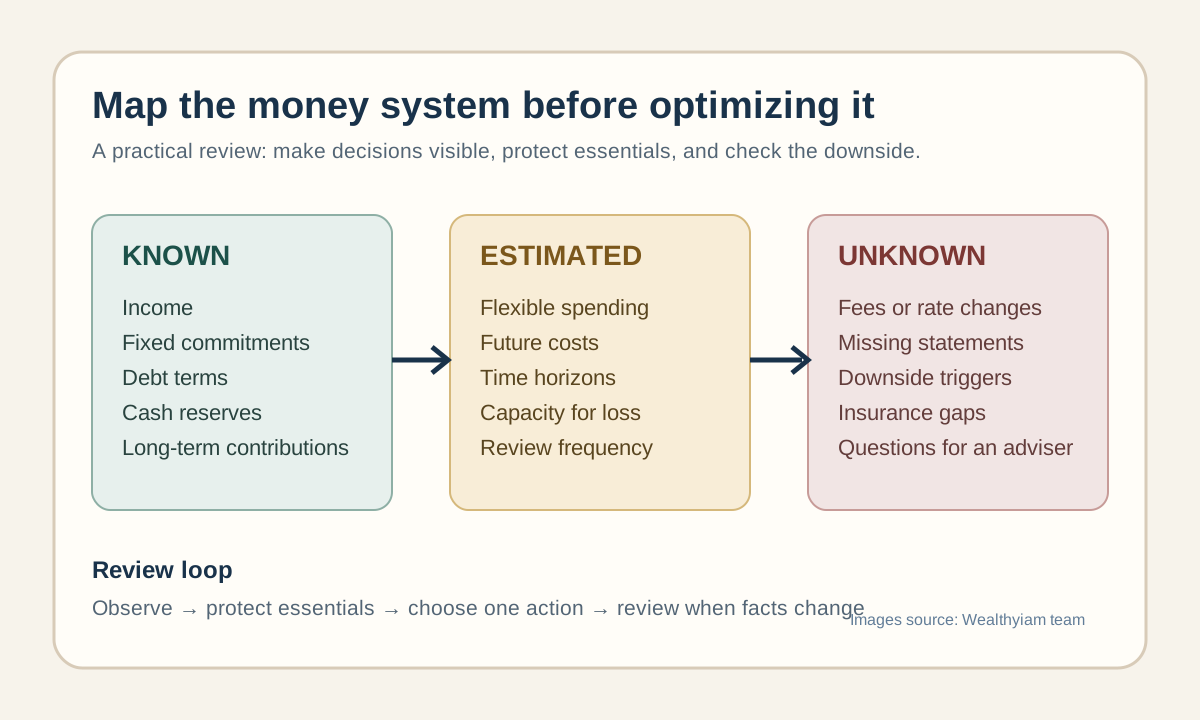
Wealthy I AM application: create a one-page money map with take-home income, fixed commitments, flexible spending, debt payments, cash reserves, and long-term contributions. Use your actual statements rather than a remembered average. The map is not a moral score; it is a description of the system you are currently operating.
Try this: choose one weekly review time that does not compromise sleep, caregiving, or essential work. Record three decisions you want to repeat and one expense or obligation that needs investigation.
2. Saving is a protection mechanism, not only an accumulation goal
The inventory connects the book with saving, spending, debt, work, and investing. A practical implication is that cash reserves can protect a long-term plan from being interrupted by an ordinary surprise. The right reserve depends on circumstances; there is no universally correct balance or timetable.
Hypothetical illustration: suppose a household is deciding whether every available dollar should go toward an investment contribution. If an unplanned repair would otherwise require expensive borrowing or a forced sale, keeping some accessible cash may reduce that vulnerability. This example is not a forecast or a recommendation about a specific amount.
Try this: separate money by purpose: near-term obligations, emergency access, and longer-term goals. Check whether the account and transfer choices match the time horizon and access you actually need.
3. Spending less than you earn is a starting condition, not a complete plan
A spending surplus creates room for debt reduction, reserves, learning, or investing. But a narrow focus on cutting can become counterproductive if it ignores health, safety, relationships, or the earning capacity that supports the plan. The goal is not to perform deprivation; it is to direct resources toward stated priorities.
Wealthy I AM application: classify spending into essential, valuable, convenient, and accidental. Do not assume that a category is wasteful merely because it is not an investment. Ask whether each recurring cost is serving the life you are trying to fund.
Try this: cancel or renegotiate one low-value recurring expense, then assign the released cash before it disappears into general spending. Review the change after one month and keep it only if it is workable.
4. Debt deserves a decision rule, not denial or panic
Debt is money borrowed under an obligation to repay, usually with interest and other terms. Some debt may support education, housing, or a business, while high-cost or poorly understood debt can reduce flexibility. The label alone does not answer whether it is suitable.
Wealthy I AM application: list each balance, rate, minimum payment, due date, fees, and whether the rate can change. Then choose a method you can sustain and understand. A plan that looks mathematically attractive but repeatedly fails in practice may need redesign rather than more self-criticism.
Try this: before taking on new debt, write what problem it solves, the total repayment obligation, the downside if income falls, and the condition under which you would stop. If you cannot explain the terms in plain language, pause and seek qualified advice.
5. Investing is a long-term process with uncertainty attached
Investing means committing money to assets that may rise or fall in value. Diversification means spreading exposure across different investments rather than depending on one outcome. Neither removes risk. A book about household wealth habits cannot determine the right portfolio, account, tax treatment, or risk level for every person.
Wealthy I AM application: begin with purpose, time horizon, liquidity needs, and capacity for loss. Then learn what you own, what it costs, how it is diversified, and what could cause you to sell at the wrong time. Avoid converting a broad lesson about investing into a promise of a particular return.
Try this: write a short investment policy for yourself: goal, time horizon, acceptable volatility, contribution schedule, review frequency, and reasons you would change course. A qualified adviser may be appropriate when the decision is complex or material to your financial security.
A simple household wealth review you can complete this week
This is an educational workflow, not an individualized recommendation.
- Name the purpose. Choose one near-term goal and one longer-term goal. Give each a date or condition that can be checked.
- Gather evidence. Use recent account statements, bills, loan documents, and investment records. Mark anything unknown instead of filling the gap with a guess.
- Build three columns. Put each item under known, estimated, or unknown. The third column shows where more information is needed.
- Set a resilience boundary. Protect essential housing, food, utilities, insurance, health needs, and legally required obligations before pursuing an optional goal.
- Choose one automatic action. An appropriately timed transfer or payment can reduce dependence on memory, but confirm the amount will not cause overdrafts or missed essentials.
- Run a downside check. Ask what changes if income drops, a major cost arrives, or an investment loses value. Label every scenario as an illustration, not a prediction.
- Schedule a review. Revisit the plan after a defined period and change it when facts change. A system is useful only if it remains compatible with real life.
Mistakes to avoid when applying the book’s message
Mistake 1: Treating a millionaire household as a template
A household’s outcome may reflect timing, location, education, family structure, opportunity, luck, or other factors not captured by a short description. Extract a principle to test; do not assume you know the whole cause.
Mistake 2: Confusing income with wealth
Income is money received over a period. Wealth is a broader picture of assets, obligations, resilience, and financial choices. A higher income can improve options, but it does not guarantee a surplus or durable security.
Mistake 3: Cutting so aggressively that the plan breaks
A budget that undermines health, safety, or essential relationships may not be sustainable. Use a stop-or-modify condition and protect necessities.
Mistake 4: Automating without monitoring
Automation can make a good intention consistent, but an unchanged transfer can become harmful when income, bills, fees, or account balances change. Check the system.
Mistake 5: Treating investing examples as instructions
Historical or household examples are not personal forecasts. Verify current information, costs, tax rules, and product terms before acting.
Frequently asked questions
Is Everyday Millionaires a step-by-step financial plan?
The available research record describes survey findings and practical lessons about habits associated with millionaire households. It does not establish a universal plan or guarantee. Readers should distinguish the book’s broad message from the original worksheet and applications in this article.
Does the book say that anyone can become a millionaire?
The title is encouraging, but a title is not a guarantee. Outcomes depend on circumstances, decisions, time, uncertainty, and factors outside a reader’s control. Use the book as a prompt for reflection, not as a promised result.
What should I do first if my finances feel disorganized?
Gather recent statements and make the three-column review: known, estimated, and unknown. Then protect essential obligations and choose one manageable action. Do not make a major investment or debt decision while key terms remain unclear.
Should I prioritize debt repayment or investing?
There is no universal answer. Compare the debt terms, liquidity needs, employer or account rules, taxes, risk, and your ability to withstand a setback. General education cannot select the right trade-off for your situation.
Is this article financial advice?
No. It is general educational commentary on a book and a practical way to organize questions. Tax, legal, lending, insurance, and investment decisions may require current, jurisdiction-specific professional advice.
Keep the book’s ideas separate from Wealthy I AM advice
The book lens emphasizes ordinary household behaviors associated with wealth. Wealthy I AM’s narrower application is to make those behaviors visible, preserve flexibility, question unsupported assumptions, and review the system regularly. That application is editorial synthesis, not a quotation, endorsement, or guarantee from Chris Hogan or Dave Ramsey.
Sources / Further reading
Book identity and research boundary: Open Library work record for Everyday Millionaires. The record lists Chris Hogan and Dave Ramsey as the work’s authors and supports the broad personal-finance subject context; it is not treated as a complete substitute for reading the book.
Author identity records: Chris Hogan and Dave Ramsey on Open Library.
Image credit: Open Library Covers API, cover ID 11982529: cover image source. The source states catalog provenance; reuse rights should be checked before publication.
</small>
Conclusion: build a money system you can actually review
The most useful takeaway is modest but powerful: wealth-building becomes easier to examine when it is expressed as repeatable decisions rather than an identity or a shortcut. Track the system, protect essentials, understand obligations, and treat investing as uncertain long-term work.
Your next step is to complete one weekly money map and circle the single unknown that could most disrupt your plan. Resolve that question before adding complexity. A reader does not need to imitate every household in a book to begin making more deliberate choices.