The problem: confident forecasts can still produce weak decisions
Money decisions often arrive wrapped in certainty: a headline predicts a market move, a commentator names the next winning sector, or a business plan assumes one estimate will come true. The hard part is not finding information; it is deciding what the information can actually support.
Early answer: better money decisions do not require perfect prediction. They require separating evidence from noise, expressing uncertainty, considering more than one plausible outcome, and choosing an action whose downside remains tolerable if the forecast is wrong.
This article uses The Signal and the Noise by Nate Silver as a lens. Open Library’s work record describes the book as an examination of forecasting, probability, uncertainty, and signal-versus-noise problems in fields including politics, weather, economics, sports, poker, and the stock market. The seven lessons below are a Wealthy I AM synthesis, not a claim that the book presents this exact numbered framework. The catalog sources used here do not establish a complete chapter-by-chapter summary.
What this summary is for
This guide is for readers seeking a practical summary of The Signal and the Noise and a cautious way to apply forecasting ideas to saving, investing, careers, and business. It is general education, not individualized financial advice. Investment losses are possible, and a forecast is not a guarantee.
After reading, you will have a small process for asking: What do I know? What am I estimating? What remains unknown? What would change my mind?
The core idea: forecasts are judgments under uncertainty
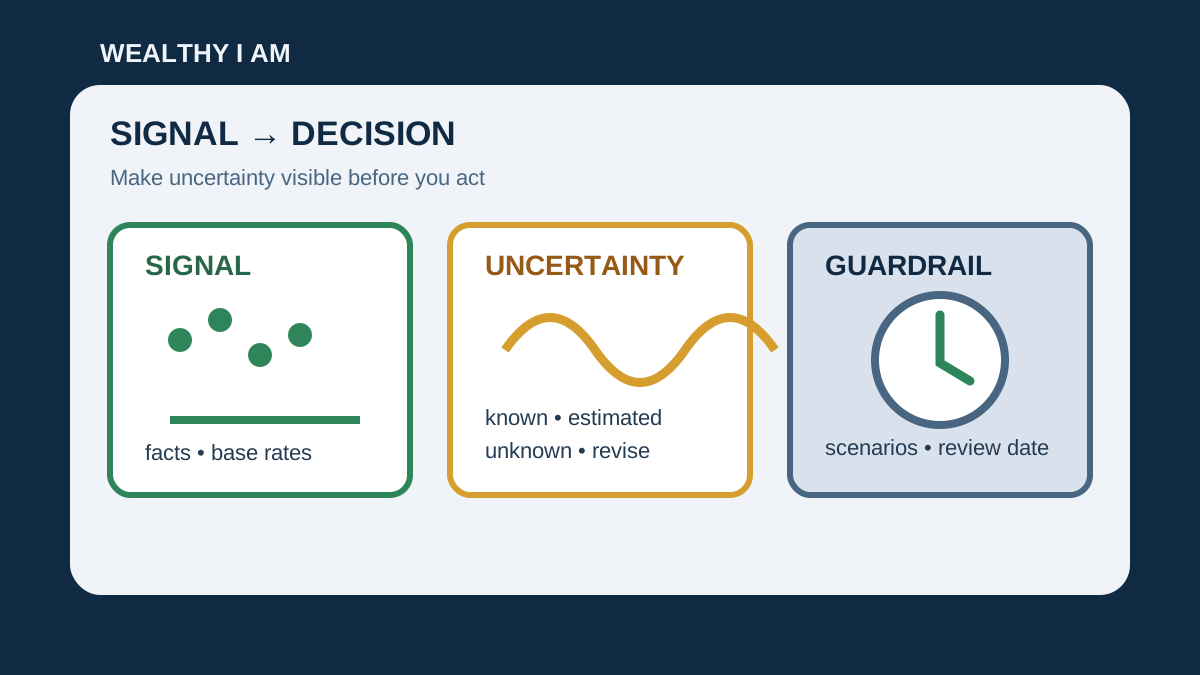
A forecast is an estimate about a future event. Uncertainty means the result may differ from that estimate. Signal is information that helps distinguish among possible outcomes; noise distracts, overwhelms, or appears meaningful without improving the decision.
In personal finance, the practical goal is not to eliminate uncertainty. It is to make decisions that acknowledge it.
Seven practical lessons from the book’s forecasting lens
1. Start with a question that can be checked
Vague questions invite vague confidence. “Will this investment do well?” is difficult to test. “What conditions would make this investment unsuitable for my time horizon and ability to absorb a loss?” is more useful.
Action: write one decision question in a form that can later be reviewed. Include a time horizon, the evidence expected to matter, and what would count as a changed view.
2. Separate observations from interpretations
An observation is something recorded or directly available. An interpretation is the meaning assigned to it. Mixing them makes a story feel like evidence.
For a household review, “monthly spending rose for three months” is an observation. “We are permanently bad at budgeting” is an interpretation. The first can be investigated; the second may be an unhelpful label.
Action: keep two columns in a decision note: known facts and explanations that still need testing.
3. Treat confidence as a degree, not a switch
Forecasting becomes safer when confidence can be revised. Instead of “this will happen,” use “my current estimate is,” followed by the assumptions supporting it. This makes the assumptions visible and allows a career plan, business launch, or investment thesis to be reviewed without pretending uncertainty has disappeared.
Action: record confidence in ordinary language—low, moderate, or high—and one reason it could be too high. Do not confuse confidence with precise probability.
4. Look for base rates before a compelling story
A base rate is what has happened across a relevant group or comparable situation. A story focuses on one case and may be unusually memorable.
For a business idea, ask how often similar customers have paid for the proposed solution, not only why one enthusiastic person liked it. For an investment, ask what assumptions about growth, valuation, and risk the current price appears to reflect; do not treat a persuasive narrative as proof.
Action: write down the comparable cases being used and why they are comparable. If no meaningful comparison exists, label the estimate especially uncertain.
5. Use multiple scenarios instead of one neat forecast
A scenario is a plausible description of how conditions could unfold; it is not a prediction. Use three cases:
| Scenario | What would need to be true? | Sensible response | |—|—|—| | Better than expected | Demand, income, or conditions improve | Decide in advance how much, if any, upside to keep exposed | | Roughly expected | Central assumptions hold | Follow the written plan and review dates | | Worse than expected | Income falls, costs rise, or the thesis weakens | Protect essentials, liquidity, and ability to change course |
This is a hypothetical planning tool, not a return forecast. It makes downside visible before money is committed.
6. Prefer decisions robust to being wrong
A robust decision can remain acceptable across several plausible outcomes. For a household, that may mean preserving a cash reserve before taking optional risk. For an investor, it may mean matching risk to time horizon and capacity for loss rather than copying someone else’s conviction.
Robustness does not mean avoiding all risk. It means asking whether the consequences of error are survivable.
Action: finish this sentence before acting: “If my central estimate is wrong, the first harm I need to limit is…” Then choose a guardrail that addresses it.
7. Update without chasing every new signal
Good updating differs from reacting to every headline. Decide which evidence is relevant, how often you will review it, and what would genuinely change the plan.
A written investment policy, savings rule, or business scorecard can reduce impulsive changes while allowing revision when facts change materially. A rule that cannot be updated is as risky as a decision with no rule.
Action: schedule a review date and list two or three decision-changing facts. Ignore unrelated commentary unless it supplies new evidence about one of them.
A 30-minute decision audit
- Name the decision: what might you do, and by when?
- List evidence: separate verified facts, estimates, and unknowns.
- Write the story: what explanation feels most persuasive?
- Challenge it: what base rate, counterexample, or missing fact could weaken it?
- Map three scenarios: describe better, expected, and worse outcomes without guarantees.
- Choose a guardrail: consider a review date, affordable-loss limit, cash buffer, or smaller reversible test.
- Record the trigger: what new information would make you update or stop?
For an investment, the output can be a short business description, three to five value drivers, relevant assumptions, what the current price appears to require, and one fact that would change your view. It does not produce a recommendation or guarantee a result.
Mistakes to avoid
- Confusing detail with accuracy: precise numbers can rest on uncertain assumptions.
- Using one vivid example as proof: anecdotes illustrate without establishing typicality.
- Reacting to every headline: new information matters only when it changes a relevant assumption.
- Borrowing another person’s risk capacity: income, obligations, time horizon, and ability to absorb loss differ.
- Calling a scenario a promise: planning for upside is not evidence that upside will occur.
- Skipping the cost of being wrong: liquidity and essential obligations deserve attention before optional speculation.
Book ideas versus Wealthy I AM advice
The book provides the forecasting lens. Wealthy I AM’s application is the decision audit, the known/estimated/unknown distinction, scenario planning, and guardrails. These are editorial recommendations, not quotations or a reconstruction of Silver’s exact method.
A cautious money system may therefore look less exciting than a prediction: maintain a visible cash-flow plan, diversify where appropriate for your circumstances, define risk plainly, and review decisions on a schedule. Diversification means spreading exposure so one holding or outcome does not determine the whole result; it cannot remove market loss.
Frequently asked questions
Is The Signal and the Noise an investing book?
The book examines forecasting across several fields, including economics and the stock market, according to the Open Library work description. Treat it primarily as a book about reasoning with evidence and uncertainty, not as a list of investments to buy.
Does it teach reliable market prediction?
No source used for this article supports such a promise. Its practical value here is questioning forecasts, inspecting assumptions, and managing decisions when predictions can be wrong.
Should beginners use forecasts when investing?
They can learn from forecasts without treating them as certainty. Start with goals, time horizon, liquidity needs, and risk capacity. Consider qualified advice for complex decisions that materially affect your finances.
What is the simplest takeaway?
Write down what you know, what you estimate, and what you do not know. Choose a plan whose downside you can live with and a date on which you will review it.
A low-risk next step
Choose one pending money decision—not your entire financial life—and complete the seven-step audit. Do not commit money merely to complete the exercise. The useful outcome is a clearer question, visible assumptions, and a pre-decided response if evidence changes.
Conclusion
The Signal and the Noise is useful not because it removes uncertainty, but because it encourages a more disciplined relationship with it. Better wealth decisions begin with checkable questions, revisable confidence, downside scenarios, and guardrails that protect essential goals.
Take one forecast you currently rely on and label each part known, estimated, or unknown. That small separation can make the decision—and its risks—easier to see.
Sources / Further reading
- Open Library work record for The Signal and the Noise — bibliographic identity, author link, subjects, cover IDs, and public description used to verify the article’s evidence boundary.
- Open Library author record for Nate Silver — author identity cross-check.
- Open Library cover image, cover ID 7256893 — source and provenance for the relevant cover image recorded in the editorial handoff. Image reuse rights must be confirmed before publication.