If your portfolio feels like a pile of unrelated investments—or if one market headline can change your plan overnight—the problem may be structure rather than your ability to predict markets. All About Asset Allocation by Richard A. Ferri offers a useful starting point: decide how money is divided among broad asset classes before choosing individual holdings.
Quick answer: what is the book’s main lesson?
Asset allocation means choosing the mix of investment categories—such as stocks, bonds, cash, and other assets—that fits a goal, time horizon, and ability to tolerate loss. The available bibliographic record identifies the book with the subject of asset allocation; the seven lessons below are a Wealthy I AM editorial synthesis, not a claimed list of the book’s exact chapters.
The practical answer is not to copy a model portfolio. Write down the goal, identify the risk you can actually carry, choose a diversified mix, and rebalance under pre-agreed conditions. This is general education, not individualized investment, tax, or legal advice.
Who is All About Asset Allocation for?
The book is most relevant to a reader who wants a repeatable portfolio process rather than a hot tip. It may help someone saving for a long-term goal, reviewing an existing mix, or learning why owning several investments does not necessarily mean having different risks.
It does not replace a personal financial plan. Taxes, debt, emergency reserves, employment security, time horizon, and near-term cash needs can change what is suitable. A mix reasonable for one person can be unsuitable for another.
Seven practical lessons from All About Asset Allocation
1. Start with the goal, not the investment menu
A portfolio exists to serve a purpose. “Grow my money” is too vague to guide an allocation. Name the goal, approximate when the money may be needed, and identify whether the amount is flexible or essential.
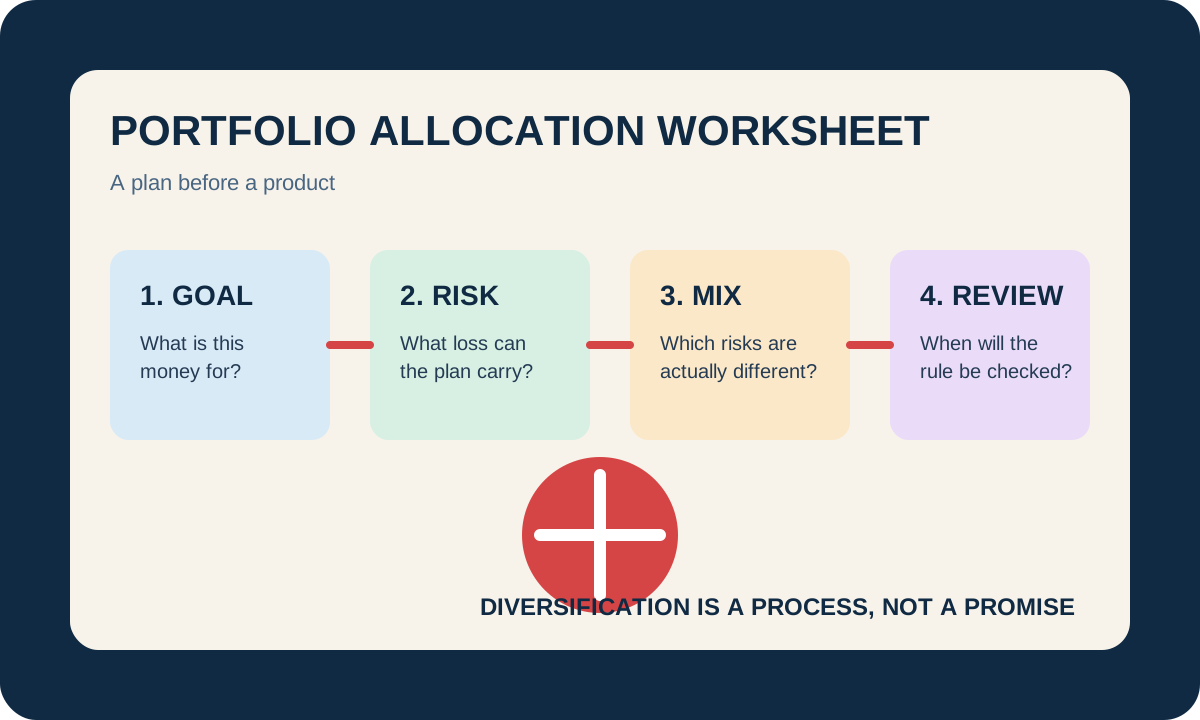
A retirement account with a distant horizon and a reserve for a bill due soon have different jobs. Begin with four questions: What is this money for? When might I need it? How much loss could make the goal fail? What contributions or withdrawals are realistic?
Wealthy I AM application: write the goal before researching funds. If the goal is unclear, the allocation discussion is premature.
2. Risk is more than a questionnaire score
Risk tolerance is your emotional willingness to endure volatility. Risk capacity is your financial ability to absorb a loss without abandoning an essential plan. They are not the same.
Someone may say they can tolerate a large decline yet need the money soon for a home purchase. Someone else may have a long horizon but unstable income and little cash reserve. A questionnaire cannot replace context. Ask what you would do if the account fell substantially and recovery took an unknown amount of time. The answer should be a plan, not a prediction.
3. Diversification works only when the risks are different
Diversification is spreading exposure across investments whose returns do not always move together. Owning many funds is not automatically diversified if they hold similar companies, sectors, countries, or risk factors.
Check what sits underneath each holding. Look for concentration by company, industry, geography, and asset class. A portfolio can appear busy while still depending heavily on one economic outcome. This is a structural lesson, not a promise that diversification prevents losses; different assets can become more correlated during stressful periods.
4. Choose an allocation you can keep through difficulty
A theoretically attractive allocation is not useful if you abandon it during an uncomfortable drawdown. The better question is not which mix has the highest possible return, but which mix you can maintain while still funding the goal.
Label each part of the portfolio by its job. Growth assets may support a long-term objective but fluctuate. Stabilizing assets may reduce some market impact but have their own inflation and interest-rate risks. Cash can provide liquidity, but its purchasing power may change. Ferri’s framework is a planning lens, not a guarantee that an allocation will outperform.
5. Separate allocation decisions from product decisions
First decide how much exposure you want to an asset class. Only then compare the vehicles used to obtain it. Otherwise, a persuasive fund description or familiar company name can quietly determine the portfolio.
For each proposed holding, ask: What exposure does it provide? What does it cost? What risks does it add? How does it overlap with what I own? What would make me replace it? This sequence makes the portfolio easier to explain and reduces the temptation to treat a product as a strategy.
6. Rebalancing is a discipline, not a forecast
Rebalancing means bringing a portfolio toward its intended allocation after markets or contributions change the weights. It can require selling an asset that rose or adding to one that lagged, which can feel uncomfortable.
Choose the rule in advance. A calendar review or tolerance-band review can be a starting point, but taxes, transaction costs, account type, and local rules matter. Rebalancing may have consequences, so a qualified professional can help with personal circumstances. The goal is not to predict the next winner; it is to prevent drift into a risk level you did not choose.
7. Review the plan when life changes
An allocation should be connected to the goal, not treated as a permanent identity. New dependents, a job change, a major purchase, a change in health, or a shorter horizon can alter the plan.
Create an annual review: confirm the goal, horizon, cash needs, contribution rate, allocation, costs, and concentration. A review is not a command to trade. Sometimes the correct action is to leave the portfolio alone after checking that the original assumptions still hold.
A practical 30-minute allocation check
Use this as an educational worksheet, not a recommendation to buy or sell:
- Name the job. Write the goal and the earliest realistic date the money may be needed.
- Map constraints. List emergency cash, high-interest debt, expected withdrawals, tax considerations, and income uncertainty.
- Inventory exposure. Record each holding, broad asset class, approximate weight, cost, and geographic or sector concentration.
- Test the mix. Ask what could make several holdings fall together and whether a large decline would change your behavior.
- Write the rule. State when you will review and what event would justify a change.
- Pause before acting. If the decision affects essential money, taxes, or a complex account, seek appropriately qualified advice.
A clearly hypothetical example
Suppose a reader has three funds that look different by name but hold many of the same large companies. The goal is ten years away, yet there is no written cash-reserve plan or rebalancing rule. The next step is not to predict which fund will win. It is to identify overlap, clarify the goal, decide how much liquidity is needed, and create a review process.
This example is hypothetical. It does not forecast returns or imply that a particular allocation is suitable.
Mistakes to avoid
- Chasing last year’s winner: past performance does not establish what happens next.
- Confusing variety with diversification: multiple holdings can share underlying risks.
- Ignoring liquidity: long-term investments may be a poor match for money needed soon.
- Changing the plan during headlines: news-driven trades can turn allocation into guesses.
- Treating a model as personal advice: a published allocation cannot know your obligations, taxes, or risk capacity.
- Forgetting costs and taxes: implementation details require current, jurisdiction-specific checking.
Frequently asked questions
Is asset allocation the same as diversification?
No. Asset allocation is the mix of broad categories. Diversification is spreading exposure within and across those categories so the portfolio is not dependent on one narrow outcome.
How often should I rebalance?
There is no universal schedule. A calendar review or preset tolerance rule can create discipline, but the appropriate method depends on account type, taxes, costs, and circumstances. A review does not always require a trade.
Does a diversified portfolio eliminate risk?
No. Markets can fall, correlations can change, and every asset class has risks. Diversification cannot guarantee a profit or protect every goal.
Can I use this book to choose specific investments?
The available inventory describes the book as a guide to combining asset classes, diversifying risk, choosing an allocation, and implementing a portfolio. That is different from individualized product selection. Check current fund documents and obtain professional advice when the decision is material or complex.
Sources / Further reading
<small><ul><li><a href=’https://openlibrary.org/works/OL222834W’>Open Library work record for <em>All About Asset Allocation</em></a> — bibliographic source for title, author, subject, and work identification.</li><li><a href=’https://books.google.com/books?q=All+About+Asset+Allocation+Richard+A.+Ferri’>Google Books search for <em>All About Asset Allocation</em> by Richard A. Ferri</a> — additional catalog/source link.</li><li>Image credit: <a href=’https://covers.openlibrary.org/b/id/59534-M.jpg?default=false’>Open Library Covers API cover image</a> — provenance and reuse rights should be confirmed before publication.</li></ul></small>
A grounded next step
Do not begin by searching for the perfect allocation. Begin by writing the goal, date, cash needs, and loss you can genuinely carry. Then inspect what your current holdings actually own. That small audit can reveal whether your portfolio reflects your plan—or merely accumulated one decision at a time.