Many people do not need another burst of financial motivation. They need a process for turning income into greater stability, useful skills, and future options. Dennis Kimbro’s The Wealth Choice: Success Secrets of Black Millionaires is a useful lens for that problem because it directs attention toward education, enterprise, self-belief, and repeated choices rather than a single get-rich tactic.
The practical takeaway is not that the right mindset guarantees wealth. It is that a financial life becomes easier to examine when you treat it as a system: what you learn, how you earn, what you keep, which risks you take, and whether your choices expand or reduce your options.
> Scope note: Open Library records verify the book’s identity, author, 2013 publication, 304-page edition, and broad subjects. The seven lessons below are a Wealthy I AM synthesis informed by those records and the assignment materials. They are not presented as Kimbro’s exact numbered framework or as a chapter-by-chapter summary.
Who this book is for—and what it cannot promise
This perspective is useful for readers who want to connect day-to-day money habits with skill development, work, entrepreneurship, and ownership. Employees, self-employed professionals, founders, and investors can all use the questions in this article, although their answers will differ.
It is not a predictive financial plan. Education and discipline matter, but so do access to capital, health, discrimination, family obligations, market conditions, timing, and luck. Examples of successful millionaires can generate useful questions without proving that another person can reproduce the same outcome.
The central idea: repeated choices can expand your options
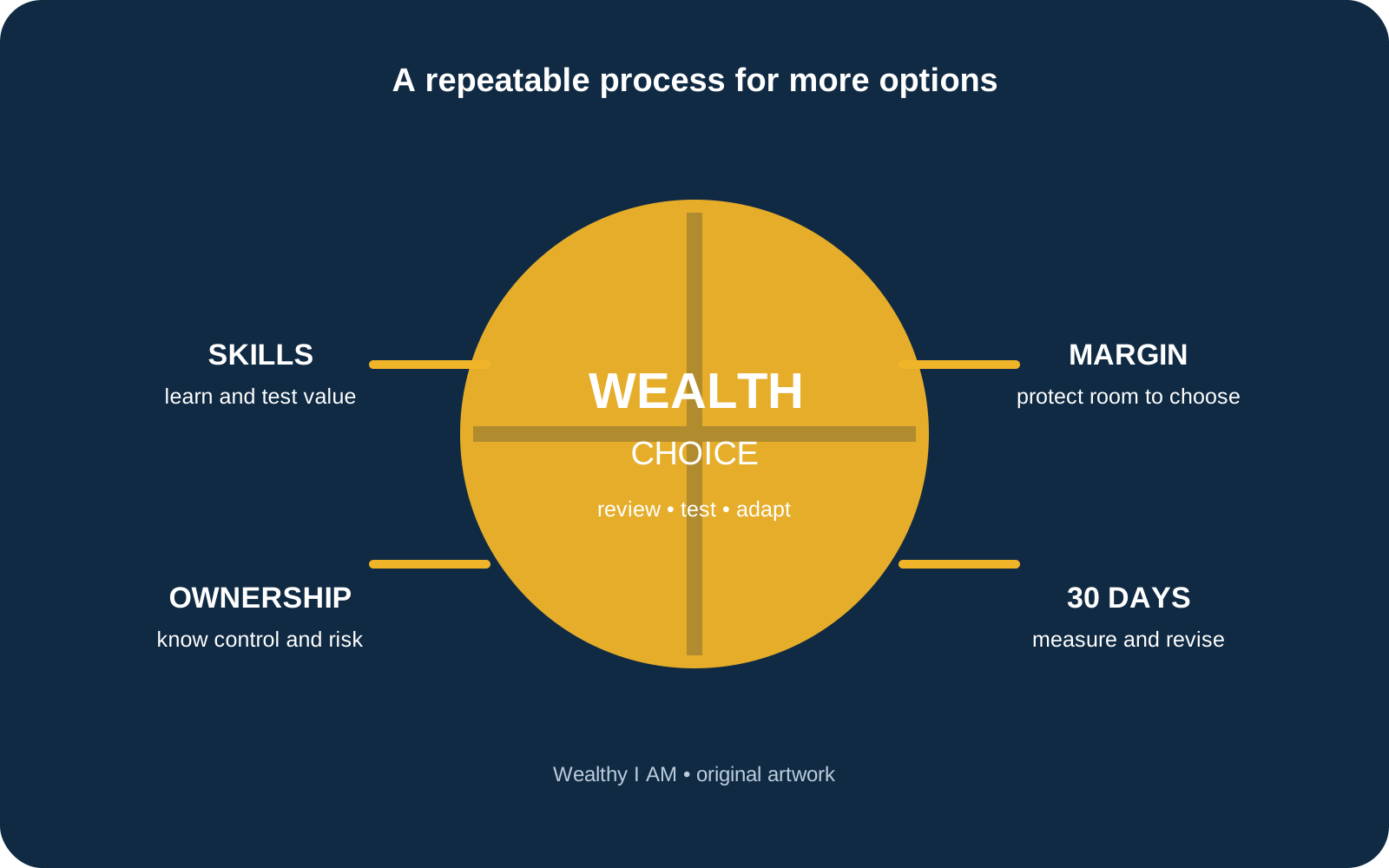
A budget shows where money went. A broader wealth process asks what those dollars make possible next. Does current spending leave a margin for emergencies or training? Does a new skill solve a problem people will pay to address? Does an ownership opportunity create a durable claim on value, or only add risk and obligations?
This is where the idea of choice becomes practical. The goal is not perfect control. It is to make important trade-offs visible, test assumptions, and keep enough resilience to recover when a plan fails.
7 practical lessons from The Wealth Choice
1. Treat education as an asset you can use
Financial education is valuable when it changes the quality of your decisions. Memorizing terminology is less important than learning to ask where money comes from, where it goes, what fees apply, and who carries the downside.
Try this: Schedule a short weekly money review. List account balances, debt interest rates, recurring charges, savings contributions, and one item you do not understand. The first goal is not to forecast returns; it is to identify the next question that needs an answer.
2. Build a skill around a real problem
A skill does not guarantee higher income. It can, however, improve the value you offer and widen the range of work you can attempt. The key is to connect learning with evidence instead of collecting credentials without testing their usefulness.
Choose one problem close to your current work or community. Build a small sample, ask someone knowledgeable for feedback, and revise it. A spreadsheet that clarifies a business’s cash position or a short sample that demonstrates a service is an experiment—not proof that clients or sales will follow.
3. Separate ownership from leverage
Ownership means having a claim on an asset or business. Leverage means using borrowed money, technology, a platform, or another resource to extend your reach. They can work together, but they are not the same, and neither is automatically safe.
Ownership may be illiquid or lose value. Financial leverage creates an obligation and can magnify losses as well as gains. Before acting, write down what you control, what you do not control, and the single failure that would hurt most. Do not borrow merely because ownership sounds like a wealth-building move; read the terms and test whether you could survive a bad outcome.
4. Protect the margin between earning and spending
Higher income does not automatically produce wealth if every increase becomes a new fixed commitment. The margin left after necessary costs is what creates room for a cash buffer, debt reduction, education, or long-term investing.
Use a simple three-bucket review: immediate needs, future options, and discretionary spending. There is no universal percentage that fits every household. The useful part is seeing whether today’s commitments leave any capacity for tomorrow.
5. Make values part of the plan
A financial plan can be mathematically tidy and still conflict with the life it is meant to support. Wealth does not have to mean maximizing every dollar. It may also mean protecting time, health, relationships, generosity, or the freedom to leave a harmful situation.
Name one non-negotiable value, one financial goal, and one limit on what you will risk for that goal. This creates a decision rule for opportunities that look profitable but demand too much elsewhere.
6. Match saving and investing to the job the money must do
Saving and investing are not interchangeable. Money reserved for a near-term bill or emergency usually has a different job from money intended for a distant goal. Investing exposes money to market and price risk; diversification can reduce concentration, but it cannot eliminate losses.
Before investing, consider the time horizon, liquidity needs, high-interest debt, cash reserves, fees, taxes, and the amount of loss you can tolerate without abandoning the plan. Financial, tax, and legal decisions depend on personal circumstances and jurisdiction, so qualified professional guidance may be appropriate.
7. Measure the process, not only net worth
Net worth can be useful, but it is a lagging measure and can move with asset prices. A process scorecard shows whether the behaviors and safeguards under your control are improving.
Once a month, record one habit kept, one skill tested, one risk reviewed, and one action for the next month. Also note what changed outside your control. This turns progress into a feedback loop rather than a verdict on your character or a prediction of future wealth.
A 30-day wealth-process review
Use this short exercise to turn the ideas into a test:
- Map the present: List income, fixed costs, variable costs, debt, cash reserves, and near-term obligations.
- Choose one capacity: Select one skill to develop and one real-world way to test whether it creates value.
- Stress the downside: Write what could go wrong, what you would lose, and what would make you stop.
- Protect a value: Check whether the plan leaves reasonable room for health, time, and relationships.
- Define evidence: Choose one observable result to review after 30 days.
- Revise one assumption: Keep what worked, change what did not, and avoid rebuilding the entire plan from one result.
The purpose is not to become wealthy in a month. It is to create a repeatable review that makes your choices and constraints clearer.
Mistakes to avoid
- Treating millionaires as a single group: Their industries, starting points, access, obligations, and timing differ.
- Confusing income with wealth: Revenue or salary is not the same as durable assets, liquidity, or financial resilience.
- Mistaking discipline for control: A sound process can improve decisions, but it cannot control markets, employers, health events, or economic conditions.
- Borrowing because ownership sounds wealthy: Debt adds a fixed obligation even when the expected result does not arrive.
- Turning examples into guarantees: A reported outcome can illustrate a possibility without establishing a forecast for your household.
- Ignoring survivorship bias: Studying people who succeeded can hide those who made similar choices and did not receive the same outcome.
Frequently asked questions
Does The Wealth Choice guarantee a path to wealth?
No. The book’s subject and examples can prompt readers to examine education, enterprise, self-confidence, and financial choices, but no set of behaviors guarantees a millionaire outcome.
Is this perspective only for investors or entrepreneurs?
No. Employees and self-employed professionals can also apply it by improving skills, protecting cash-flow margin, evaluating risk, and deciding what forms of ownership fit their circumstances.
What should a beginner do first?
Start with one money review and one low-cost skill test. Understand your obligations and capacity for loss before taking investment or borrowing risk.
How should I use stories about millionaires?
Use them to generate questions, not formulas. Ask what conditions helped, what risks were taken, what failures are missing from the sample, and which parts of the story do not transfer to your situation.
Conclusion: build a process you can repeat
The Wealth Choice is most useful as an invitation to examine the choices that shape capability, cash margin, ownership, and resilience—not as a shortcut or a promise. A sensible next step is small: write down one choice that could expand your future options, one constraint you must protect, and one result you will review in 30 days.
This article provides general education, not individualized financial, investment, tax, or legal advice.
Sources and further reading
<small> <ul> <li><a href="https://openlibrary.org/works/OL20683645W">Open Library work record: <em>The Wealth Choice</em></a></li> <li><a href="https://openlibrary.org/books/OL27967348M">Open Library edition record: <em>The Wealth Choice: Success Secrets of Black Millionaires</em></a></li> <li><a href="https://openlibrary.org/authors/OL2677997A">Open Library author record: Dennis Kimbro</a></li> </ul> </small>