If your financial plan works only when motivation is high, the plan is fragile. A busy week, an unexpected bill, or a tempting purchase can push a long-term goal out of view. The useful question is not whether you can feel motivated every day. It is whether your next money action is clear enough to repeat.
The Psychology of Achievement by Brian Tracy is a broad personal-development and goal-setting book, first published in 1984 according to the catalog record cited below. It is not a portfolio manual, tax guide, or individualized financial plan.
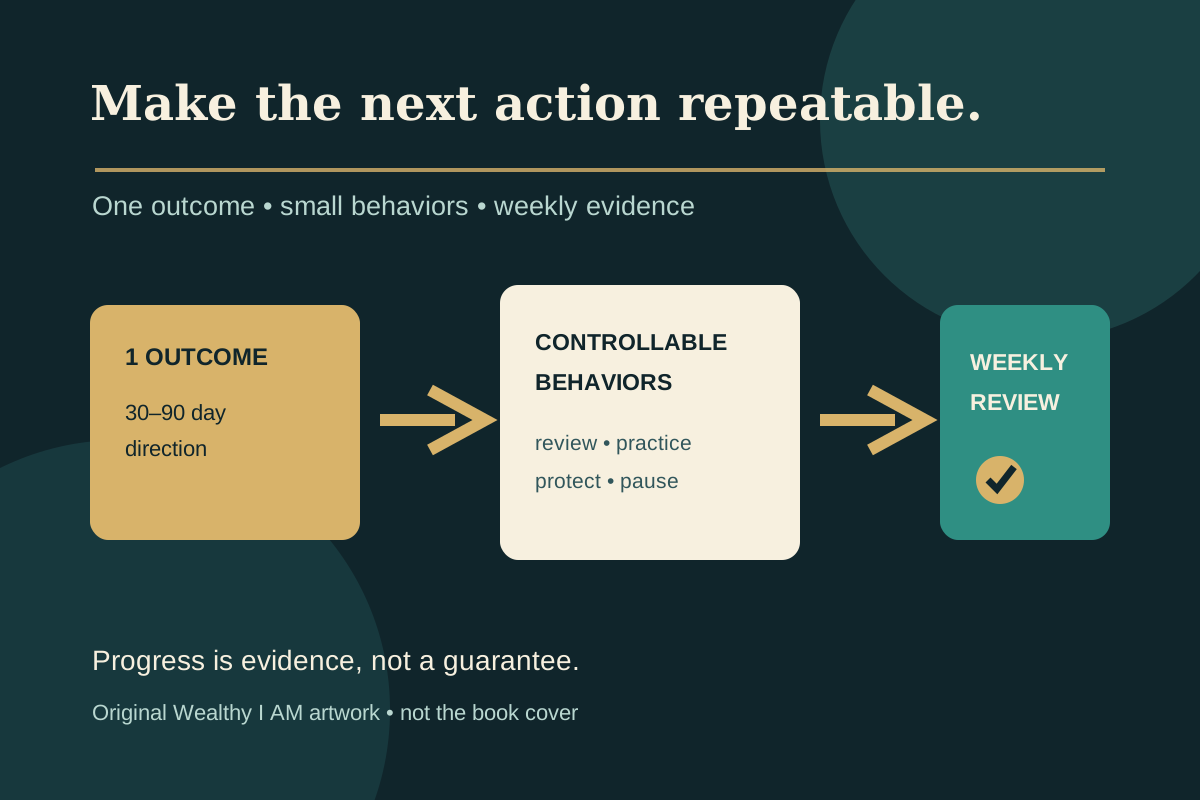
The short answer: Convert one broad ambition into a written outcome, a small set of controllable behaviors, and a regular review. That process cannot guarantee wealth, but it can make follow-through easier to observe and improve.
The four lessons below are a Wealthy I AM application of the book’s broad themes—not a verified chapter-by-chapter outline or a claim that Tracy prescribes these exact money workflows.
Image credit: Open Library Covers API. Exact cover identity was checked against the catalogued work; reuse terms should be confirmed before publication. Source: Open Library cover record.
What The Psychology of Achievement is about
Tracy’s book connects achievement with goals, self-image, habits, learning, relationships, and personal responsibility. For wealth-building readers, its value is mainly behavioral: earning, saving, learning, and investing all require decisions repeated over time.
The limitation is equally important. Discipline cannot remove market risk, job loss, business risk, inflation, taxes, health constraints, or emergencies. A consistent process can support better decisions, but it does not control every financial outcome.
Four practical lessons for better money follow-through
1. Define a result, not a vague wish
“Build wealth” is directionally useful but operationally weak. A result gives you a time frame and a visible next step: “By the end of this month, I will review recurring expenses and choose one change that fits my cash flow.”
Write one outcome for the next 30–90 days. Then list what is outside your control—market returns, another person’s decision, or an employer’s timing—and what is inside it, such as reviewing a fee, learning a skill, or making a planned transfer.
Example: A reader who wants higher income might choose “complete three portfolio samples and request feedback from two people in my field,” rather than “earn more soon.” This is a planning illustration, not a forecast.
2. Track behaviors before judging results
Results can lag. A new skill may take time to produce income; a diversified investment may rise or fall for reasons unrelated to one week’s decisions. Tracking only the outcome can create overconfidence after a lucky result or discouragement after an unlucky one.
Track a few behaviors you can repeat: a weekly spending review, a learning session, a debt-payment check, a written investing decision rule, or a conversation about a career opportunity. Keep the list short enough to maintain.
A simple scorecard can ask:
- Plan: Did I write the next action?
- Protect: Did I preserve cash needed for near-term obligations?
- Practice: Did I build a skill or review a decision?
- Pause: Did I avoid acting solely from fear, urgency, or excitement?
A scorecard is a feedback tool, not a measure of your worth.
3. Design a cue and a low-friction action
A goal competes with the environment around it. If the first step requires searching through statements, remembering a password, and making several decisions, postponement is predictable. Attach the action to a stable cue—such as a weekly calendar review—and prepare the smallest useful version.
For example, the first step in a spending review can be opening the last 30 days of transactions and marking recurring commitments. The first step in a career plan can be identifying one skill requested in relevant job descriptions. The first step in an investing review can be checking whether your written allocation still matches your time horizon and risk capacity—not reacting to a headline.
These are Wealthy I AM applications, not claims that Tracy prescribes these exact workflows.
4. Review without turning a miss into an identity
A missed action is information. Ask: Was the action unclear, too large, badly timed, or incompatible with current health, caregiving, work, or cash-flow constraints? Adjust the system before adding self-criticism.
A useful weekly review has three questions:
- What did I intend to do?
- What actually happened, and what evidence do I have?
- What is the next smallest action that still matters?
If the plan requires sacrificing sleep, safety, essential bills, or medical care, it needs redesign. Discipline is not a reason to ignore legitimate limits.
A 20-minute achievement-to-money reset
Use this as an educational worksheet, not a guarantee or a substitute for professional advice. It is an original Wealthy I AM application, not a claim about Tracy’s exact method.
- Two minutes: Write one financial or career outcome for the next 30–90 days.
- Five minutes: List three controllable behaviors that support it.
- Five minutes: Choose one cue and put the action on your calendar.
- Three minutes: Name one foreseeable obstacle and a safer fallback.
- Five minutes: Decide how you will review the behavior once a week.
A hypothetical example: someone wants to create more saving capacity. Their first behavior might be a weekly cash-flow check; their fallback might be a 10-minute review when the full session is not possible. The exercise does not predict a savings amount and does not tell every reader what to cut.
Mistakes to avoid
Treating motivation as a financial strategy
Motivation varies. A plan should not require constant enthusiasm, and it should leave room for rest and recovery.
Copying a book’s confidence as a guarantee
A motivational framework can encourage action, but it cannot guarantee income, investment returns, debt elimination, or business success.
Measuring only money
Income and balances matter, but so do liquidity, risk, time, health, relationships, and the ability to sustain the plan.
Turning a miss into a moral verdict
Review the system. Do not infer your character from one missed transfer or unfinished task.
Frequently asked questions
Is The Psychology of Achievement an investing book?
No. It is a broad personal-growth and achievement title. This article applies its themes cautiously to money behavior; it does not turn the book into investment advice.
What is the best first action after reading it?
Write one outcome for the next 30–90 days and one behavior you can review weekly. Start small enough that the action remains possible during an ordinary difficult week.
Can discipline guarantee financial success?
No. Discipline can support preparation and consistency, but outcomes also depend on economic conditions, opportunities, health, taxes, costs, risk, and chance.
Should I follow every recommendation in a motivation book?
No. Test ideas against your obligations, risk tolerance, legal and tax context, health, and values. A qualified professional can help with individualized financial, tax, or legal questions.
Sources and further reading
- The Psychology of Achievement on Open Library — bibliographic identity and catalogued work.
- Google Books search for The Psychology of Achievement by Brian Tracy — supplementary source discovery.
- Open Library Covers API image source — cover provenance; reuse permission should be confirmed.
A grounded next step
Choose one outcome, one behavior, and one weekly review. Keep the action compatible with your real cash flow and life constraints. If the system survives an ordinary week—not just an inspired day—it is giving you useful evidence.
CTA: Save this worksheet, schedule the first review, and revisit the plan before making any significant financial decision.