If your income depends on one job, one client, or one product, the problem may not be a lack of ambition. It may be that you have not separated an attractive idea from a repeatable business model. The Millionaire Maker’s Guide to Creating a Cash Machine for Life by Loral Langemeier addresses that entrepreneurial question: how might useful opportunities become income-producing activities?
The short answer
Treat additional income as a testable system, not a promise of effortless cash. Define a customer problem, specify the offer, calculate the work and costs, test demand with a small commitment, and review whether the result is worth continuing. The book’s “cash machine” language is best read as a business-building metaphor—not a guarantee of passive income or wealth.
This article is a Wealthy I AM synthesis of the book’s broad topic, not a reconstruction of its exact chapter framework. It is general education, not individualized financial advice.
Who this book may help—and what it cannot promise
The available book record describes a guide to building a business, testing sales potential, developing a team, and managing areas such as marketing, operations, finance, and growth. That broad scope may interest a worker considering a side business, a founder looking for another revenue stream, or an owner trying to turn scattered opportunities into a plan.
It is not a substitute for customer research, bookkeeping, legal review, tax advice, or a realistic assessment of available time. A recurring-income idea still has operating costs, customer-acquisition work, delivery obligations, competition, and uncertainty. Multiple streams can also mean multiple responsibilities. A second activity is only helpful if it improves your situation after time, cash, risk, and complexity are considered.
Four practical lessons for testing an income-producing system
The four lessons below are editorially organized applications of the book’s broad subject, not claims about its verified numbered framework.
1. Start with a customer problem, not a product fantasy
An idea becomes commercially meaningful when a specific group recognizes a problem and may pay to solve it. “I want another income stream” describes the owner’s goal, not the customer’s need.
Write: “For [specific customer], [recurring problem] causes [cost, delay, frustration, or risk].” Then describe the smallest useful offer. Ask potential customers what they do now, what they have tried, and what a satisfactory result looks like. Polite enthusiasm is not proof of demand.
Before building a website, buying equipment, or committing to a subscription, seek a small and ethical signal of demand, such as a paid pilot or clearly defined trial. Respect consumer-protection rules and never misrepresent the offer.
2. Turn cash flow into a simple operating model
Cash flow is money moving into and out of an activity. It differs from revenue, which is money earned from sales, and from profit, which remains after relevant expenses. A business can make sales while still needing cash for supplies, refunds, contractors, taxes, debt payments, or delayed invoices.
Make a plain table showing the customer and offer, price and payment timing, direct delivery costs, recurring costs, hours required to sell and deliver, refund or compliance risks, and the reserve needed before the activity is stable. This is a decision screen, not a forecast. If an assumption is unknown, mark it unknown.
3. Build repeatability before chasing scale
A process is repeatable when another occurrence can be delivered with a similar method, quality standard, and cost structure. That does not mean guaranteed revenue; it means you can inspect what happened and learn.
Document the customer promise, intake, delivery checklist, follow-up, payment collection, and quality checks. Run a small number of iterations. Compare actual time and cost with the assumptions. If every sale requires a custom rescue effort, the activity may be a job rather than a system. That can still be valid, but evaluate it honestly.
Choose one offer, one customer segment, and one 30-day test window. Set a maximum cash and time budget before starting. Continue only if the test provides evidence of customer value and the economics remain acceptable after real costs.
4. Protect the core while exploring the next opportunity
Adding an income activity can expose a household or business to new risk. Do not use emergency savings, essential bill money, or unaffordable borrowing for an unvalidated experiment. Consider whether the project could damage an existing job, client relationship, or health.
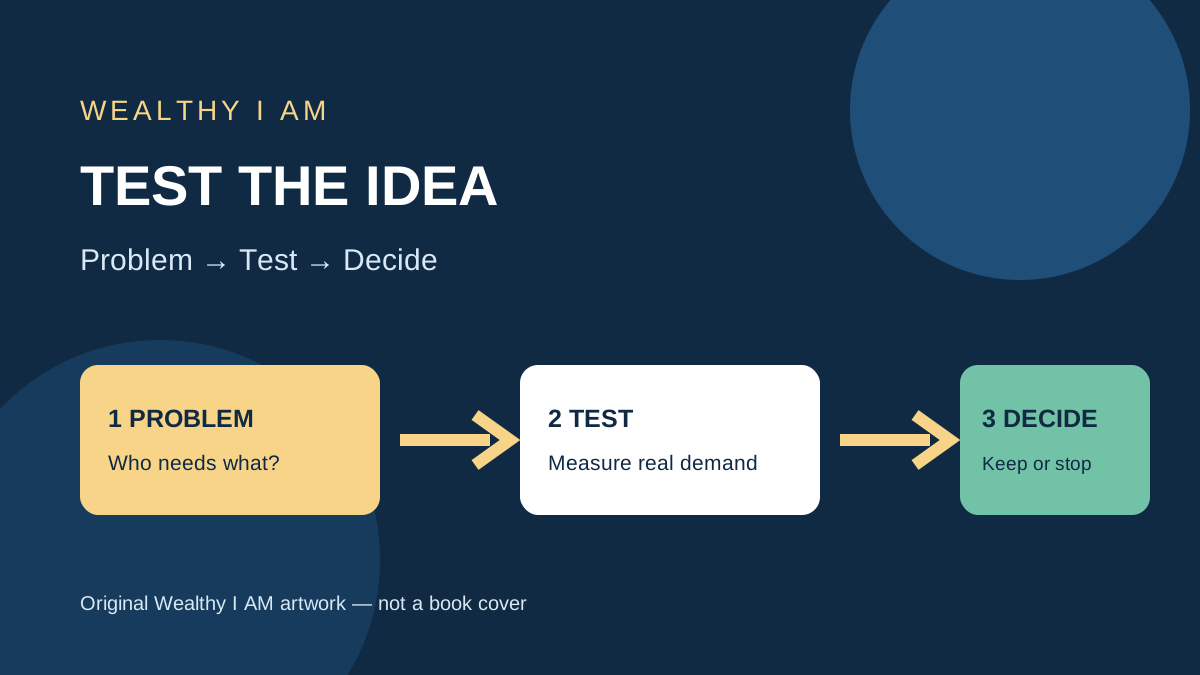
Use a simple protect, test, decide sequence:
- Protect: keep essential obligations, reserves, insurance, records, and commitments visible.
- Test: limit scope, budget, and time; learn from actual delivery rather than an attractive plan.
- Decide: continue, modify, pause, or stop using pre-set criteria.
Stopping a weak experiment is not a personal failure. It prevents a small uncertainty from becoming a large commitment.
A practical 45-minute income-idea screen
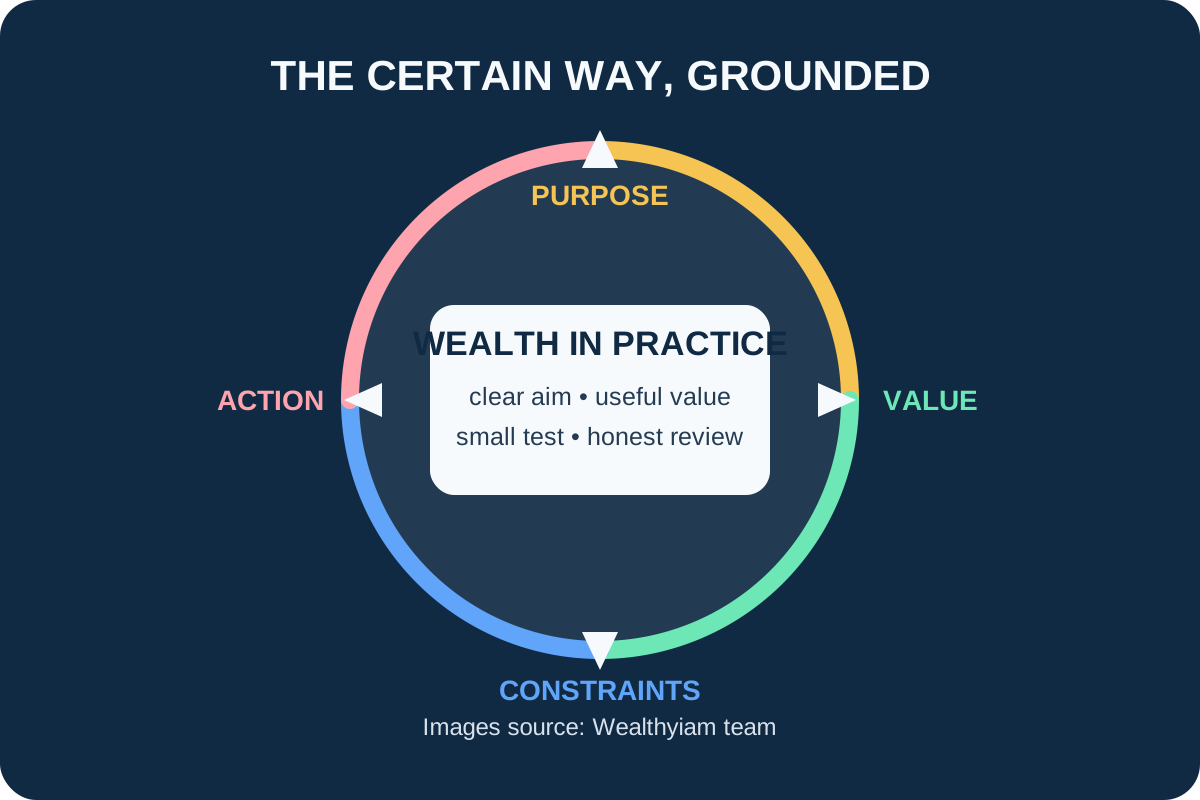
Choose one idea and write:
- Problem: Who has it, and how do you know?
- Offer: What result will you deliver, and what is outside scope?
- Evidence: What have people actually done—not merely said—to show interest?
- Economics: What are price, direct costs, time cost, and payment timing?
- Constraints: Which legal, tax, safety, insurance, licensing, or platform rules may apply?
- Stop rule: What evidence would make you pause or redesign the idea?
For example, a hypothetical designer might consider a monthly service for a narrow group of local businesses. Before buying tools, the designer could interview potential customers, offer a limited pilot, measure hours per delivery, and compare collected payments with direct costs. This is illustrative only; it establishes neither demand nor profitability.
If the activity passes the screen, the next step is not automatically expansion. It may be a second small test with clearer pricing, delivery limits, and records.
Mistakes to avoid
Calling revenue profit
Sales are not money available to spend. Track collection timing and expenses separately, and set aside money for obligations under current local rules and professional advice.
Starting several streams at once
Several experiments make learning difficult and multiply fixed costs. Begin with one bounded test unless there is a compelling reason not to.
Treating a framework as a guarantee
A book can offer a lens; it cannot remove competition, execution risk, or personal constraints. Be skeptical of any claim that implies a predictable outcome from following a formula.
Borrowing before validating
Debt magnifies gains and losses. A plan that depends on optimistic sales deserves independent scrutiny before borrowing or signing a long-term contract.
Ignoring the value of the owner’s time
If an activity produces cash but consumes unsustainable hours, it may not improve financial independence. Include selling, administration, support, and recovery time.
FAQs
Is this a passive-income plan?
The title emphasizes recurring or cash-producing activity, but a real business requires some combination of creation, marketing, delivery, administration, and risk management. Treat “passive” as a claim to examine.
How many income streams should a beginner build?
There is no universal number. One affordable, understood experiment may be easier to evaluate than several simultaneous projects. Scope should fit obligations, skills, time, reserves, and risk capacity.
Can I apply the ideas without starting a business?
Yes. The problem-and-evidence process can evaluate freelance work, a career skill, a productized service, or expanded responsibility at an existing employer. The application should fit your circumstances.
Does a cash-producing activity guarantee wealth?
No. Revenue, profit, and long-term wealth are different outcomes. Results depend on demand, costs, taxes, competition, execution, and circumstances outside your control.
A grounded next step
Pick one income idea and complete the six-part screen before spending meaningful money. If the problem is unclear, interview more people. If economics are unclear, measure a small pilot. If risk is unacceptable, stop. The goal is not to force a “cash machine”; it is to learn whether a useful, repeatable activity can responsibly earn its place in your financial life.
Sources / Further reading
Book record: Open Library record for The Millionaire Maker’s Guide to Creating a Cash Machine for Life. This supports bibliographic identity and the broad public description used here; it does not independently verify every practical interpretation.
Image credit: Open Library Covers API cover image. Cover provenance and reuse terms should be checked before publication.