If your money feels scattered across bills, debt, saving, insurance, and investing, the problem may be sequencing rather than a missing hot tip. Personal Finance for Dummies by Eric Tyson presents a broad beginner’s map of budgeting, spending, debt, saving, taxes, insurance, investing, and financial goals.
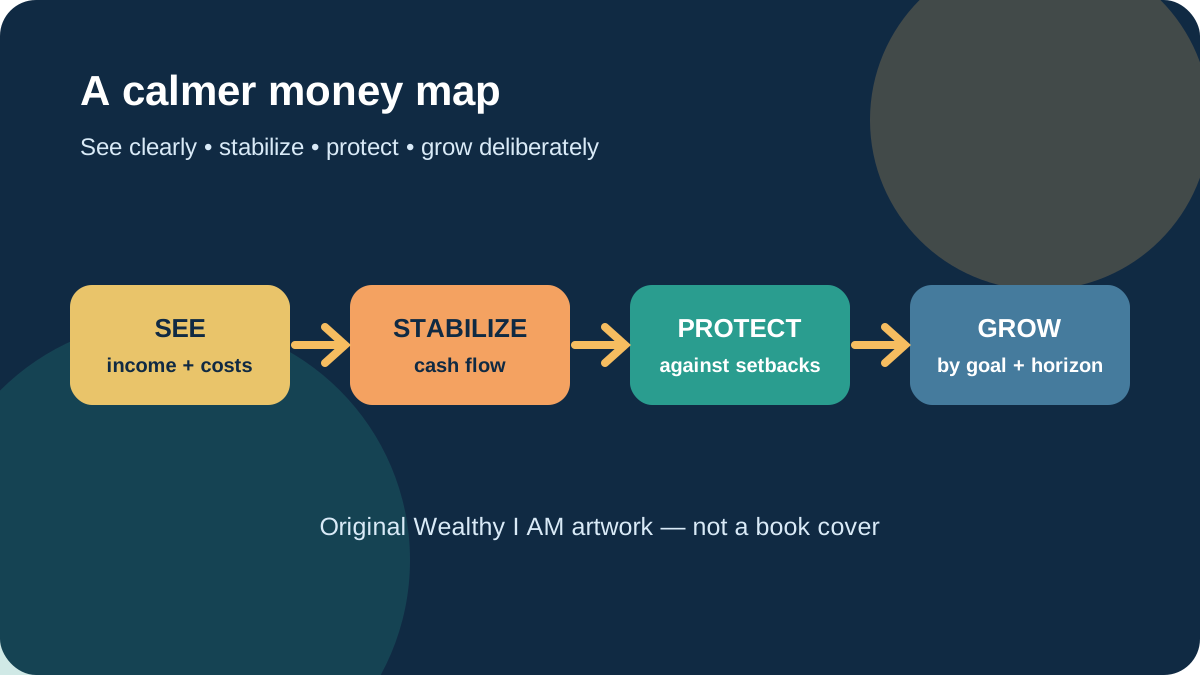
Short answer: see clearly, stabilize cash flow, protect against major setbacks, and only then grow money according to a goal and time horizon. That sequence is a Wealthy I AM synthesis of the book’s documented scope—not a claim that Tyson presents these exact four numbered steps—and it is not individualized financial advice.
What the book covers
Open Library’s work description identifies Tyson’s guide as covering expenditure tracking, spending reduction, high-interest debt, investing basics, risks and returns, investment options, saving for major goals, and taxes. Its value for a beginner is breadth: investing is not treated as the entire wealth problem. Cash flow, debt, protection, taxes, and goals all affect which financial decision is sensible.
The specific rules and products discussed in any edition may become dated or vary by country. Use the book for orientation, then verify current tax, legal, insurance, and investment details with authoritative sources or a qualified professional.
Four practical lessons for organizing your money
1. Build a one-page money map
Record monthly take-home income, essential and flexible spending, recurring and irregular costs, debts, liquid savings, insurance, and long-term accounts. Mark unknowns as “verify” rather than guessing. A budget is a planning tool, not a moral scorecard.
Try this: review one complete month, list each debt with its balance, interest rate, minimum payment, and due date, then identify one missing fact that would improve your next decision.
2. Stabilize cash flow before optimizing
A plan that excludes annual insurance, maintenance, gifts, subscriptions, or fees is incomplete. Before choosing an ambitious saving transfer, check that essential bills and predictable irregular costs are covered. A repeatable modest action is usually more useful than a plan that works only in an unusually good month.
3. Protect the plan from setbacks
Protection can include liquidity, fraud controls, insurance, and preparation for loss of income or other large costs. Insurance transfers selected risks to an insurer under stated terms; suitability depends on circumstances, exclusions, deductibles, cost, and local rules.
A useful Wealthy I AM application is to ask what could break the plan and classify each risk as something to prevent, self-fund, transfer, or consciously accept. This is a decision aid, not a recommendation to buy a product.
4. Give each investment a job
Investing commits money to assets whose value can rise or fall. Before comparing investments, write down the goal, time horizon, liquidity need, costs, tax context, and ability to tolerate loss. Diversification—spreading exposure across investments—can reduce concentration risk, but it cannot eliminate loss or guarantee returns.
Ask: What is this money for? When might it be needed? What loss could I tolerate? What fees and restrictions apply? What evidence would change my mind? A book summary can explain decision factors, but it cannot determine what suits your circumstances.
A 30-day beginner plan
Week 1—inventory: collect balances, debt terms, bills, subscriptions, insurance documents, and recent spending.
Week 2—stabilize: choose one verifiable action, such as planning for an irregular bill, cancelling an unused recurring cost, or setting a modest transfer.
Week 3—goals and risks: write one near-, medium-, and long-term goal. Give each a time horizon and name the main risk that could interfere.
Week 4—review: compare planned with actual cash flow and document the next decision. For investing, record the reason, risks, costs, and evidence that would change your view.
Hypothetical example—not a forecast
A household discovers that its monthly plan excludes annual insurance and vehicle maintenance. Its first step may be to plan those costs and review liquidity or expensive debt—not to buy a sophisticated investment. This example makes no return prediction and is not a universal prescription.
Mistakes to avoid
- Treating a broad guide as current local tax, legal, insurance, or investment advice.
- Optimizing a portfolio before understanding cash flow and debt terms.
- Copying a percentage without considering income, obligations, goals, and risk capacity.
- Ignoring fees, taxes, leverage, illiquidity, concentration, and possible loss.
- Using shame instead of a visible, repeatable process.
Who should read it?
The book suits beginners who want a broad map before studying a narrower topic. Readers with complex tax, legal, estate, business, insurance, debt, or investment situations may need current professional guidance. The book—and this article—cannot know your facts.
FAQs
Is Personal Finance for Dummies good for beginners?
Yes, as an accessible overview of connected money topics. Verify current rules and treat guidelines as starting points, not personal recommendations.
Should I pay off debt before investing?
There is no universal answer. Consider debt cost, liquidity, employer benefits, taxes, goals, and risk capacity; seek tailored advice when appropriate.
Can it tell me what to invest in?
It can explain concepts and decision factors, but neither the book nor this article can determine what suits your circumstances.
What can I do today?
Make the one-page money map, choose one small stabilizing action, and schedule a review date.
Conclusion
Personal Finance for Dummies is most useful as an orientation to connected money decisions. Its practical lesson is not to chase a single clever tactic: see clearly, stabilize what is fragile, protect what matters, and grow deliberately according to the job of the money. Open a blank page today and mark unknowns as “verify.” Reading a summary or a book cannot guarantee wealth or replace advice tailored to your circumstances.
Sources / further reading
Book identity and scope: Open Library work record; edition record: Open Library edition record.
Image credit: Open Library Covers API, cover ID 521604. Publisher should confirm reuse terms and featured-media attachment before publication.
Current tax, legal, insurance, and investment details require separate authoritative verification.