\n
Search intent: what this guide answers
If you searched for a Range summary, you likely want to know what David Epstein means by “generalists,” whether the idea applies to work and wealth, and what to do if your path feels scattered. This article answers those questions without treating a book summary as a career or investment prescription.
Who this is for: Readers considering a career change, business experiment, or broader skill portfolio who want a practical interpretation rather than a chapter-by-chapter reconstruction. The article is about 1,700 words and can be read in roughly eight minutes.
The problem: a narrow path can feel safe until the world changes
Many people assume the fastest route to opportunity is choosing one specialty early and repeating it forever. That can work in some fields, but it can also leave a person exposed when technology, employers, industries, or personal interests change. The harder problem is knowing how to explore broadly without becoming permanently unfocused.
Why it matters for wealth
Income and financial resilience are influenced by skills, judgment, relationships, and the ability to adapt—not only by selecting an investment. Transferable skills can help someone learn a new role, communicate across disciplines, assess opportunities, or build a small business. None of that guarantees higher income, and personal circumstances, market conditions, and risk capacity still matter.
The honest curiosity gap
Range is often reduced to “be a generalist.” That is too simple. The more useful question is when breadth improves judgment, when specialization is valuable, and how to combine exploration with deliberate practice. The answer is a portfolio of skills: broad enough to see connections, focused enough to produce useful work.
The early answer and promise
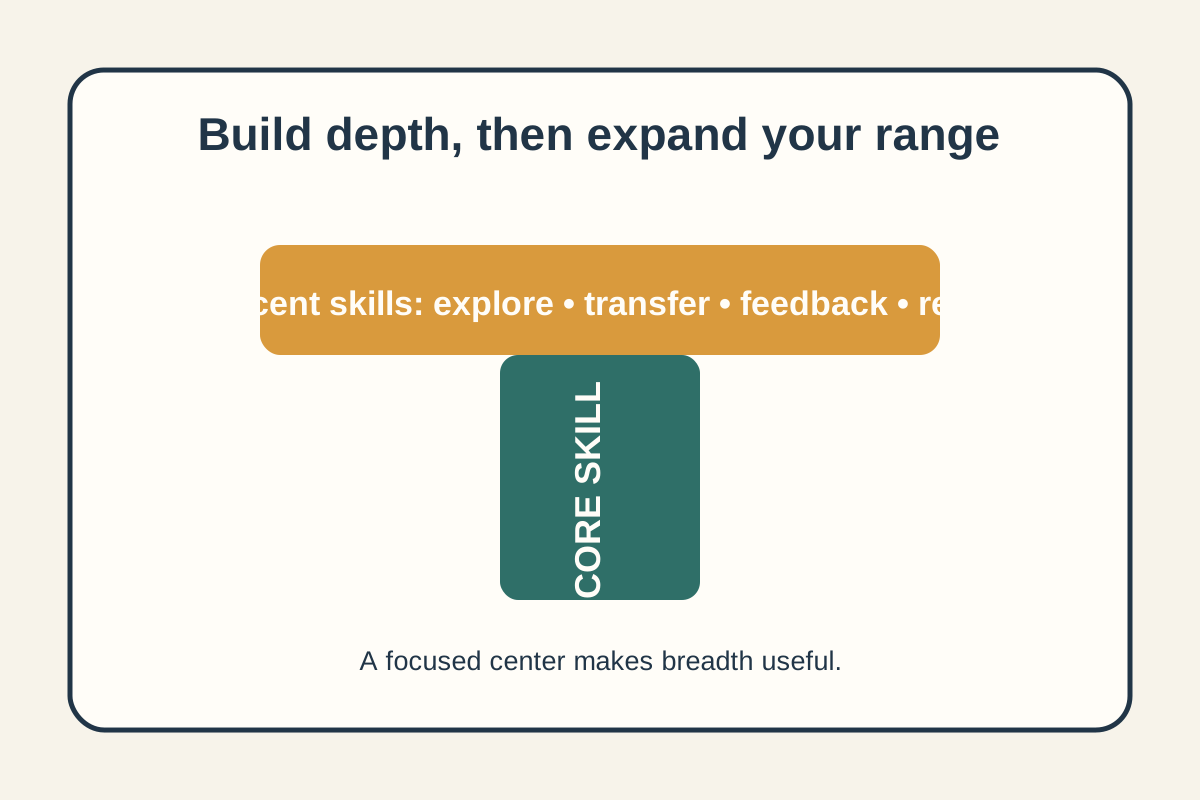
The practical answer is to build a T-shaped capability: develop one or two areas deeply enough to create value, then add adjacent skills that improve judgment and collaboration. The seven lessons below are a Wealthy I AM synthesis of the book’s broad theme, not a claim that Epstein presents this exact numbered framework. You will also get an ordered experiment, a hypothetical example, mistakes to avoid, FAQs, and one low-risk next step.
> Evidence boundary: The research inventory verifies the book’s identity, author, publication context, and broad subject: how generalists can benefit in a specialized world. The applications and seven-part structure below are original Wealthy I AM interpretation. They are not a reconstruction of every chapter, study, or example.
What Range is about—and what it does not promise
Google Books identifies Range: Why Generalists Triumph in a Specialized World as a 2019 Riverhead Books work by David J. Epstein. Its description argues that broad experience can be valuable, particularly in complex and unpredictable environments. Open Library independently identifies the same title, author, subtitle, and 2019 publication year.
The book is not a promise that specialization is bad, nor does it establish a universal formula for earning more. A reader should treat it as a lens for evaluating learning and career choices. The examples and applications below should not be mistaken for individualized career, business, or investment advice.
Seven practical lessons for building a more adaptable career
1. Delay irreversible narrowing when the cost of exploration is low
Book-related idea: Early specialization is not automatically the best route for every person or domain.
Wealthy I AM application: Before committing years, debt, or reputation to one path, run small tests. A short course, volunteer project, conversation with a practitioner, or paid pilot can reveal fit more cheaply than a dramatic leap.
Action: List one career or business direction you are considering and design a two-week test with a defined output.
2. Build a deep skill that gives your breadth a center
Breadth is not a substitute for competence. Choose a core capability—such as writing, analysis, sales, design, operations, or a technical skill—and practice it enough to become useful. Then add adjacent abilities that make the core more valuable.
Action: Write a one-sentence description of your core skill and three complementary skills that help a real person or business.
3. Transfer patterns instead of collecting unrelated facts
A generalist creates value when knowledge from one setting improves a decision in another. Ask: “Where else have I seen this constraint, incentive, failure mode, or customer problem?” This turns learning into judgment rather than trivia.
Action: Keep a weekly transfer log with one lesson from work, money, or study and one different context where it might apply.
4. Prefer learning environments that provide honest feedback
A skill grows when you can observe the result of an action and adjust. If feedback is vague or arrives years later, use smaller cycles: ship a draft, test an offer, review a decision, or ask a customer what was confusing.
Action: For your next project, define the earliest observable signal that would tell you to continue, change, or stop.
5. Use comparison across fields to challenge hidden assumptions
People often inherit rules from one profession and apply them everywhere. Comparing industries can expose assumptions about pricing, incentives, quality, or risk. This is useful for entrepreneurs and investors, but analogies are prompts for investigation—not proof.
Action: Take one important assumption in your plan and ask how a different industry would test it.
6. Keep a decision journal, not just a results journal
A good outcome can come from luck; a poor outcome can follow a reasonable decision. Record the choice, assumptions, alternatives, confidence level, and information that would change your mind. Review the reasoning later without pretending you could have known the future.
Action: For a material money or career decision, write a one-page pre-mortem and a review date. This is education, not individualized investment advice.
7. Combine exploration with a clear economic constraint
Exploration costs time and sometimes money. Set a boundary: a monthly learning budget, a limited number of experiments, or a date by which a project must produce evidence of usefulness. Constraints protect curiosity from becoming avoidance.
Action: Choose one exploration project, its maximum cost, its weekly time limit, and the evidence required before expanding it.
A four-step Wealthy I AM experiment
- Map: Write your core skill, adjacent skills, interests, and current constraints.
- Test: Select one small project that creates a real deliverable for a real audience.
- Review: Record what happened, what you expected, and which assumption changed.
- Integrate: Keep, modify, or stop the project; then decide what skill deserves deeper practice.
Hypothetical example: Suppose Maya works in customer support and is curious about analytics. She might spend two weeks turning anonymized, non-confidential support themes into a simple practice dashboard, ask a manager what would make it useful, and compare the feedback with her original assumptions. This does not predict a promotion or income increase; it simply creates evidence before a larger commitment.
Mistakes to avoid
- Treating “generalist” as permission to avoid mastering anything.
- Copying a book’s broad idea as though it were a guaranteed career formula.
- Spending heavily on courses before testing whether the skill solves a real problem.
- Using an analogy as evidence for an investment or business decision.
- Confusing constant novelty with deliberate exploration.
- Ignoring sleep, health, caregiving, debt, or other constraints that affect a safe experiment.
FAQs
Is Range against specialization?
No. The useful distinction is between specialization that fits the environment and premature narrowing that prevents learning. Many people need depth and breadth at different stages.
Can generalist skills build wealth?
They may improve adaptability, communication, and problem-solving, but there is no guaranteed financial result. Income depends on demand, execution, negotiation, opportunity, and circumstances.
What should I learn first?
Start with a skill connected to a real problem you can observe. Pick a small project, define the output, and use feedback before buying an expensive program or changing careers.
How long should an experiment last?
Long enough to produce meaningful evidence, but short enough that failure is affordable. Two weeks is a hypothetical starting point, not a universal rule.
What related Wealthy I AM resources should I read?
See <a href="https://wealthyiam.com/the-great-ceo-within-by-matt-mochary-practical-lessons-for-building-a-more-resilient-company/">guide to building a small business</a> and <a href="https://wealthyiam.com/the-coaching-habit-by-michael-bungay-stanier-summary-seven-questions-and-practical-work-applications/">practical guide to focused work</a>. For money decisions, see <a href="https://wealthyiam.com/thinking-in-bets-annie-duke-better-money-decisions/">guide to decision-making under uncertainty</a>.
One useful next step
Open a blank page and write the four lines in the experiment above. Then choose one small test whose maximum cost you can comfortably absorb. If you want more practical book-based frameworks, explore the Wealthy I AM <a href="https://wealthyiam.com/thinking-in-bets-annie-duke-better-money-decisions/">Books and money lessons hub</a>.
Conclusion
The durable lesson of Range is not “ignore specialization.” It is to notice that a changing world rewards people who can learn, transfer ideas, and revise their path while still producing useful work. Build depth, explore deliberately, keep the cost of learning visible, and review decisions by their reasoning—not only their results. That approach cannot remove uncertainty, but it can help you make your next commitment more informed.
Sources
- Google Books: https://books.google.com/books/about/Range.html?id=TzG5wgEACAAJ
- Open Library search record: https://openlibrary.org/search.json?title=Range&author=David%20Epstein
- Open Library cover record: https://covers.openlibrary.org/b/id/8782615-L.jpg