Search intent: what readers want to know
If you searched for an *Investing Demystified* summary, you probably want two answers: what Lars Kroijer’s book argues, and what a beginner can do differently after reading it. This article offers a concise, practical interpretation—not a substitute for the book or individualized financial advice. The book is especially relevant to readers who want a long-term investing process without making frequent forecasts.
The problem: investing advice often rewards activity
A new investor can be pulled toward hot stocks, confident predictions, complicated products, and constant market commentary. Activity can feel like control, but it can also add costs, concentration, and emotional decisions. Kroijer’s broad challenge is to question whether an individual investor has a durable edge over a highly competitive market.
Why this matters
Investing is the process of putting money into assets with the hope of future value; risk is the possibility that the outcome is worse than expected, including permanent loss. A sound process has to work not only when markets rise, but also when prices fall, information is uncertain, and your attention is limited. The answer suggested by the book’s public identity and description is a deliberately simple baseline: diversify broadly, control what you can, and treat speculation as a choice rather than a requirement.
The short answer
The most useful takeaway is not “find the next winner.” It is: **build a diversified, low-cost plan around your goals, then add complexity only when you can explain its purpose and downside.** The seven lessons below are a Wealthy I AM synthesis of that idea, not a claim that Kroijer presents this exact numbered framework.
What the available evidence does—and does not—show
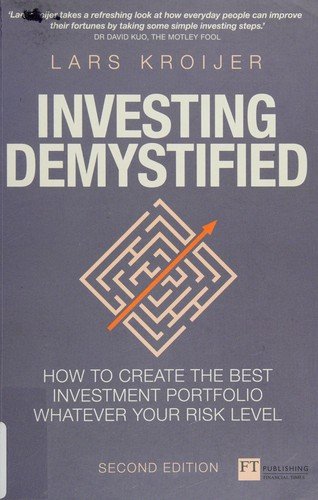
The selected work is *Investing Demystified: How to Invest Without Speculation and Sleepless Nights* by Lars Kroijer. Open Library identifies this work and its 2014 edition, and its records also list a later second edition with the subtitle *How to Create the Best Investment Portfolio Whatever Your Risk Level*. The selected image is the Open Library cover for that later second edition; it visibly identifies the same author and work. These records verify the work’s identity, subject, and edition context. They do not establish every chapter detail, quotation, performance claim, or exact sequence of recommendations. Accordingly, book-related statements here stay at the level of the central premise; the checklist and examples are original Wealthy I AM applications.
Seven practical lessons from the book's central idea
1. Start with a default plan, not a prediction
A default plan is the portfolio and behavior you will follow unless a clearly defined reason changes it. This reduces the pressure to predict the next market move. A plan might specify a savings rate, broad asset categories, a review schedule, and a rule for rebalancing—rebalancing means returning a portfolio toward its chosen mix after prices move.
**Wealthy I AM application:** write the default before reading market commentary. If you cannot state what would change your plan, you may be reacting rather than investing.
2. Diversification is a risk tool, not a promise
Diversification spreads exposure across investments so that one company, sector, country, or asset does not determine the entire result. It cannot remove market risk, inflation risk, currency risk, or the possibility of loss. It can, however, reduce dependence on one fragile thesis.
For a beginner, “broad and understandable” may be a more useful starting question than “exciting and high-growth.” The appropriate mix depends on time horizon, obligations, emergency reserves, tax position, and ability to tolerate losses.
3. Keep costs visible
Costs include fund expenses, trading spreads, commissions where applicable, taxes, and the cost of unnecessary turnover. A small fee difference may matter over a long period, but the exact effect depends on contributions, returns, taxes, and time. Do not treat a generic illustration as a forecast.
**Action:** before buying an investment, record its ongoing charges, transaction costs, and any restrictions in plain language. If you cannot locate them, pause and verify them from the provider’s current documents.
4. Separate investing from speculation
Investing generally starts with a reasoned claim about an asset’s future cash flows, value, or role in a portfolio. Speculation accepts more uncertainty about value in exchange for a hoped-for price movement. Neither label makes an activity automatically safe or unsafe; the distinction helps you name what you actually know.
A useful question is: “What evidence would prove my thesis wrong, and how much can I afford to lose if I am wrong?” If the answer is “I hope someone else pays more,” treat that exposure as speculative and size it accordingly—or omit it.
5. Match risk to the job of the money
Money needed soon has a different job from money invested for a distant goal. A portfolio can be theoretically diversified yet still unsuitable if a forced sale would be required during a downturn. This is a Wealthy I AM risk-management application, not a universal allocation rule.
**Action:** label each pool of money by purpose and approximate timing. Keep near-term obligations and emergency needs distinct from long-term growth capital, while checking local rules and professional guidance where relevant.
6. Make behavior part of the strategy
A plan that looks good on paper but causes panic selling may be a poor practical plan. Before investing, write down how you will respond to a substantial decline, a news-driven rally, or an unexpected expense. The goal is not emotional perfection; it is fewer decisions made under pressure.
A low-risk experiment is to run a written portfolio review for one month without changing holdings. Note what information triggers urgency. Then decide whether the portfolio, the information diet, or both need adjustment.
7. Let complexity earn its place
Complexity can be justified by a specific need, but it should not be used to create an illusion of sophistication. A new strategy should answer three questions: what problem does it solve, what could go wrong, and how will you know whether it helped after costs and taxes?
If you cannot answer those questions, keep the simpler baseline. Simplicity is not a guarantee of good results; it is a way to make assumptions and mistakes easier to see.
A four-step Investing Demystified workflow for beginners
- Define the job. Write the goal, time horizon, liquidity needs, and the loss you could realistically tolerate.
- Choose the baseline. Select a diversified approach you understand, and document its costs, risks, and maintenance rules.
- Create a speculation boundary. If you want to explore an individual asset or active strategy, set a limit in advance. This is a guardrail, not a recommendation or a guarantee.
- Review on schedule. Check whether the plan still matches the goal at a preselected interval. Avoid turning every headline into a portfolio decision.
A clearly hypothetical example
Imagine a reader, Sam, who has a long-term goal but no written plan. Sam creates a one-page policy: the goal, a broad diversified baseline, the maximum amount—if any—reserved for speculative ideas, and conditions that would trigger a review. This example is hypothetical. It does not predict returns, identify a suitable portfolio, or guarantee better behavior; it shows how to convert a principle into a decision process.
Mistakes to avoid
- Treating “diversified” as “cannot lose money.”
- Copying an allocation without checking your own time horizon and obligations.
- Ignoring fees, taxes, spreads, or currency exposure.
- Confusing a recent winner with a repeatable edge.
- Using leverage or borrowed money without understanding the possibility of rapid loss.
- Changing a long-term plan because of one headline.
- Presenting a book's historical discussion as current financial, tax, or legal advice.
- Calling a hypothetical result a forecast.
Frequently asked questions
Is Investing Demystified suitable for a beginner?
It is a useful starting point for someone trying to understand why a simple, diversified process may be preferable to constant prediction. A reader still needs current product documents and, when appropriate, qualified professional advice.
Does the book recommend never buying individual stocks?
This draft does not assert an exact universal rule without full-text verification. Its practical distinction is that individual-stock selection requires a reason, evidence, and acceptance of additional uncertainty; it should not be presented as a guaranteed path to outperformance.
Is diversification enough to make investing safe?
No. Diversification addresses concentration risk, not every risk. Prices can fall across a whole market, and investments can lose value.
How often should I review a plan?
There is no universal schedule. A preselected interval can reduce impulsive changes, but life events, major goal changes, or material risk changes may justify an earlier review.
One cautious next step
Download or create a one-page investment policy for yourself. Fill in the job of the money, the baseline approach, the costs you have verified, the risks you accept, and the situations that would make you pause. Do not buy anything merely because a summary made it sound attractive. **Use the page to ask better questions before you commit capital.**
Conclusion: invest with fewer assumptions
*Investing Demystified* points readers away from the exhausting search for certainty and toward a process that makes uncertainty visible. The Wealthy I AM synthesis is simple: define the job of the money, diversify thoughtfully, control costs, distinguish investing from speculation, and give complexity a burden of proof. The approach cannot eliminate losses or guarantee financial freedom. Its value is that it can make your decisions more explainable—and explainability is a useful defense against panic and hype.
Sources
- Open Library work record: https://openlibrary.org/works/OL20052365W
- Open Library search record: https://openlibrary.org/search.json?title=Investing%20Demystified&author=Lars%20Kroijer
- Open Library cover record: https://covers.openlibrary.org/b/id/14480374-L.jpg