Money decisions can feel like a pile of disconnected terms: cash flow, margins, debt, return, and valuation. The problem is not always the arithmetic. It is knowing how the numbers fit together and what to ask before committing money.
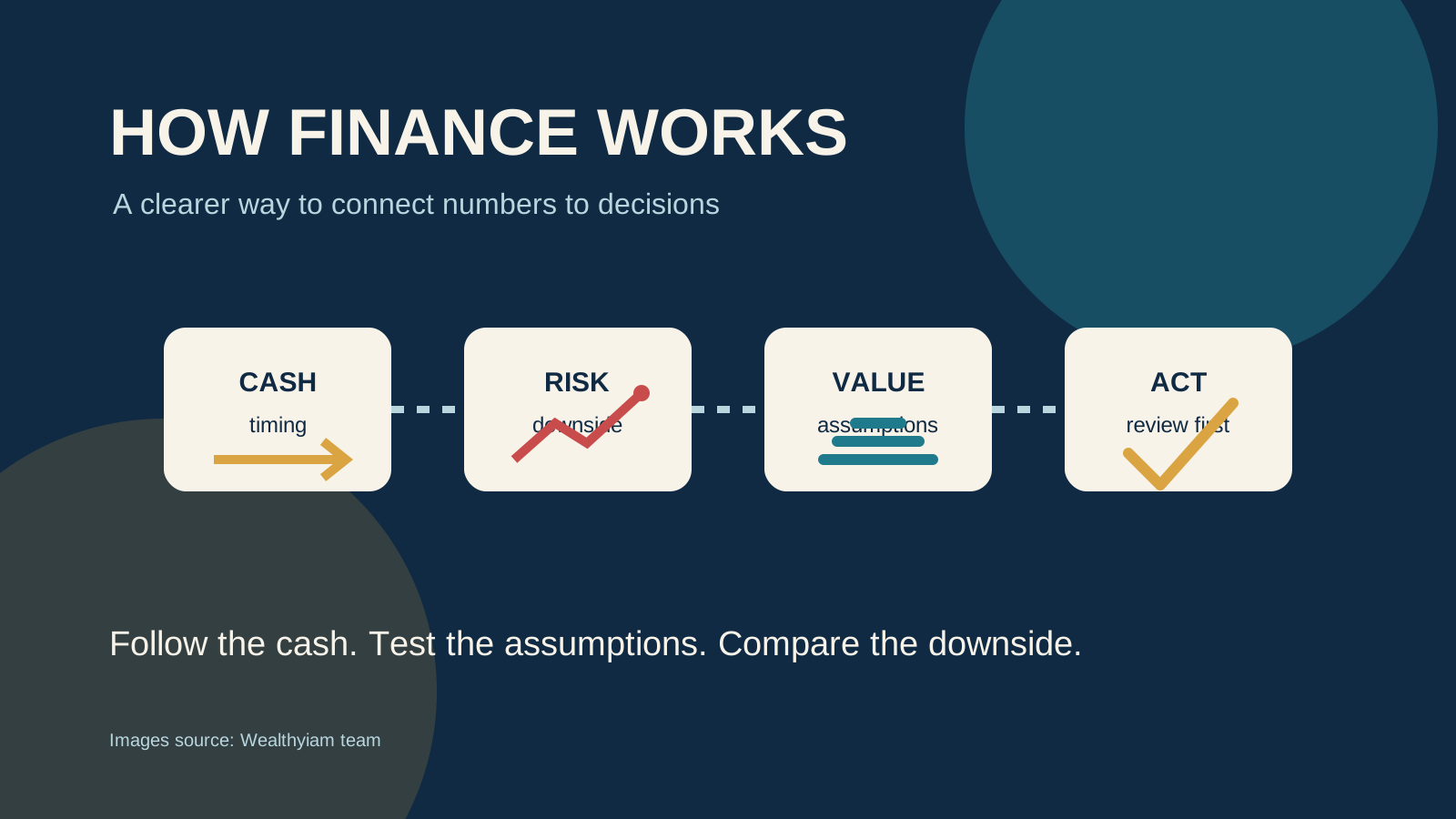
The short answer: Mihir Desai’s How Finance Works presents finance as a practical way to connect business activity, cash, risk, funding, and value. For a beginner, the most useful starting point is to follow the cash, make assumptions visible, and compare the potential reward with the downside before acting.
This guide is for readers who want a plain-English summary and a repeatable process for evaluating a purchase, investment, business project, or career decision involving meaningful money. It is general education, not individualized financial advice.
What How Finance Works covers
Harvard Business Review Press published How Finance Works: The HBR Guide to Thinking Smart About the Numbers in 2019. Its chapters cover financial analysis, the finance perspective, capital markets, value creation, valuation, and capital allocation. The book is designed to make those subjects accessible through examples, exercises, and visual explanations.
The seven lessons below are a Wealthy I AM synthesis of that finance lens, not Mihir Desai’s exact numbered framework. They do not replace the book, current financial records, a prospectus, or qualified advice for a high-stakes decision.
The core idea: finance is a decision language
Finance describes resources, obligations, timing, trade-offs, and uncertainty. A profit figure can look healthy while cash is unavailable. A high return can reflect high risk. A low price can represent an opportunity—or a business whose prospects have deteriorated.
That is why an isolated number is rarely enough. Ask where it came from, when it becomes cash, what assumptions support it, what risks accompany it, and what the number leaves out.
Seven practical lessons from the book’s finance lens
1. Start with the economic activity, not the spreadsheet
Before studying ratios or forecasts, describe what is actually happening. Who pays? What is delivered? Which resources are required? What could interrupt the process?
A spreadsheet can be internally consistent while representing a weak business or an unrealistic plan. Understanding the activity first helps you decide which numbers matter.
Action: Write one jargon-free sentence describing the business or decision. Then list three factors that could strengthen or weaken the outcome.
2. Profit and cash are related, but not the same
Profit is an accounting measure for a period. Cash flow tracks money entering and leaving. Unpaid invoices, inventory purchases, debt payments, and capital spending can cause the two to diverge.
Hypothetical example: A consultancy invoices $100,000 but collects only $60,000 before payroll and rent are due. The invoice may support reported revenue, but the bank account still faces a cash constraint. This example illustrates timing; it is not a forecast.
Action: Make two columns: earned or billed, and cash received or paid. Add the expected dates. This simple exercise can expose a timing problem that a profit total hides.
3. A return compensates you for committing resources under uncertain conditions
A percentage alone does not describe a decision. Ask how long the money is tied up, how uncertain the result is, how easily you can exit, and what could cause a permanent loss.
The same expected return can mean something very different for cash needed next month than for money set aside for a distant goal. Comparisons become more useful when time, liquidity, and downside are included.
Action: Ask four questions: What am I committing? For how long? What can go wrong? What would make the result difficult to reverse?
4. Funding choices change both opportunity and fragility
Businesses and households can use borrowing to fund useful activity, but debt creates fixed obligations. Those payments remain when revenue falls, costs rise, or income is delayed. Leverage—using borrowed money alongside your own capital—can magnify gains and losses.
Action: Stress-test the payment against a lower-income month, a delayed customer payment, or a higher cost. Do not assume refinancing will be available. Complex borrowing requires current terms and, when appropriate, jurisdiction-specific professional guidance.
5. Valuation is an estimate built from assumptions
Valuation is not a discovered truth. It is an estimate of worth based on assumptions about future cash flows, growth, costs, risk, and available alternatives. A model can produce a precise answer even when its inputs are uncertain.
For that reason, a valuation range and a sensitivity check are often more informative than one impressive-looking number.
Action: Identify the three assumptions doing the most work. Record the evidence for each and what change would materially alter the result.
6. Read incentives alongside the numbers
Reports and proposals are created within systems of incentives. That does not mean every report is misleading. It does mean you should ask how a result was measured, which period was selected, who benefits from the decision, and what has been omitted.
If a presentation highlights revenue growth, also ask about cash collection, costs, customer concentration, and the obligations required to produce that revenue.
Action: Separate what was reported from how it was interpreted. Write down one alternative explanation and one missing measure that would help you judge between them.
7. Use finance to compare choices, not to perform certainty
A model is often most useful for comparing option A with option B, acting now with waiting, or a central case with a downside case. It cannot make uncertainty disappear.
Action: Build better-than-expected, central, and worse-than-expected cases. Name the assumptions behind each. Use ranges or plain language when exact numbers would imply unsupported accuracy, and identify the evidence that would make you pause.
A 30-minute finance decision review
Use this process before a purchase, investment, business commitment, or career decision involving meaningful money:
- Define the decision: Write the choice and deadline in one sentence.
- Map the cash: List money in, money out, timing, and fixed obligations.
- Name the value driver: What must be true for the choice to be worthwhile?
- List three risks: Include at least one factor outside your control.
- Build a downside case: Describe what happens if a key assumption fails.
- Check reversibility: Can you exit, delay, reduce, or test the commitment?
- Set a review trigger: Name one fact that would make you revisit the choice.
The output can fit on one page: the decision, cash timing, three to five value drivers, downside conditions, and one mind-changing fact. A short memo that can be reviewed may be more useful than a complicated spreadsheet no one updates.
Common mistakes to avoid
Treating revenue as spendable cash
Revenue may be unpaid, delayed, or offset by costs and commitments. Check collections and timing before relying on it.
Comparing percentages without context
A percentage needs a time horizon, risk level, liquidity conditions, and a relevant comparison point.
Relying on one forecast
One forecast hides assumptions that may fail. Compare cases and identify which inputs have the greatest effect.
Confusing a model with evidence
A formula organizes assumptions; it does not verify them. Label known facts, estimates, and unknowns.
Letting a book replace due diligence
Current filings, contracts, fees, taxes, laws, lending terms, and personal circumstances require separate verification. A book can improve the questions you ask; it cannot remove the risks of the decision.
How different readers can apply the lessons
For a household, start with cash timing and fixed obligations before taking optional investment risk. For a small business, connect the income statement to bank activity, customer collections, inventory, and other working-capital needs. For an investor, treat valuation as a range of assumptions and consider diversification, liquidity, time horizon, and capacity for loss.
These are prompts, not product recommendations. The right decision depends on current facts, goals, constraints, and the consequences of being wrong.
Frequently asked questions
Is How Finance Works suitable for beginners?
Yes, it is positioned as an accessible guide for readers who want financial concepts connected to real decisions. Beginners should still pause over unfamiliar terms and verify current details before making a high-stakes commitment.
Does the book provide an investing formula?
This article does not claim that it does. The framework here is an editorial synthesis: follow cash, examine risk and incentives, test assumptions, and compare choices.
What finance concept should I learn first?
Start with the difference between accounting performance and cash timing. Then learn how obligations, risk, funding, and valuation assumptions interact.
Can this guide tell me what to buy or borrow?
No. It is general education. Suitability, taxes, laws, lending terms, fees, and investment risks depend on current circumstances.
A grounded next step
Choose one real decision this week and write a seven-line memo: decision, cash timing, value drivers, risks, downside, reversibility, and review trigger. Do not aim for a perfect prediction. Aim for a clearer question you can revisit when the evidence changes.
Finance works best as a discipline of attention. Connect numbers to cash, obligations, incentives, and uncertainty, and you are less likely to be impressed by an isolated figure—and more able to make a decision you understand.
Sources and further reading
- Open Library work record for How Finance Works
- Open Library edition record for How Finance Works: The HBR Guide to Thinking Smart About the Numbers
- Open Library author record for Mihir Desai
- Open Library cover source, cover ID 10330403 — image provenance only; reuse rights must be confirmed before publication.