Search intent: A careful summary of what is publicly verifiable about Spend Well, Live Rich, plus a practical values-based framework for applying its premise without treating editorial interpretation as the book’s exact text.
The short answer
Spend Well, Live Rich is a personal-finance book by Michelle Singletary, published by Ballantine in 2004. The accessible Open Library record classifies it under personal finance and cash management and gives the subtitle “how to get what you want with the money you have.” Its edition notes say it was originally published in hardback as 7 Money Mantras [for a Richer Life].
That catalog evidence supports a values-and-money reading of the title. It does not provide the complete text or establish every chapter, example, recommendation, or “lesson” in the book. The framework below is therefore a Wealthy I AM application—not a reconstruction of Singletary’s exact numbered structure.
What can be verified about the book
The current Open Library work and edition records identify:
- Title: Spend Well, Live Rich
- Author: Michelle Singletary
- Publisher and year: Ballantine, 2004
- Edition: First Ballantine Books edition
- Length: 262 pages
- Subjects: Personal finance and cash management
- Subtitle: “how to get what you want with the money you have”
The records are useful for bibliographic identity and scope, but they are not a substitute for reading the book. They currently state that the work and edition do not have a description. Claims about the book’s detailed advice should therefore be checked against the full book or an authoritative publisher or author source before being presented as direct summaries.
The central idea readers can take from the title
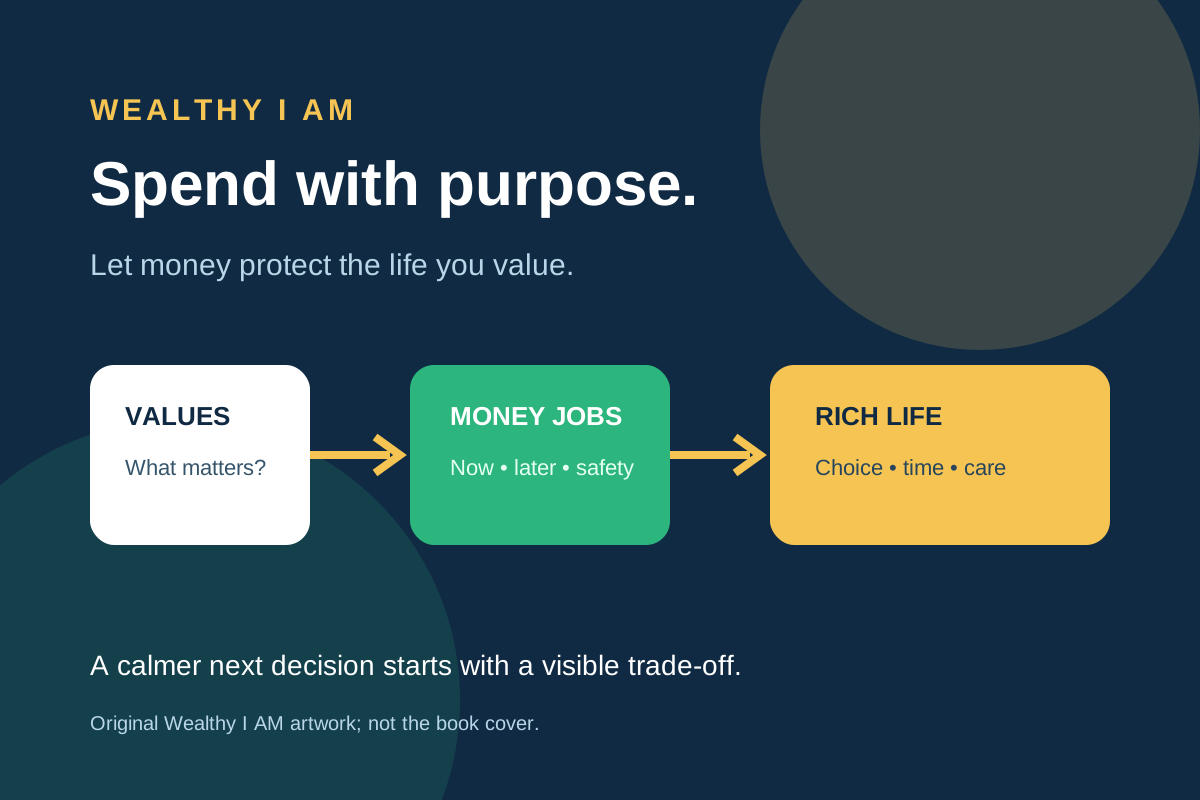
Money is a means, not a complete definition of a good life. A higher income can help, but income alone does not decide whether spending creates security, time, health, connection, or freedom. The more useful question is: What is this money meant to make possible?
That question does not make every enjoyable purchase irresponsible. It asks whether a purchase serves a real priority, meets an obligation, or mainly responds to comparison and pressure. A values-based approach can include generosity, comfort, convenience, and pleasure alongside saving and debt repayment—as long as the trade-offs are visible and the plan is affordable.
A practical framework inspired by the book’s premise
The following five tests are editorial application. They are not presented as Singletary’s exact chapter headings.
1. Define “rich” in observable terms
A vague goal leaves spending to habit and social comparison. Write a short description of what a rich month or year would contain: dependable housing, time with family, creative work, health support, travel, generosity, or the ability to change jobs. Choose a few priorities rather than trying to fund everything at once.
Try this: Complete the sentence, “A financially rich month would include ____.” Then identify one expense that supports that sentence and one expense that does not clearly support it.
2. Give money jobs without turning the budget into a moral scorecard
A budget is a plan for competing uses of cash. It can include essentials, debt payments, savings, giving, and discretionary spending. Discretionary means flexible or optional; it does not automatically mean wasteful.
Try this: For one month, sort transactions into four plain categories: obligations, future you, chosen values, and unplanned leakage. Use the result as information, not as a verdict about your character.
3. Separate need, preference, and pressure
The same purchase can be a need for one household, a preference for another, and a pressure purchase for a third. A purchase can be affordable and still crowd out a more important goal.
Try this: Before a non-routine purchase, write its purpose, expected use, full cost, and the goal it might delay. If the main answer is “people like me are supposed to have this,” wait 48 hours and reconsider without the urgency.
4. Treat debt as a claim on future choices
Debt commits future income. Interest is the cost of borrowing, while fees, variable rates, collateral, and missed-payment consequences can add risk. A payment that fits today may still reduce tomorrow’s flexibility.
Try this: List each debt’s balance, annual percentage rate, minimum payment, due date, and whether the rate can change. Confirm the terms with the lender. Then choose a sustainable payoff approach that does not ignore essential bills or appropriate cash reserves. Complex or distressed situations may require qualified, jurisdiction-appropriate help.
5. Use saving to protect priorities and resilience
Savings can create options when income falls, an essential repair arrives, or a planned opportunity appears. There is no single emergency-fund amount that fits every household. The appropriate target depends on income stability, obligations, insurance, access to support, and other risks.
Try this: Name the risks your reserve is meant to cover, such as a deductible, a period between jobs, or an essential repair. Automate a manageable transfer if possible, then review it after a major life change.
A five-minute spending decision
Use this workflow for a purchase, subscription, or lifestyle upgrade:
- Name the purpose. What problem does the money solve?
- Calculate the full cost. Include recurring fees, maintenance, financing, taxes, delivery, and cancellation terms where relevant.
- Check the trade-off. What goal, reserve, or future option is delayed?
- Test the pressure. Would you still choose it without social comparison, urgency, or a limited-time message?
- Choose a review date. Revisit recurring spending in 30 or 90 days based on actual value.
For example, someone considering a recurring service can total a year of payments, compare that amount with a named priority, and run a short trial if the cancellation terms permit. This process does not predict happiness or guarantee savings. It improves the quality of the decision before the commitment becomes routine.
Mistakes to avoid
- Confusing frugality with virtue: Lower spending is not automatically better if it undermines safety, health, or a stated priority.
- Copying another household’s budget: Income, dependents, location, debt, benefits, and risk capacity differ.
- Using guilt instead of information: Shame does not identify which trade-off needs attention.
- Ignoring irregular costs: Annual bills, repairs, fees, and maintenance can break a monthly plan.
- Treating debt advice as universal: Rates, contracts, legal protections, and hardship options vary.
- Assuming old examples are current evidence: Prices, products, tax rules, and economic conditions change.
- Mistaking higher income for automatic wealth: New income can create new commitments unless priorities are made explicit.
Frequently asked questions
Is Spend Well, Live Rich an extreme-budgeting book?
The accessible records identify it as a personal-finance and cash-management book with the subtitle “how to get what you want with the money you have.” They do not establish that it prescribes extreme deprivation. Readers should consult the full text before attributing a specific budgeting method to Singletary.
What should I do first after reading this summary?
Write one sentence describing a rich life, then review one week of transactions. Mark each item as an obligation, future-you investment, chosen value, or leakage. Pick one small, reversible change that protects a named priority.
Should I stop spending on enjoyable things?
Not necessarily. Enjoyment can be a legitimate value. The relevant questions are whether the spending is intentional, affordable within wider obligations, and worth the trade-off.
How does this apply when I have debt?
Start with an accurate list of balances, rates, minimums, and terms. Protect essential obligations and seek qualified help when needed. This general article cannot select the right payoff method for an individual.
Does spending less guarantee wealth?
No. Income, savings behavior, debt costs, taxes, health, housing, investment risk, and unexpected events also matter. No book or checklist guarantees a financial outcome.
A calmer next step
Do not redesign every category today. Choose one recurring expense that repeatedly conflicts with your priorities. Apply the five-minute workflow for the next seven days, record what you learn, and make one reversible adjustment. The aim is not a perfect money identity; it is a better next decision.
Conclusion
The verified record for Spend Well, Live Rich presents a personal-finance and cash-management book about getting what you want with the money you have. Its title invites a useful question: whether spending is helping create the life you actually value. The practical application is to define those values, inspect full costs and trade-offs, and build flexible habits that protect them.
This is general education, not individualized financial, tax, legal, or investment advice. Rules and suitable choices vary by jurisdiction and circumstance.
CTA: What does a rich life mean in your household? Write one sentence, then use it to review one recurring expense this week.
Sources and image provenance
- Open Library work record: Spend well, live rich — title, author, 2004 publication record, subtitle, subjects, and work details.
- Open Library edition record — Ballantine edition, 262 pages, edition notes, and identifiers.
- Open Library Covers API image — exact-title cover provenance; reuse rights must be confirmed before publication.
Primary image: Exact book cover of Spend Well, Live Rich by Michelle Singletary.
The original book-cover working file was not used for publication; the page uses original Wealthy I AM artwork instead.