Book: The Warren Buffett Portfolio: Mastering the Power of the Focus Investment Strategy Author: Robert G. Hagstrom
A focused portfolio can make an investment thesis more meaningful—but it can also make a mistake more expensive. Robert G. Hagstrom’s The Warren Buffett Portfolio presents “focus investing” as a concentrated, business-oriented approach associated with Warren Buffett. Its practical value is not a stock tip or a promise of superior returns. It is a question: can you understand what you own, estimate what it may be worth, and survive being wrong?
What the book is about
Open Library’s 1999 work record describes the book as an explanation of focus investing: selecting a concentrated group of businesses by examining management, financial position, and stock price. The record also connects shareholder returns with the economics of the underlying business. Those details support the broad theme, but they do not establish every chapter, example, quotation, or formula.
The lessons and checklist below are therefore a cautious Wealthy I AM application of the documented idea—not a claim to reproduce Hagstrom’s exact chapter structure.
Focused investing means allocating a relatively large share of a portfolio to fewer investments than a highly diversified strategy would. It is not the same as buying a few familiar companies. Focus requires a reasoned thesis, valuation discipline, and a clear understanding of what could make the thesis wrong.
> Important boundary: This is general educational material, not individualized investment advice. Concentration can produce substantial losses. Your time horizon, emergency savings, debt, taxes, account rules, income, dependents, and risk capacity all matter.
Conviction versus resilience
A concentrated position can reward a correct decision, but it also increases the effect of a disappointing business, an excessive purchase price, a liquidity problem, or an analytical mistake. Diversification—owning investments whose risks are not perfectly identical—can reduce the damage caused by one company or sector disappointing, although it cannot eliminate market losses.
That trade-off creates a useful test. Do you understand the proposed investment well enough to explain it in plain language? More importantly, would your wider financial plan remain intact if the investment declined sharply or took years to recover?
Five practical lessons from the focus-investing idea
1. Start with the business, not the ticker symbol
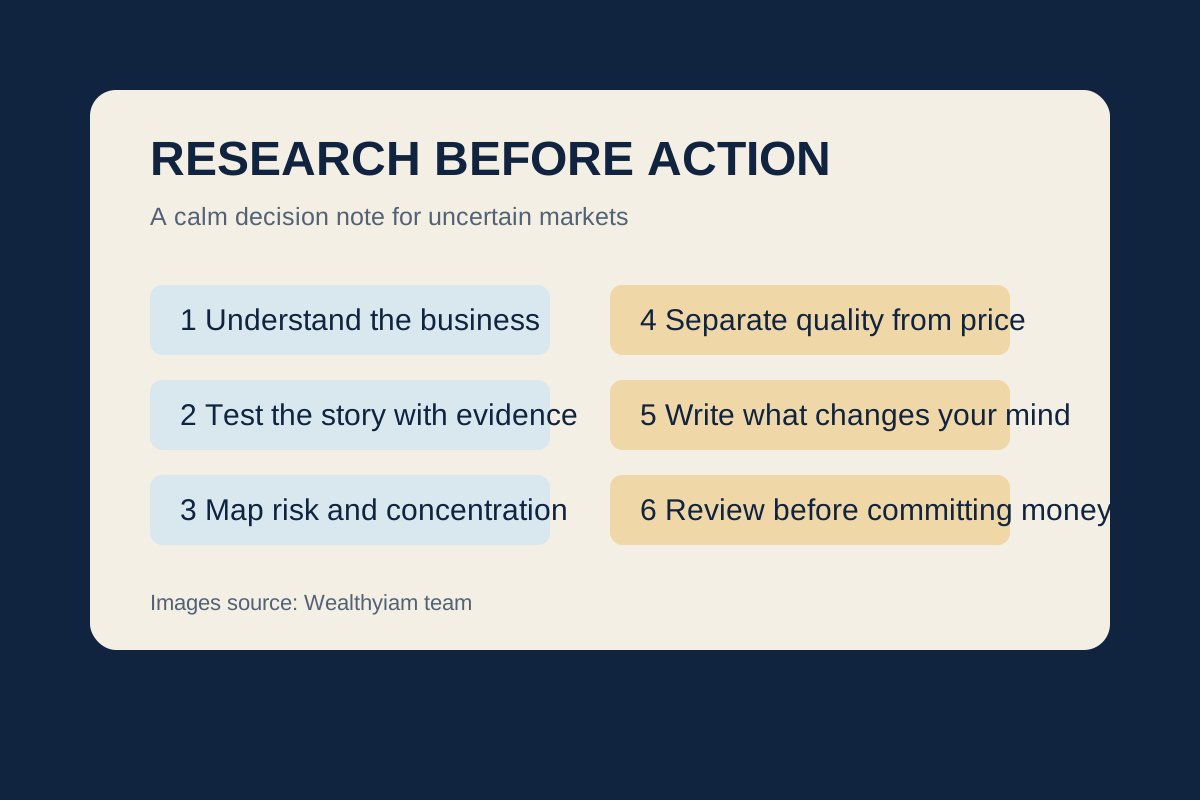
Before asking whether a share price may rise, ask what the company does, who pays it, what makes the offering useful, and what could weaken that advantage. Write a one-page summary covering the customer, product or service, revenue source, major costs, competitors, and two conditions that could make your thesis wrong. If you cannot explain the company without repeating promotional language, pause and research further.
2. Separate business quality from price
A durable business can still be a poor investment when its price leaves little room for disappointment. Valuation is an estimate of what an asset may be worth based on assumptions about cash flows, growth, profitability, and risk. It is not a precise fact.
Record the assumptions behind your estimate and use a range rather than a single number. Ask which assumption matters most. A conclusion that depends on perpetual rapid growth deserves more skepticism than one that remains reasonable under slower growth. Neither conclusion is guaranteed.
3. Treat concentration as a risk decision
“Focused” is a relative description, not a universal holding-count rule. Build two paper portfolios before committing money: a diversified baseline appropriate to your time horizon and risk capacity, and a focused version showing what happens if one major holding loses substantial value.
This is a hypothetical stress test, not a forecast. If the focused version would force you to sell essential assets, abandon a goal, or lose sleep, the proposed exposure may be too large for your circumstances.
4. Use patience as a process, not a slogan
Long-term investing is not the same as refusing to change your mind. Review business results, valuation, competition, debt, taxes, liquidity, and personal goals. Before buying, write an “exit or review” list: a broken business assumption, a material change in debt or competition, a price that no longer offers a reasonable margin for error, or a personal need for the money.
A review rule is not a prediction; it is a guardrail against improvising under stress.
5. Make the decision auditable
Record the date, thesis, evidence, valuation assumptions, risks, expected holding conditions, and what you do not know. Revisit the record on a reasonable schedule rather than every time a headline appears. The goal is not to prove that you were right, but to learn whether your reasoning was clear, incomplete, or too dependent on recent events.
A cautious five-step implementation checklist
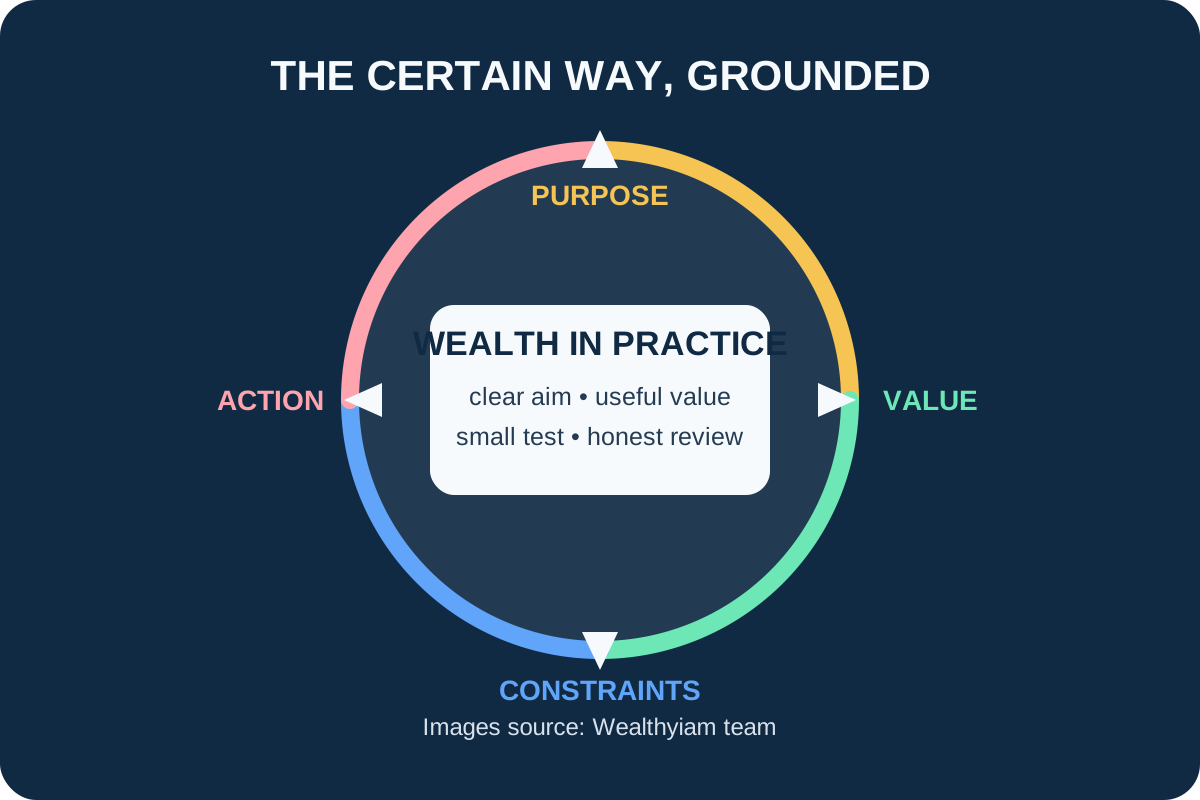
Step 1: Define the job of the money
Is the money for an emergency reserve, a near-term purchase, retirement, or a long-term goal? Money with a short time horizon should not be exposed to a strategy that could experience a large decline when you need it.
Step 2: Define the consequences of being wrong
Do not begin with a desired return. Consider income stability, high-interest debt, dependents, emergency savings, taxes, and access to cash. Avoid using borrowed money casually; leverage can magnify losses and create obligations during a decline.
Step 3: Research primary materials where possible
Read company filings, investor disclosures, and official communications, then compare them with independent analysis. Marketing copy can explain a product; it does not independently verify an investment case. Check the date of every time-sensitive fact.
Step 4: Compare with a simpler alternative
A focused idea should earn its complexity. Compare it with a low-cost, diversified alternative suitable for your jurisdiction, account, time horizon, and risk tolerance. Fees, taxes, tracking differences, and implementation constraints matter.
Step 5: Write the decision before placing the order
State what you believe, why it may be true, what could falsify it, how much you could lose, and when you will review it. If the thesis cannot survive written scrutiny, do not let urgency make the decision for you.
A hypothetical example: conviction versus resilience
Suppose an investor is researching a fictional company called Northstar Tools. The investor understands its product and believes its economics are durable. Instead of assuming that conviction justifies a large purchase, the investor compares two hypothetical allocations and asks what a severe company-specific decline would do to the overall plan.
The point is not an invented percentage or outcome. It is to expose the trade-off: greater concentration makes the thesis more important, while broader diversification can make one mistaken thesis less damaging. The appropriate choice depends on goals, risk capacity, knowledge, taxes, and circumstances.
Mistakes to avoid
- Copying a famous investor: A public figure’s resources, time horizon, tax position, and access to information may differ from yours.
- Confusing a good company with a good price: Quality does not eliminate valuation risk.
- Calling concentration “focus” without a thesis: A short list of holdings is not automatically researched or disciplined.
- Using past performance as proof: Historical results may reflect luck, a different market regime, survivorship bias, or hidden risks.
- Ignoring liquidity: A strategy is unsuitable if it could force a sale at an inconvenient time.
- Treating patience as refusal to review: New evidence can change an investment case.
- Using borrowed money casually: Leverage can magnify losses and obligations.
Frequently asked questions
Is The Warren Buffett Portfolio suitable for a beginner?
It may help a beginner understand how business analysis, valuation, and portfolio construction fit together. A beginner should also learn basic diversification, fees, taxes, account rules, and risk before considering concentration.
Does focused investing mean owning only a few stocks?
Not necessarily. “Focused” is relative to the alternative portfolio and the investor’s circumstances. There is no universal holding-count rule that makes a portfolio safe or focused.
Is this the same as Warren Buffett’s current portfolio?
No. This article discusses a book-level idea documented in the cited catalog record. It does not verify current holdings or a current recommendation; those claims require separately dated, authoritative sources.
Can focused investing guarantee better returns?
No. Focus can increase the impact of both successful and unsuccessful decisions. No investment method guarantees a profit or prevents loss.
What is a low-risk way to apply the idea?
Choose one investment you already own or are considering and write its business summary, key assumptions, downside conditions, and diversified baseline. Do not place a trade merely to complete the exercise. If material money, tax consequences, debt, or a complex product is involved, consider consulting a qualified professional who understands your circumstances.
Conclusion
The Warren Buffett Portfolio offers a useful question: can you explain what you own, why it may be valuable, and what would make your thesis wrong? Its focus-investing lens can encourage deeper research, but concentration raises the cost of mistakes. The cautious application is not to imitate a famous investor. It is to make risk visible, compare alternatives, write down assumptions, and choose an exposure your wider financial plan can withstand.
Sources and image provenance
- Open Library work record: The Warren Buffett Portfolio — title, author, 1999 publication context, and catalog description.
- Google Books search for The Warren Buffett Portfolio by Robert G. Hagstrom — additional bibliographic reference.
- Image source: Open Library Covers API, cover ID 6797853.
- Image provenance: JPEG, 180 × 281 pixels, 15,582 bytes, SHA-256 `3d9aeec05c789a6f71d879a628de3015c1437d285106fae0e031336d25acc314`. The cover matches the title and author. Open Library availability establishes source provenance, not an unrestricted reuse license; the publisher must verify rights before publication.