Search intent: A careful summary and practical application of The Revenue Growth Habit: The Simple Art of Growing Your Business by 15% in 15 Minutes a Day by Alex L. Goldfayn for owners and sales professionals who want more consistent customer follow-up without relying on pressure or guesswork.
If good customers are going quiet, the problem may be follow-up
Many small businesses do not lose opportunities because the offer is useless. They lose them because a satisfied customer is not contacted at the right time, a warm conversation is never continued, or the owner postpones relationship-building until the pipeline feels empty. By then, follow-up feels like an emergency.
Short answer: Goldfayn’s book argues for making customer contact a brief, repeatable habit rather than an occasional burst of selling. The practical value is not a promise of a particular revenue increase. It is a system for remembering useful conversations, asking for the next appropriate step, and learning from what customers actually say.
The seven lessons below are a Wealthy I AM synthesis of the inventory description and bibliographic record. They are not presented as Goldfayn’s exact numbered framework, and the available sources do not establish every chapter, exercise, statistic, or example in the full book. This article separates the book’s broad idea from original application.
This is general business education, not a guarantee of sales, revenue, or profit. Results depend on the offer, market, customer need, capacity, price, competition, and execution. Do not use persistent contact to pressure people or ignore consent and applicable marketing rules.
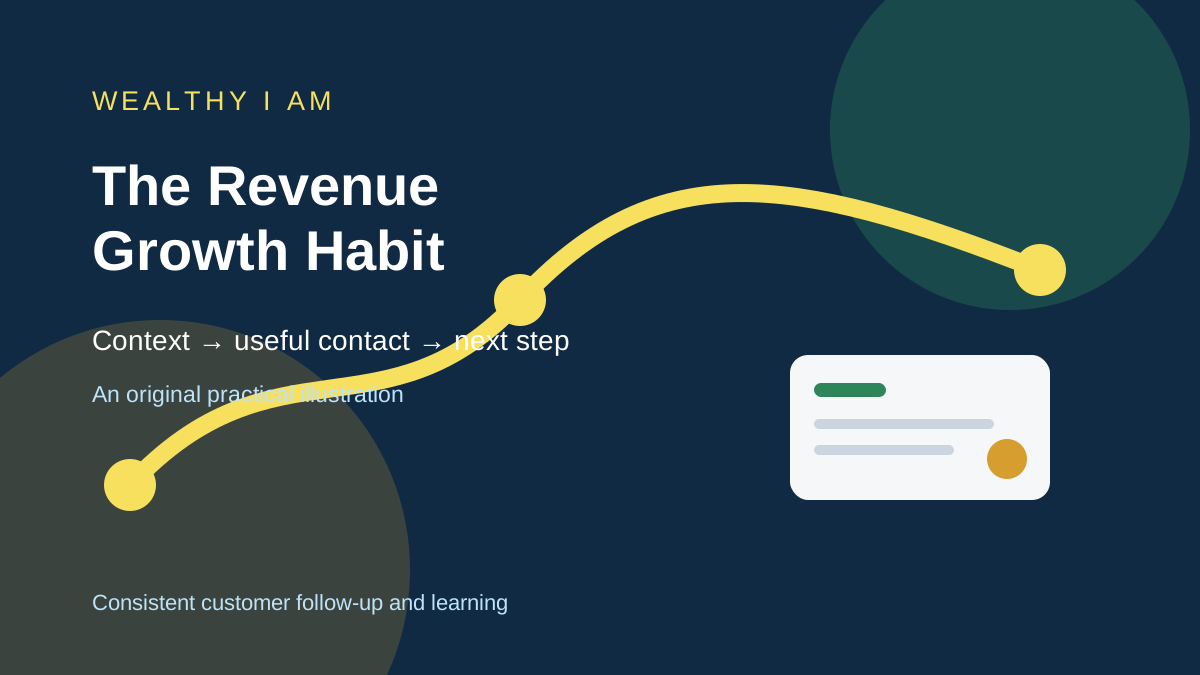
Image credit: The article uses original Wealthy I AM artwork rather than a third-party book cover.
Who this book may help—and what it does not replace
This book is most relevant to a service business, consultant, salesperson, agency, or owner whose growth depends partly on existing relationships. It may be useful when the business has customers but no dependable way to stay in touch with them.
It does not replace product quality, delivery, pricing judgment, customer service, cash-flow management, or a realistic acquisition strategy. A follow-up routine can expose demand; it cannot manufacture a need that is not there.
The central idea: make relationship-building operational
A habit is a behavior attached to a regular cue. In this context, the cue might be the first 15 minutes of a workday or a scheduled block on a calendar; the behavior is a small number of thoughtful customer contacts. The point is to move follow-up from memory and mood into a process that can be reviewed.
The book’s broad premise, as described by the inventory record, connects brief repeatable customer contact with retention, referrals, sales conversations, and revenue growth. The application below turns that premise into a cautious workflow: identify a relevant person, use context, offer something useful, ask one clear question, record the response, and set a next step only when appropriate.
Seven practical lessons from the book’s idea
1. Consistency is more dependable than a last-minute sales sprint
Book idea: Regular customer contact is preferable to waiting for a revenue shortfall before acting.
Plain-language meaning: A small process that happens repeatedly is easier to inspect than a heroic effort that appears only when sales are slow. Consistency also gives the business more chances to notice changing needs.
Wealthy I AM application: Create a 15-minute “relationship block” three or four workdays per week. Start with three customers or prospects whose needs you understand. The goal is a completed, relevant conversation—not an arbitrary quota of messages.
2. Start with customer context, not a generic pitch
A message that says “Just checking in” gives the recipient little reason to respond. Context can be simple: a recent project, a known renewal date, a question they previously asked, or a useful update.
Example: A bookkeeping firm might write, “You mentioned that monthly cash-flow visibility was difficult during busy season. Has that changed, or would a short review of the current reporting process be useful?” That is a hypothetical example, not a reported case study or expected result.
Before contacting someone, write down the last relevant fact you know. If you have no useful context, consider whether the message should be sent at all.
3. Treat contact as service before treating it as a transaction
Book idea: Customer relationships can support retention and referrals when contact is useful and human.
Application: Ask, “What information, reminder, introduction, or small improvement could make this person’s current problem easier?” Sometimes the answer is a sales conversation. Sometimes it is a clarification, a candid limitation, or no offer at all.
This distinction protects trust. A relationship is not a license to repeatedly push a product. Honor opt-outs, frequency preferences, privacy expectations, and relevant advertising requirements.
4. Ask for one clear next step
Vague follow-up creates vague outcomes. After explaining why you are contacting someone, ask one answerable question: “Would Tuesday or Thursday suit a 20-minute review?” or “Should I send the comparison, or is this not a priority?”
A clear question makes “not now” and “no” easier to express. That is valuable information. It also reduces wasted time for both sides.
5. Track conversations so the habit creates learning
Contact without a record becomes repetition. Keep a lightweight log with the date, context, customer response, stated need, next step, and permission or preference where relevant.
Do not turn this into a complicated customer relationship management project before the basic habit works. A spreadsheet may be enough at first. Review it weekly and look for patterns: common questions, stalled handoffs, recurring service gaps, and customers who need a different type of support.
6. Measure leading actions without confusing them with financial outcomes
A leading measure is an activity that occurs before the final result. Contacts completed, conversations held, follow-up tasks closed, and response themes can be useful leading measures. Revenue, margin, retention, and cash collected are outcomes.
Do not claim that completing a contact quota causes a particular percentage increase. The title’s “15% in 15 minutes a day” is part of the book’s title; it should not be presented here as a forecast for your business.
A sensible dashboard might compare, over a defined period, the number of relevant contacts, replies, qualified conversations, proposals, closed work, gross margin, and cancellations. Interpret small samples cautiously.
7. Protect the habit from low-value busyness
A short block can still be wasted if it becomes mass messaging, inbox refreshing, or unplanned discounting. Keep the standard high: the contact should be relevant, accurate, respectful, and connected to a real customer need.
If the routine produces no useful learning after a fair test, inspect the offer, audience, timing, message, and service experience. The answer may be to change the business process—not simply to contact more people.
A low-risk 30-minute implementation test
This is original Wealthy I AM application, not a claim that the book prescribes this exact test.
- Choose a narrow group. Select 10 existing customers or warm contacts whose needs and permission status you can identify.
- Write the reason first. For each person, record the relevant context in one sentence.
- Send fewer, better messages. Begin with three to five contacts. Offer a useful answer, resource, review, or question; do not force a pitch.
- Record what happens. Note replies, requests, objections, timing concerns, and opt-outs. Do not invent missing data.
- Set a review date. After two or four weeks, compare response quality and business outcomes with your starting point. A short test cannot prove causation.
- Change one variable. If the result is weak, adjust the audience, context, offer, or timing one at a time rather than adding volume blindly.
A useful output from the test is not merely “more messages sent.” It is a clearer description of which customers have which problems, what help they value, and where the current process breaks.
Mistakes to avoid
Mistake 1: Treating the title’s growth language as a guarantee
A book title can express an author’s positioning. It is not individualized evidence about your revenue. Use the idea as a process experiment, not a promise.
Mistake 2: Contacting everyone with the same script
Generic volume can damage trust and produce poor learning. Start with a small, relevant group and make the reason for contact specific.
Mistake 3: Measuring activity while ignoring economics
More conversations do not automatically mean more profit. Track delivery cost, discounts, refunds, capacity, and margin alongside sales indicators.
Mistake 4: Continuing after a clear no
Respect a refusal, unsubscribe request, or stated preference. A durable business relationship requires boundaries.
Mistake 5: Using follow-up to hide a weak offer
If customers repeatedly say the problem is not urgent, the price is unclear, or the service does not fit, treat that feedback as product or positioning information.
Frequently asked questions
Is The Revenue Growth Habit a book about cold calling?
The inventory description emphasizes repeatable customer contact, retention, referrals, and sales conversations. That broad description does not establish that every recommendation is cold calling. The application here prioritizes existing relationships and relevant context.
Does 15 minutes a day guarantee 15% growth?
No. The phrase appears in the book’s title, but it is not a forecast for an individual business. Market conditions, offer quality, customer need, capacity, and margins all matter.
How often should a business follow up?
There is no universal interval. Use the customer’s buying cycle, the importance of the issue, prior preferences, and applicable rules. When uncertain, ask for a preferred timing or channel.
What should I track first?
Start with context, contact date, response, next step, and opt-out or preference information. Add financial measures such as revenue and margin so activity is not mistaken for value.
Is this suitable for a solo business?
Potentially. A solo operator can test a small calendar block and a simple log. Keep the routine small enough that it does not displace delivery, invoicing, rest, or higher-value work.
Sources / Further reading
- Open Library: The Revenue Growth Habit catalog record — identity and bibliographic source used for this draft.
- Open Library Covers API image — cover provenance and identity record; reuse rights should be checked before publication.
A practical next step
Choose three customer relationships that already have clear context. Write one useful, respectful message for each, record the response, and review what you learned before increasing the volume. The durable lesson is not that a short routine can guarantee growth. It is that a business can make customer attention visible, repeatable, and accountable.
Conclusion
The Revenue Growth Habit points toward a simple operating discipline: stay meaningfully connected to customers instead of treating follow-up as an emergency. Its usefulness for a wealth-building business lies in the process—better listening, clearer next steps, and evidence about where value is created—not in a promised percentage outcome. Test the habit cautiously, respect customer boundaries, and judge it by both relationship quality and business economics.