Search intent and the reader problem
If you are comparing bank accounts, investment funds, subscriptions, side-business ideas, or career paths and still cannot decide, the problem may not be a lack of information. It may be that every additional option is making the decision harder to finish.
This article answers the search intent behind The Paradox of Choice summary and practical lessons. It explains Barry Schwartz’s central idea, translates it cautiously into a money-decision process, and shows how to reduce avoidable choice overload without pretending that one rule fits every person.
The short answer
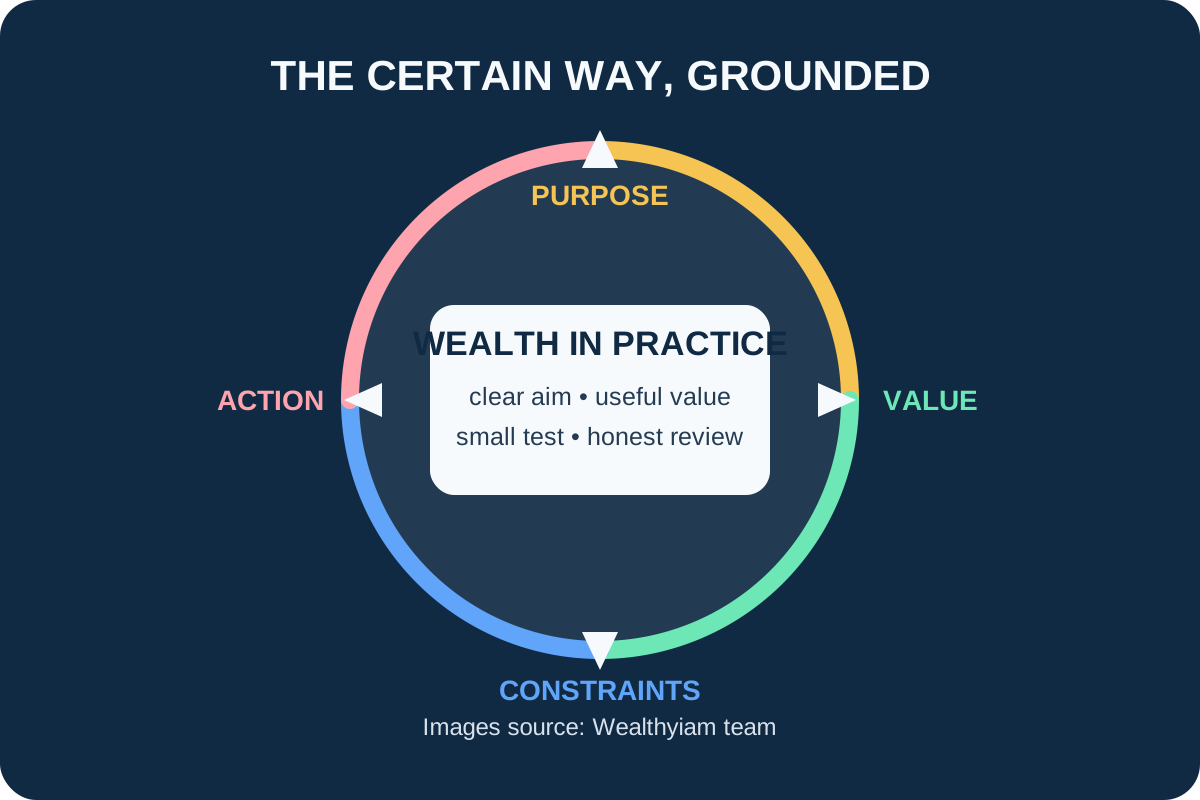
The book’s central warning is that more choice can create overload, anxiety, regret, and paralysis rather than greater satisfaction. A useful Wealthy I AM application is to decide what matters before comparing options, set a reasonable stopping rule, and review the decision after a defined period instead of reopening it every day.
That does not mean choosing carelessly. It means separating decisions that deserve deep research from reversible, low-stakes choices that do not. The seven lessons below are a Wealthy I AM editorial synthesis inspired by the book’s subject, not a claim that Schwartz presents this exact numbered framework.
Who this is for: readers who want a practical summary, people stuck in comparison loops, and anyone whose financial plan is repeatedly delayed by too many plausible options. The book is not a substitute for individualized financial, tax, legal, or mental-health advice.
What choice overload means in everyday money decisions
Choice overload is the difficulty that can arise when the number or complexity of alternatives exceeds what a person can comfortably evaluate. The issue is not simply having options. Options can be valuable when they reveal a better fit. The issue is allowing an open-ended comparison process to consume attention, delay action, and create doubt after a reasonable decision has already been made.
For example, a person may spend weeks comparing investment platforms while leaving their broader saving plan untouched. A small-business owner may keep redesigning a service menu instead of talking with potential customers. A household may research every possible insurance feature without first identifying the risks it actually needs to cover. These are hypothetical illustrations, not reported case studies or forecasts.
The book idea and the Wealthy I AM advice should be kept distinct. Schwartz examines the psychology of choice. The practical framework here applies that idea to financial and work decisions while recognizing that suitability, cost, risk, access, and personal circumstances still matter.
Seven practical lessons inspired by The Paradox of Choice
1. Define the decision before collecting options
A vague question creates an unlimited comparison. “What should I do with my money?” is too broad to finish. A bounded question is more useful: “Which accessible savings option fits my emergency-fund purpose and my need for liquidity?” The answer may still require research, but the decision has a shape.
Try this: write the decision in one sentence, name the time horizon, and state the constraint that matters most. If you cannot explain what a good-enough answer would accomplish, more research may only add noise.
2. Separate important choices from reversible choices
Not every decision deserves the same level of analysis. A decision is more consequential when it is difficult to reverse, affects safety or legal obligations, or exposes substantial money to loss. A decision is more reversible when the cost of changing course is small and the consequences are limited.
This is a Wealthy I AM decision rule, not a guarantee from the book. Use deeper due diligence for an investment, loan, insurance policy, business commitment, or tax-sensitive move. Use a lighter process for a budgeting-app trial, a low-cost learning resource, or a routine purchase that can be returned.
Try this: label each decision high-consequence, medium-consequence, or reversible. Match the research effort to the label rather than treating every choice as a referendum on your future.
3. Choose criteria before you compare products
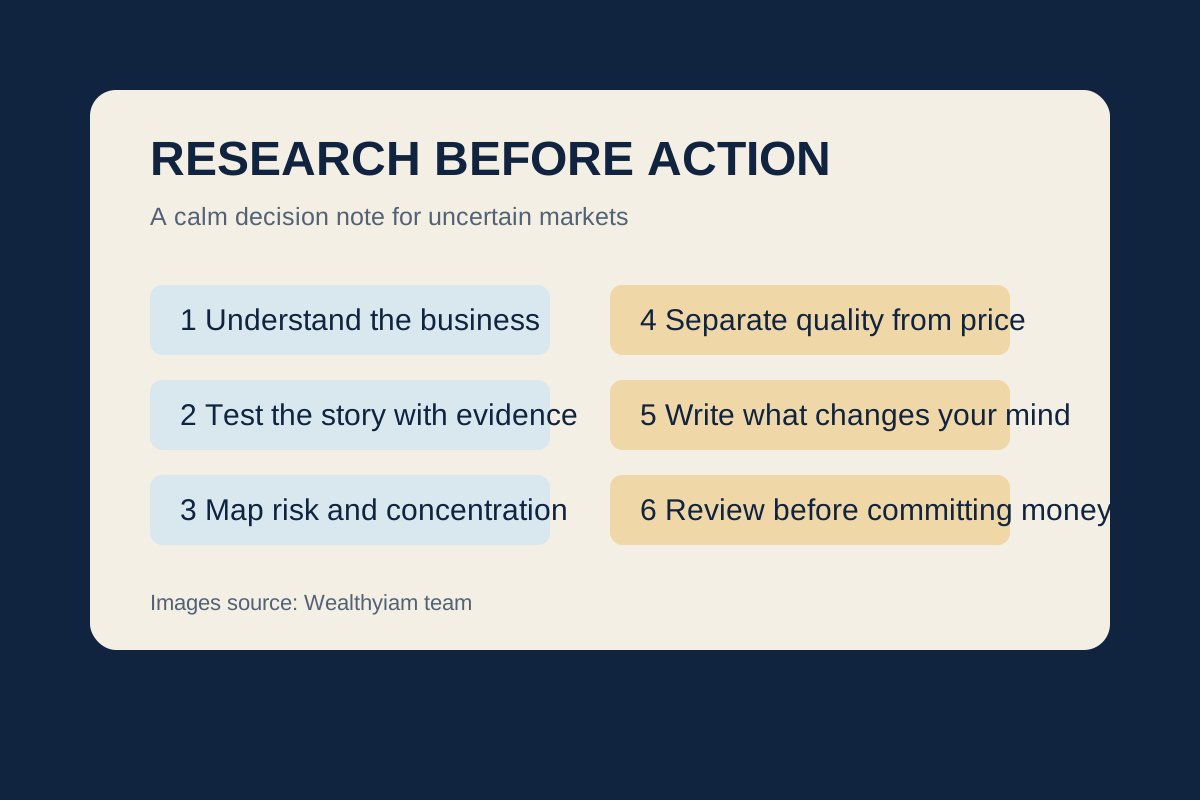
Comparison becomes exhausting when the criteria change every time a new option appears. Before looking at alternatives, list three to five requirements. For a financial account, those might include access to cash, fees, protections, convenience, and whether the product is available in your location. The right criteria depend on the decision; this is not a recommendation of any particular product.
Try this: mark each criterion as essential, preferred, or irrelevant. Reject an option that fails an essential requirement. Do not let a flashy feature compensate for a non-negotiable weakness.
4. Use a good-enough threshold instead of chasing the theoretical best
The book challenges the assumption that more alternatives always produce a better result. A good-enough threshold does not mean ignoring quality. It means deciding in advance what would make an option acceptable and stopping when one meets the threshold and important risks have been checked.
For a hypothetical side project, a threshold might be: “I can explain the customer problem, estimate the time required, test demand without borrowing, and stop if the test creates unacceptable safety, legal, or financial exposure.” The threshold is an experiment boundary, not a prediction of revenue.
Try this: write the minimum acceptable conditions before the comparison begins. Then record why the selected option meets them.
5. Treat regret as information, not automatic proof of a bad decision
When many options look attractive, the unchosen alternatives remain visible in the imagination. That can make a reasonable decision feel wrong simply because another path might have worked. Regret can sometimes reveal that a criterion was missing, but it can also be the emotional cost of accepting trade-offs.
Try this: after deciding, write the two trade-offs you knowingly accepted and the evidence that supported the choice. If new information appears, update the decision. Do not reopen it merely because another option is still available.
6. Protect attention from repeated reopening
A plan cannot compound if it is constantly interrupted. This applies to saving routines, skill building, business systems, and investing behavior. Rechecking every day can create activity without improving the decision.
Try this: set a review date. Between now and then, monitor only facts that could materially change your choice, such as a fee change, a change in access, a material change in your circumstances, or a risk you previously failed to understand. General education is not individualized financial advice.
7. Build a process that makes the next choice easier
The lasting benefit is not one perfect decision. It is a repeatable process. A short checklist, a default category in the budget, a written investment policy, or a standard customer-research script can reduce the number of choices you must recreate from scratch.
Try this: after finishing a decision, save the criteria, evidence, selected option, trade-offs, and review date. The record helps you learn without relying on memory or emotion alone.
A 30-minute anti-overload decision workflow
Use this as a Wealthy I AM application, not as a substitute for due diligence.
- State the outcome. What must this choice accomplish, and by when?
- Name the constraints. Include affordability, liquidity, time, risk capacity, access, and any professional review needed.
- Choose three to five criteria. Define what is essential before opening comparison pages.
- Create a shortlist. Start with a small number of plausible options from reliable sources. Do not treat a shortlist as proof that an option is suitable.
- Check disqualifiers first. Remove options that fail essential requirements, create unacceptable exposure, or are not available to you.
- Apply the threshold. Select the first option that meets the defined standard and has no unresolved material concern.
- Write the trade-off. Record what you gave up and why that was acceptable for this purpose.
- Set a review date. Define what evidence would justify changing course.
For a high-stakes investment, debt, insurance, tax, or legal decision, this workflow is only a starting structure. Consider authoritative information and qualified professional advice appropriate to your circumstances.
Mistakes to avoid
Confusing more research with better judgment
Research is useful when it answers a defined question. It becomes counterproductive when it expands the question indefinitely. Keep a research log with the question, source, finding, and decision impact.
Comparing features while ignoring purpose
A feature is not a benefit unless it helps the objective. Ask what problem the feature solves and whether that problem matters to you.
Treating a book’s framework as a universal financial rule
The book is about choice and psychology, not a personal portfolio prescription. Different people have different goals, obligations, time horizons, and tolerance for loss.
Using a default without checking its consequences
Defaults can reduce friction, but they can also hide fees, lock-ins, inappropriate risk, or an unsuitable commitment. Review the important terms before accepting a default.
Reopening a decision because of discomfort alone
Discomfort can signal uncertainty, but it is not the same as new evidence. Identify whether the concern is factual, emotional, or a genuine change in circumstances.
What The Paradox of Choice does not prove
The book’s argument should not be turned into a claim that fewer choices are always better. More alternatives can help when they reveal a meaningful difference, improve access, or correct a poor default. Choice can also be essential in personal, cultural, medical, legal, and financial contexts where people have different needs.
Nor does reducing choice guarantee higher returns, more income, or a stress-free life. The sensible application is narrower: make the decision boundary visible, avoid unnecessary comparison, and preserve a way to correct mistakes when new evidence appears.
Frequently asked questions
Is The Paradox of Choice a personal-finance book?
No. It is a psychology and decision-making book whose ideas can be applied to spending, saving, investing, work, and business choices. Application should not be mistaken for individualized advice.
What is the main lesson of The Paradox of Choice?
Its central concern is that an abundance of options can contribute to overload, anxiety, regret, and paralysis. A practical response is to define purpose, criteria, and a stopping rule before comparing alternatives.
Should I always choose the cheapest option?
No. Price is one criterion. Access, quality, reliability, risk, liquidity, protections, and fit may matter as well. Choose criteria that serve the decision’s purpose rather than using a single rule for every purchase or financial product.
How many options should I compare?
There is no universal number. Compare enough plausible options to test the important differences, then stop when one meets your pre-set threshold and material questions are answered. The right amount depends on the consequences and reversibility of the choice.
Can this approach help with investing?
It can help organize research and reduce impulsive switching, but it cannot identify a suitable investment or remove market risk. Review diversification, fees, liquidity, taxes, time horizon, and potential loss; seek qualified advice when needed.
What should I do if I already feel stuck?
Write the decision, the purpose, three essential criteria, and the next smallest reversible step. If the decision is high consequence, pause the commitment and obtain relevant authoritative information or professional review rather than forcing speed.
A practical next step
Choose one decision you have postponed. Spend five minutes writing its purpose, three essential criteria, the main disqualifier, and a review date. If it is high consequence, use the exercise to prepare better questions for a qualified professional—not to bypass due diligence.
Conclusion
The Paradox of Choice offers a useful correction to the belief that an endless menu automatically improves life. In money and work, attention is a scarce resource. The goal is not to eliminate judgment or settle for careless defaults. It is to define the decision, match effort to risk, accept visible trade-offs, and create a process that makes future choices easier.
The Wealthy I AM takeaway is modest and actionable: stop asking for every possible option when you have not yet defined what a suitable option must do. Set the boundary first, then research inside it.
Sources and further reading
- Open Library work record: The Paradox of Choice: Why More Is Less by Barry Schwartz — inventory and identity source for the selected book and its public description.
- Open Library Covers API image source — cover provenance; the publisher must verify reuse rights and edition suitability before publication.