If your calendar is full but your important goals keep moving backward, the problem may be excess: too many commitments, open loops, notifications, and low-value tasks competing with the few actions that improve skills, income, business, or financial decisions.
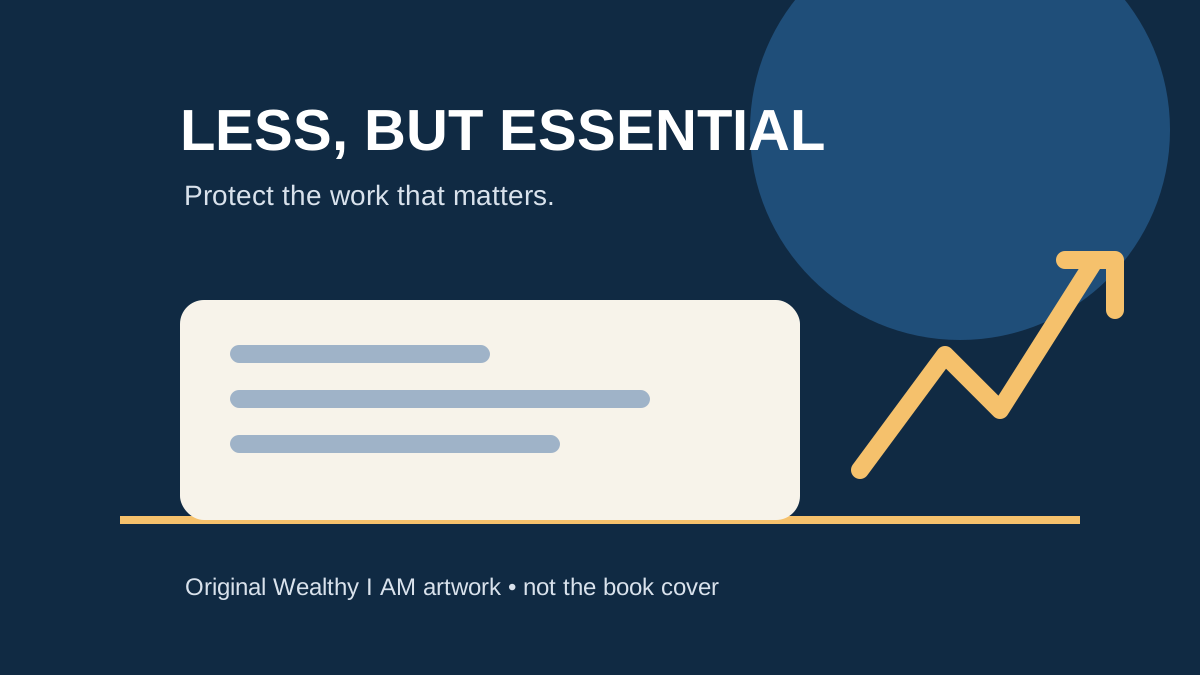
Short answer: The Power of Less points toward reducing what you carry, choosing essential outcomes, and protecting the work that matters. That may make progress easier to observe, but it is not a promise of wealth or a substitute for financial planning.
This is a cautious Wealthy I AM synthesis of the book’s documented premise and a practical application. The lessons below are editorial synthesis, not a claim about the author’s exact numbered framework.
Who this book may help—and what it cannot do
Leo Babauta’s book may help readers who feel overcommitted, distracted, or unable to protect time for meaningful work. Its productivity idea can apply to employment, small business, learning, and household administration.
A simpler schedule does not automatically create income. Wealth also depends on skills, decisions, market conditions, savings, risk, obligations, and luck. Less should mean less of what does not serve a chosen priority—not less sleep, safety, care, or due diligence.
Six practical lessons for focusing scarce resources
1. Name the bottleneck before adding another goal
When everything is urgent, you cannot tell what limits progress. The bottleneck might be unprotected focus time, unclear customer demand, inconsistent follow-up, high-interest debt, or a missing marketable skill.
Try this: write, “Progress is currently limited by _____.” Collect evidence for a week before buying a tool, enrolling in a course, or changing an investment plan.
2. Choose an essential outcome, not an impressive identity
“Be successful” is too broad to guide a Tuesday afternoon. A concrete outcome might be finishing a portfolio project, speaking with potential customers, reducing a recurring expense, or reviewing an allocation against your time horizon.
Choose one outcome for the next 30 days and define what “done” means. Keep the target within your control. Do not define success as a guaranteed return, promotion, or customer response.
3. Reduce commitments before optimizing tools
An app can organize commitments; it cannot decide which commitments deserve to exist. Make three columns: keep, pause, and decline. Note expected value, time or money cost, and the cost of stopping. Preserve health, legal, relationship, and core responsibilities even when they are not financially productive.
4. Build boundaries that make useful action easier
A boundary may be a meeting-free block, notification rule, spending pause, or fixed place for financial records. Protect two modest weekly blocks for one essential outcome and review the result. If the experiment harms sleep, caregiving, accessibility, or another responsibility, modify it. The purpose is useful work, not proving toughness.
5. Simplify decisions without hiding risk
Simple rules can hide exceptions. Automating everything may overlook volatile cash flow, fees, taxes, liquidity, insurance, or high-interest debt. Use a short record: What is the decision? What evidence matters? What could go wrong? What would change my view?
Diversification means spreading exposure rather than relying on one holding. It can reduce concentration risk, but it cannot eliminate loss.
6. Review what you removed, not only what you completed
A reduction is useful only if it gives capacity to something important. At month-end, ask what the freed time or money enabled. Restore or revise anything that created an unintended cost. A paused activity that protects a key relationship may deserve to return.
A 30-minute essential-work audit
Use this as an original Wealthy I AM worksheet, not a guaranteed method from the book:
- List recurring commitments, projects, and financial tasks.
- Mark each essential, useful, uncertain, or disposable for this season.
- Pause one item for two weeks with a clear stop condition.
- Protect one modest block for the highest-value action.
- Record output, not only time spent.
- Review and restore anything whose removal caused harm.
A hypothetical freelancer might pause low-return marketing experiments and use two weekly blocks to improve a portfolio and follow up with prospects. This does not predict clients or income; it shows how fewer actions can make learning easier to observe.
Mistakes to avoid when applying less to money
Mistaking minimalism for deprivation
Reduce waste first, not safety. Cutting essentials, necessary care, or protection can create larger future costs.
Treating a productivity book as financial advice
The book cannot determine a suitable savings rate, investment mix, tax decision, debt strategy, or insurance need. Those depend on personal facts and jurisdiction.
Cutting learning before testing its value
Define what you expect to learn, how you will apply it, and when you will review the result before calling education waste.
Using simplicity to avoid evidence
Fewer numbers do not make decisions safer. Keep facts that reveal downside, uncertainty, fees, and trade-offs.
FAQs
Is The Power of Less a book about getting rich?
No. It is a productivity and personal-growth book. Its wealth relevance is indirect: focused time may help someone develop skills, serve customers, or decide more deliberately. No financial outcome is guaranteed.
What is the best first step?
Choose one 30-day outcome, pause one nonessential commitment, and schedule a small protected work block. Review before making a larger commitment of money or time.
Does doing less mean working fewer hours?
Not necessarily. It means reducing low-value activity and protecting important work. The right amount varies with health, caregiving, employment, and other circumstances.
Can this improve investing?
It may reduce impulsive checking and clarify what information matters, but it cannot remove market risk or replace research. Consider time horizon, liquidity, diversification, costs, taxes, and risk capacity.
A cautious next step
Before adding a goal, subscription, side project, or investment, ask: What essential outcome does this support, what will it replace, and what evidence would tell me to stop? Write the answer down. If you cannot answer clearly, wait and investigate rather than adding complexity.
Conclusion
The Power of Less challenges the assumption that more activity is always more progress. The defensible wealth application is modest: remove low-value commitments, protect a chosen action, and review evidence. Keep productivity advice separate from financial advice, preserve safety and due diligence, and let a small experiment show what deserves more attention.
Sources / Further reading
<small><a href="https://openlibrary.org/works/OL17786017W/The_power_of_less" rel="noopener">Open Library: The Power of Less by Leo Babauta</a> — title, author, work identity, and catalog record.</small> <small><a href="https://covers.openlibrary.org/b/id/8064916-M.jpg?default=false" rel="noopener">Open Library Covers API image source</a> — exact-title cover asset; reuse rights must be checked before publication.</small> <small>General financial education only. Verify current authoritative guidance for your jurisdiction and consider qualified advice for investment, debt, tax, insurance, or legal decisions.</small>