Search intent: A practical summary and review for readers who want to understand The Art of Thinking Clearly and use its ideas to reduce avoidable errors in investing, work, and everyday money choices.
When a money decision feels obvious, pause
A headline can make a risky asset feel urgent. A past purchase can make you defend an option you no longer want. A confident person can make a weak argument sound stronger than it is. You can know the basics of saving and investing and still make poor decisions under pressure.
The short answer is this: better financial decisions often begin with a better decision process, not a more exciting prediction. Rolf Dobelli’s The Art of Thinking Clearly is a collection of concise discussions about cognitive errors: recurring ways human judgment can be pulled off course. It is not a personal financial plan, and it does not remove uncertainty. Its practical value is as a checklist for slowing down before a consequential choice.
This article presents nine Wealthy I AM lessons inspired by the book’s broad subject. They are an editorial synthesis, not a claim that Dobelli presents this exact numbered framework. Examples are hypothetical unless a source is identified, and the financial applications are general education rather than individualized advice.
- Open Library work record — bibliographic source for title and author identity.
- Open Library Covers API image — source provenance; the public page uses original Wealthy I AM artwork.
- Investor.gov: Investment Products — general investor-education context.
What the book can—and cannot—do
Dobelli’s central subject is the gap between how we would like to reason and how reasoning can work in real situations. Biases are not simply signs of low intelligence. They are common shortcuts, habits, and social pressures that can affect anyone, especially when information is incomplete or stakes are high.
The short format is useful for recognition. It is not a complete investing curriculum. It does not substitute for understanding fees, diversification, taxes, liquidity, time horizon, or the legal and regulatory context of a specific decision. Treat the ideas as prompts for examination, not signals to buy or sell anything.
Nine practical lessons from the book’s subject
1. Separate decision quality from outcome
A sensible process can produce an unfavorable result, while a careless decision can appear to work. Confusing the two creates hindsight: after an outcome is known, the result feels more predictable than it was.
Try this: Before an investment or business choice, write down the evidence, assumptions, risks, and what would change your view. Review the process later without judging it solely by the result. This helps prevent luck from being mistaken for a repeatable method.
2. Notice when you are defending a sunk cost
A sunk cost is money, time, or effort already spent and not recoverable through the next decision. It can still feel emotionally relevant, keeping someone in an unsuitable investment, project, or subscription.
Ask: If I did not already own or start this, would I choose it today on the same terms? Compare current options from this point forward. Do not ignore real exit costs, taxes, or contractual obligations; distinguish them from money already gone.
3. Treat first numbers as anchors, not truths
An anchor is an initial number that influences later judgment even when it is not a sound reference point. A quoted price, salary, valuation, or discount can shape what feels reasonable.
Before looking at someone else’s number, write your own range and reasons. Then ask what evidence supports it. In a company analysis, that might include revenue quality, profitability, balance-sheet resilience, and the assumptions required for growth—not merely a memorable target price.
4. Resist the pull of social proof
When many people appear to believe or do something, the behavior can feel safer. Popularity may provide information, but it can also reflect imitation, limited attention, or a shared mistake.
Use a two-column check: list evidence about the underlying decision separately from evidence that other people are excited. If the second column is doing most of the work, pause. A crowd can be right, but crowd size is not a complete risk assessment.
5. Ask what is missing from the story
Availability bias makes vivid, recent, or easily recalled information feel more important than quieter evidence. A dramatic success story can crowd out base rates, failure cases, opportunity costs, and ordinary outcomes.
Use a missing-evidence pause: What would a skeptical reader want to know? Which costs, constraints, counterexamples, or alternative explanations are absent? This is useful when a financial product is presented through one compelling anecdote.
6. Make incentives visible
Recommendations can be shaped by compensation, reputation, affiliation, or the desire to remain consistent with a previous public view. This does not automatically make a recommendation wrong. It makes the incentive structure relevant context.
Ask who benefits if you act, who bears the downside, and whether a material interest has been disclosed. Apply the same question to yourself: are you seeking truth, validation, speed, or relief from uncertainty?
7. Use an outside view before building a special story
The inside view focuses on details of one case. The outside view asks how comparable situations tend to turn out. For a new venture, career move, or investment thesis, the outside view can expose assumptions that feel unique but are common.
Write down the closest comparison class you can defend, then identify why your case may differ. If the difference is only optimism, label it as an assumption rather than a fact.
8. Build friction before an irreversible decision
Fast decisions can be useful when stakes are low and reversibility is high. They are less attractive when a choice is expensive, hard to unwind, or capable of affecting other people.
Define a cooling-off period, second review, or written checklist for decisions above a personal threshold. Keep the process proportionate. The goal is not paralysis; it is to give reflection a chance to catch up with emotion.
9. Prefer a repeatable checklist to confidence
Confidence is not the same as accuracy. A checklist can make a process less dependent on memory, mood, and the latest persuasive argument.
For a general money decision, ask:
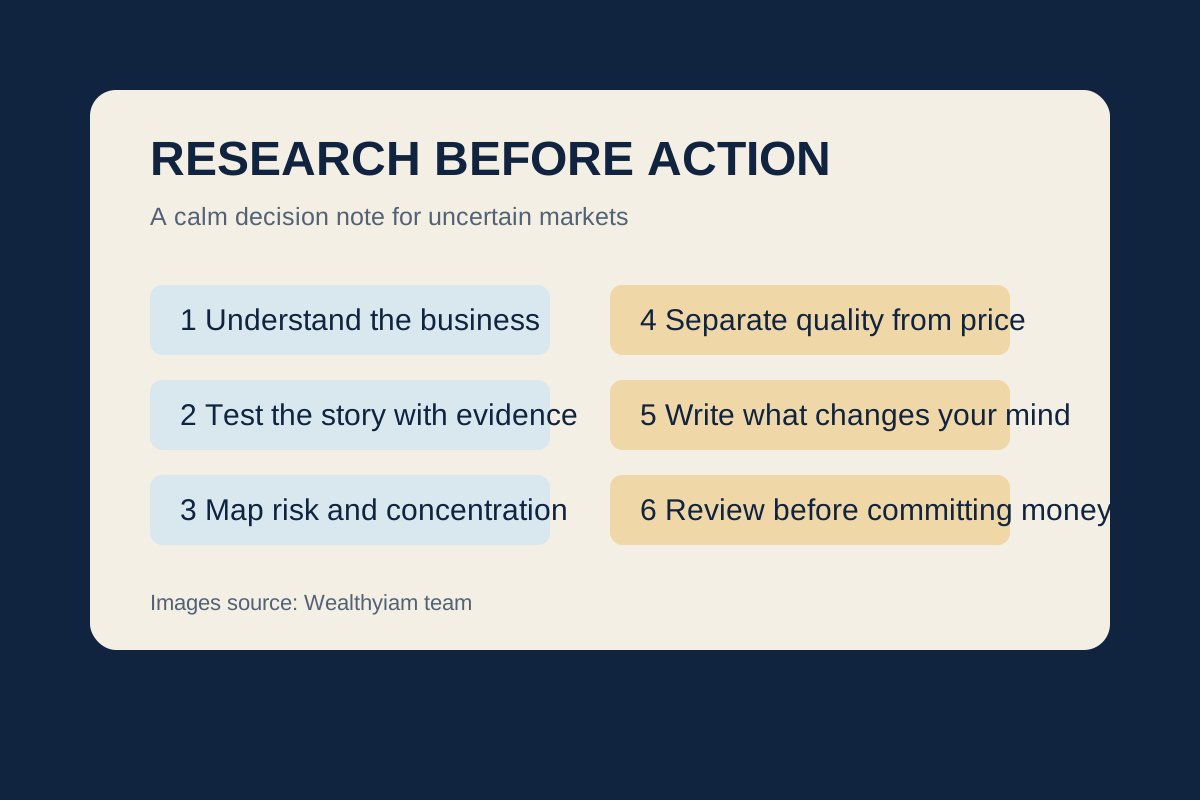
- What goal and time horizon does this serve?
- What could make the plan fail?
- What fees, taxes, obligations, or liquidity limits matter?
- Am I relying on a forecast, anecdote, or verifiable evidence?
- What is my alternative, including doing nothing for now?
- What specific fact would make me change course?
This is a Wealthy I AM application, not a quoted checklist from Dobelli. Customize it and, where appropriate, consult a qualified professional.
A 20-minute clarity review
Choose one pending decision, not your entire financial life.
- State it neutrally. Replace an emotional question with a comparison of option A, option B, and waiting.
- Write the base case and downside case. Describe what must happen and what could go wrong; do not use a guaranteed outcome.
- Label facts, assumptions, and emotions. A current balance is different from an estimate of future returns; fear and excitement are signals to examine, not evidence by themselves.
- Run the outside-view question. What comparable decisions can you identify, and which outcomes are you failing to imagine?
- Check incentives and sunk costs. Ask who benefits and whether past spending is distorting the next choice.
- Choose a review date. Decide when you will revisit assumptions and what evidence you will examine.
Hypothetical example: a tempting investment story
Imagine a reader sees a persuasive post about a fast-growing company and writes buy before checking the balance sheet, fees, concentration risk, or time horizon. A clarity review would not determine the company’s future value. It would reveal that the decision was being driven by social proof and a vivid story while key evidence was missing. The safer conclusion may be to research further, reduce the size of the decision, diversify, or decline it. None guarantees a better result; the process is simply more deliberate under uncertainty.
Mistakes to avoid
- Turning a bias label into a diagnosis of a person.
- Using bias awareness as a trading signal or market-timing method.
- Replacing one shortcut with another; a checklist must fit the decision.
- Overcorrecting into delay when a choice is reversible and low stakes.
- Treating hypothetical examples as forecasts.
- Ignoring personal circumstances, including obligations, jurisdiction, tax treatment, risk capacity, and access to advice.
Who should read The Art of Thinking Clearly?
It may suit readers seeking a concise introduction to reasoning errors, a vocabulary for discussing decisions, or prompts for reviewing financial and business judgment. Readers wanting a detailed investing method, portfolio-construction guide, or evidence review should pair it with more specialized, current sources. Short treatments can simplify complex research, so verify consequential claims independently.
FAQs
Is The Art of Thinking Clearly an investing book?
Not primarily. It addresses thinking errors broadly. Its ideas can be applied to investing, but it does not replace a diversified, goal-based plan or current due diligence.
What is the biggest personal-finance lesson?
A defensible process matters more than a confident story. Slow down, identify assumptions and incentives, consider alternatives, and separate decision quality from outcome.
How many biases does the book cover?
It is commonly presented as a collection of short chapters on many thinking errors. Chapter counts and labels can vary by edition and summary. This article intentionally uses nine editorial lessons rather than claiming an exact chapter framework.
Can a checklist prevent bad decisions?
No. It can make omissions easier to notice, but it cannot eliminate uncertainty, conflicts of interest, incomplete information, or emotional pressure.
How should a beginner apply these ideas to investing?
Start with one decision and general questions about goal, horizon, downside, diversification, costs, liquidity, evidence, and what would change your mind. Consider independent professional advice when circumstances require it.
A cautious next step
Before your next consequential money decision, take 20 minutes to write it in neutral language, list facts and assumptions separately, name the downside, and identify one missing piece of evidence. If the choice materially affects your finances, use that page to have a more productive conversation with a qualified adviser. The point is not perfect rationality. It is making avoidable errors easier to see.
Conclusion
The Art of Thinking Clearly reminds us that intelligence and good intentions do not make anyone immune to flawed judgment. The practical takeaway is modest but actionable: slow the decision, inspect the story, surface incentives, account for what is missing, and use a proportionate checklist. These habits cannot guarantee wealth or remove risk. They can help you make decisions that are more deliberate, explainable, and aligned with your goals.
Sources / Further reading
- Open Library work record — bibliographic source for title and author identity.
- Open Library Covers API image — source provenance; the public page uses original Wealthy I AM artwork.
- — general investor-education context.