If you know what you should do with your money but do not do it consistently, the problem may not be a lack of information. It may be the gap between a good intention and a repeatable system.
The Power of Discipline: How to Use Self Control and Mental Toughness to Achieve Your Goals by Daniel Walter presents self-control and mental toughness as skills that can be developed. For a wealth plan, that idea is more useful as a commitment to a process than as a promise of riches.
> The short answer: turn one wealth-related intention into a small, triggered action you can repeat even when motivation fades. The numbered lessons below are a Wealthy I AM synthesis of the book’s broad topic, not a verified chapter-by-chapter outline of Walter’s framework.
What this book can teach about wealth habits
Walter’s subject is building discipline, not finding a secret that makes hard work disappear. That makes the book relevant to saving, skill building, debt payments, business execution, and long-term investing.
The central translation is simple:
- Motivation can start a change, but it does not decide whether the change survives.
- Discipline is the design of context, commitments, and reviews that makes a desired action easier to repeat.
- The result is not guaranteed wealth, but more consistent follow-through on actions you can control.
This is general education, not individualized financial advice. A routine cannot replace a budget suited to your circumstances, professional advice where appropriate, or careful attention to debt, health, tax, and investment risks.
Four discipline lessons for better money decisions
1. Let your environment do some of the heavy work
If a decision requires you to resist the same temptation every day, willpower is a weak defense. Reduce the number of decisions you need to make.
Wealthy I AM application: create a separate savings bucket or automatic transfer for a goal already defined; schedule a working appointment for the task that creates income or reduces costs; remove one easy distraction from that task’s context.
These are system decisions, not guarantees. A hypothetical example: a scheduled transfer may make saving more consistent, but the right amount depends on income stability, obligations, access to cash, and emergency needs.
2. Shrink the action until it can survive a bad day
A plan that only works when you have abundant energy is not durable. Define the smallest useful version of the behavior. That might be reviewing one recurring charge, reading one page of a skills text, or spending ten minutes on a customer follow-up list.
The small action is not the whole wealth strategy. It is the entry point that keeps the strategy alive. Once stable, you can decide whether to increase it.
Use this format: After [existing event], I will [specific action] for [small duration]. For example: “After Friday’s payday, I will review the next seven days of spending for ten minutes.” That creates an opportunity to act; it does not forecast a financial result.
3. Track behavior, not just outcomes
Income, portfolio prices, business sales, and unexpected expenses are influenced by forces outside your control. A useful discipline review asks first: Did I perform the process I chose?
Create a weekly scorecard with three to five controllable measures:
- Did I complete the planned money review?
- Did I make the debt payment or saving transfer I scheduled?
- Did I spend focused time on the skill or work that supports my income?
- Did I record a decision I may want to revisit?
This does not make outcomes irrelevant. It prevents you from judging a sound process by one short-term result or mistaking a lucky result for a sound process.
4. Review and reset instead of using shame
A missed action is information. Ask what failed: Was the cue unclear? Was the task too large? Did the timing conflict with work, caregiving, health, or sleep? Then modify the system.
Discipline is not a demand to ignore real constraints. It is a commitment to improve the way you respond to them. Protect sleep and health; adjust the routine rather than treating exhaustion as a character test.
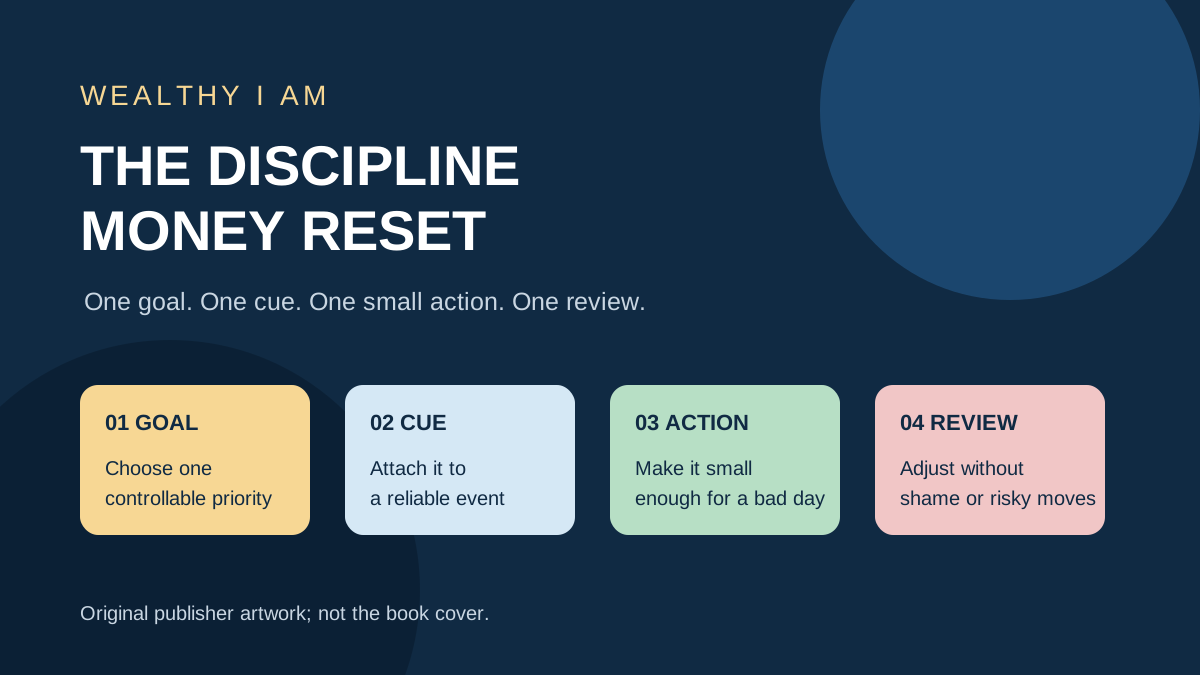
A 20-minute discipline reset for your money plan
This is an original Wealthy I AM worksheet, not a claim about Walter’s exact method.
Minutes 1–5: Name one outcome. Choose one current priority: a starter emergency reserve, debt reduction, skill development, or a business task. Do not choose all four.
Minutes 6–10: Identify the next controllable action. Write one action that can be completed in less than 20 minutes. Define what “done” means.
Minutes 11–15: Design the cue. Attach the action to a calendar event, payday, meal, commute, or another dependable event. Prepare the environment in advance.
Minutes 16–18: Add a recovery rule. If you miss the action, decide when the next attempt occurs. Do not make up for a missed day by taking a risky financial action or sacrificing sleep.
Minutes 19–20: Record the review date. Reassess after two weeks. Keep the action only if it is useful and realistic.
Mistakes to avoid
Treating discipline as a guarantee
Consistency can improve the chance that you follow a sensible plan; it cannot remove market risk, job risk, business risk, inflation, taxes, or unexpected life events. Avoid turning a habit into a promised return.
Copying a routine without checking fit
A schedule designed for another person may conflict with your health, caregiving, shift work, disability, or responsibilities. Adapt the cue and duration. Seek appropriate professional guidance when health or safety is involved.
Making the plan too complicated
Ten apps, a detailed dashboard, and a dozen simultaneous goals can become another form of avoidance. Start with one action, one cue, and one review date.
Confusing a good outcome with a good decision
A risky choice can work once, while a careful choice can have a disappointing short-term result. Record the reasoning, assumptions, and uncertainty behind important decisions.
Frequently asked questions
Is discipline more important than motivation for building wealth?
Motivation may help you begin. Discipline, understood as a repeatable system, can help you continue. Neither replaces adequate income, a realistic plan, sound information, or suitable risk management.
What is the best first money habit?
There is no universal best habit. A reasonable starting point is the action that addresses your most urgent controllable problem: seeing where cash goes, creating a small reserve, reducing high-cost debt, or building an income-supporting skill. Choose one and review it.
Can this approach help with investing?
It can help with process behaviors such as learning, documenting assumptions, diversifying when appropriate, and reviewing a plan on a schedule. It cannot tell you what to buy or predict returns. Consider fees, time horizon, liquidity needs, tax circumstances, and capacity for loss.
How long should I test a routine?
Use a short experiment, such as two weeks, then review whether the action was completed and served its intended goal. Extend or change it based on evidence, not guilt.
Sources and further reading
<small>
- <a href="https://openlibrary.org/works/OL24267786W"><em>The Power of Discipline</em> on Open Library</a> — bibliographic source used to verify the title, author, and work identity.<br>
- <a href="https://books.google.com/books?q=The+Power+of+Discipline+Daniel+Walter">Google Books search for <em>The Power of Discipline</em> by Daniel Walter</a> — supplementary bibliographic source.<br>
- <a href="https://covers.openlibrary.org/b/id/10759650-M.jpg?default=false">Open Library Covers API cover image</a> — image provenance; reuse terms should be confirmed before publication.
</small>
Conclusion
Make the next good action easier to repeat. Pick one wealth-related priority, define a small behavior, attach it to a reliable cue, and review the process without turning a missed day into a moral verdict. That will not guarantee wealth, but it can make your intentions more observable and your decisions more deliberate.