If a new idea looks exciting but you cannot explain who needs it, what it depends on, or how you will respond when conditions change, you are not yet looking at a durable wealth opportunity. You are looking at a possibility.
Short answer: Eric D. Beinhocker’s The Origin of Wealth challenges static views of economics and treats the economy as an evolving, complex system. For a reader making business, career, or investment decisions, the practical value is not a prediction formula. It is a better set of questions about value, experimentation, dependencies, adaptation, and downside.
This article offers seven Wealthy I AM applications of that broad premise. They are not presented as Beinhocker’s official seven-step framework or as a reconstruction of every chapter. This article is educational and is not individualized financial, tax, legal, or investment advice.
Who this is for
This guide is for investors, entrepreneurs, freelancers, and career builders who want a practical way to think about uncertainty. It is especially useful when a decision depends on changing markets, customer behavior, technology, institutions, or other factors no one person controls.
What the book is about
The book’s subtitle, Evolution, Complexity, and the Radical Remaking of Economics, signals its central lens: economies are not simple machines that always settle into a predictable balance. They are shaped by many interacting participants whose choices, technologies, institutions, and expectations change over time.
That idea creates a useful question: how can a reader use a systems view without turning it into another prediction machine? Use it to improve questions and experiments, not to manufacture certainty.
The cover and a quick explanation
The cover identifies the book discussed here. It does not establish that any idea, company, asset, or strategy will produce a particular result.
7 practical lessons for building resilient wealth
1. Start with value creation, not excitement
Value creation means making something people may choose because it helps with a real problem. Novelty alone is not value. A new tool can be costly, confusing, or unnecessary; an ordinary service can be valuable when it reliably solves a painful problem.
Wealthy I AM application: Describe the user before describing the product. Write the problem, the current workaround, and what evidence would show that your proposed improvement matters. Do not call a positive reaction proof of demand.
2. Test assumptions before scaling
An innovation is a possibility, not a validated business model. A practical learning loop is: state a specific claim, test it with real users or operating data, observe what happened, and adapt or stop.
Try this: List three assumptions behind your next business or career decision. Test the one that could cause the most damage with a small, reversible experiment. Measure behavior, such as a completed trial or repeat use, rather than relying only on compliments.
3. Let competition teach you without making it your strategy
Competition can reveal what customers compare, which features are common, and where existing solutions disappoint. But copying competitors rarely creates a durable advantage. The better question is what useful difference you can deliver under your actual constraints.
Try this: Compare three alternatives a customer could choose, including doing nothing. Record price, convenience, trust, switching difficulty, and the problem each option leaves unresolved. Use the comparison to improve your offer, not to make unsupported claims about winning.
4. Include institutions and dependencies in the analysis
Markets operate through rules, contracts, trust, money, platforms, suppliers, and other social arrangements. A plan that ignores these conditions may appear attractive while being difficult or unsafe to operate.
Wealthy I AM application: Before committing capital, list the permissions, agreements, vendors, platforms, data access, and skills the plan requires. Identify what you control, what you assume, and what backup exists if a dependency changes. Tax, legal, privacy, employment, and safety rules vary by jurisdiction and activity; verify current requirements with appropriate authoritative sources.
5. Prefer adaptation to a single winning formula
A systems view favors learning over loyalty to an old plan. Adaptation does not mean chasing every trend. Constant change can waste money and attention when there is no clear learning question.
Try this: Set a review date and write three possible decisions in advance: continue, modify, or stop. Define the evidence for each. Do not let sunk costs—the time or money already spent—become the sole reason to continue.
6. Treat innovation as opportunity and risk together
New technology or a new process may improve productivity, but it can also create recurring costs, provider dependence, implementation work, privacy exposure, or new failure modes.
Hypothetical example: A small firm considers software that might reduce manual reporting. Before buying, it could test one workflow, calculate the complete recurring cost, review data-handling terms, and confirm how information can be exported. This test cannot guarantee savings; it can expose assumptions before a larger commitment.
7. Build a portfolio of capabilities, not one bet
A household’s wealth system can include earning skills, cash reserves, relationships, business ownership, and long-term investments. The right mix depends on goals, timing, obligations, and risk capacity. Diversification can reduce dependence on one outcome, but it cannot eliminate loss.
Try this: Draw four columns—skills, income sources, liquid reserves, and invested assets. Under each, note one concentration risk and one low-cost learning action. Keep emergency funds and near-term obligations separate from speculative or illiquid commitments.
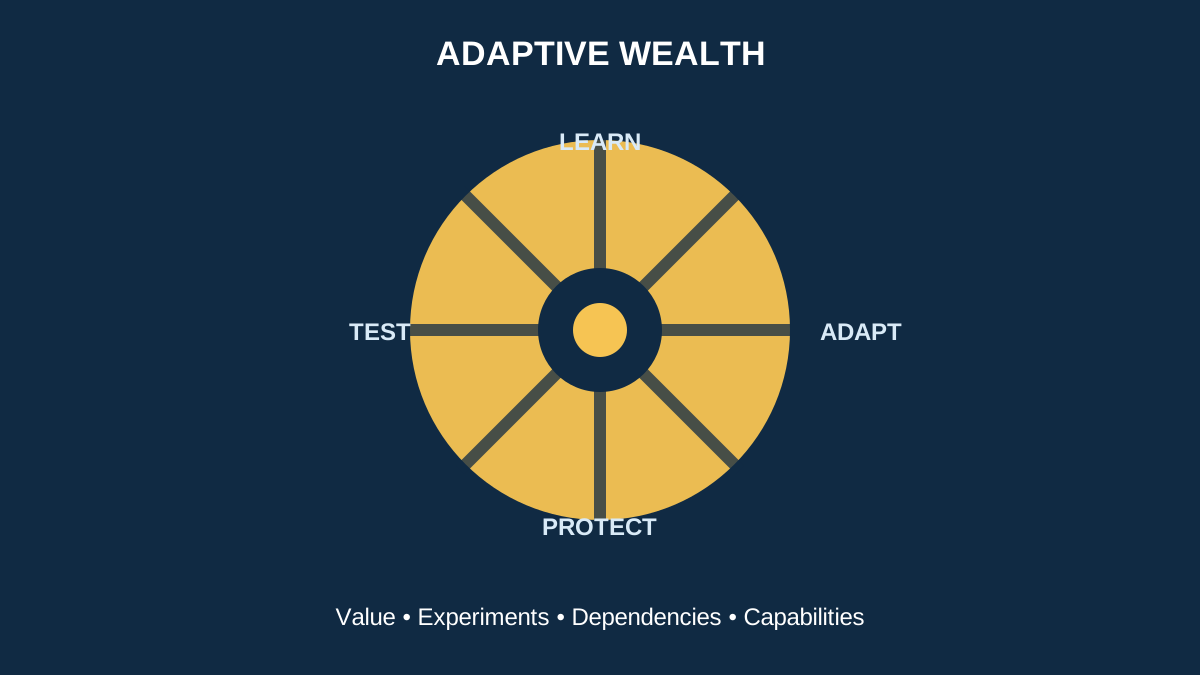
A 45-minute adaptive-wealth review
This is an original Wealthy I AM framework, not a named framework from Beinhocker’s book.
- Name the system: Choose one project, business idea, career decision, or investment plan.
- Define value: Who benefits, and what problem is being addressed?
- List assumptions: Include demand, cost, timing, access, and dependencies.
- Choose one reversible test: Keep money and exposure proportionate to what you are learning.
- Set a decision rule: Specify what would make you continue, change, or stop.
- Review downside: Consider delay, failure, loss of access, and obligations that remain.
- Record the lesson: Separate what happened from the story you hoped would be true.
The point is not to remove uncertainty. It is to make uncertainty visible before it becomes expensive.
Mistakes to avoid
Treating the book as a market forecast
A theory of wealth emergence does not identify the next winning asset, company, or business. Current research and, where appropriate, qualified local advice are still needed.
Confusing novelty with durable value
Ask who benefits, what improves, what it costs, and what evidence supports continued use.
Copying a visible success
Success can reflect timing, luck, resources, or survivorship bias—the tendency to study winners while overlooking comparable attempts that failed. Examples are context, not guarantees.
Making irreversible commitments too early
A learning process still needs limits. Do not risk money needed for essential expenses merely to test an exciting idea.
Frequently asked questions
What is the main idea of The Origin of Wealth?
The book applies evolution and complexity to economics and wealth creation. This article translates that broad perspective into practical questions; it does not claim that its seven lessons are the book’s official framework.
Is this an investing book?
It can inform how readers think about markets, businesses, and value creation, but it is not a personalized portfolio plan. The available record does not support attributing a universal asset allocation to Beinhocker.
Does innovation always create wealth?
No. An idea can fail to find demand, cost too much, create harmful effects, or be overtaken by another approach. Test claims rather than assuming newness is progress.
What can a beginner do first?
Choose one decision and write down its value proposition, assumptions, downside, dependencies, and next reversible test. For substantial financial or legal decisions, seek appropriate professional guidance.
Put it into practice
Choose one wealth-related plan this week. Before committing more time or money, ask: “What value is being created, what must be true, what can I test safely, and what would make me stop?” Write the answers down.
Sources and further reading
- Open Library edition OL8754212M — title, subtitle, author association, publisher, publication date, and ISBN for the 2006 hardcover edition.
- Open Library edition OL8493125M — 2007 paperback record associated with cover ID 1817532.
- Eric Beinhocker’s INET Oxford profile — author identity and the alternate subtitle used on the sourced cover.
- Internet Archive catalog record — bibliographic cross-check for the Harvard Business School Press edition.
<small><strong>Evidence boundary:</strong> The public records above verify the book’s identity, edition details, evolutionary/complexity framing, and alternate subtitle. The exercises, examples, seven lessons, and adaptive-wealth review are Wealthy I AM editorial interpretations. No quotation, statistic, chapter sequence, or guaranteed outcome is attributed to the book.</small>
Conclusion: build the ability to adapt
The Origin of Wealth offers a challenge to static thinking: wealth is shaped by systems that learn, compete, cooperate, and change. The responsible practical translation is not to chase every new idea. It is to define value, test assumptions, understand dependencies, protect downside, and update the plan when evidence changes.
Start with one reversible test and one written stop rule. That cannot guarantee wealth, but it can help you make the next decision with clearer eyes.