If your business depends on every decision you make, start here
A profitable business can still be fragile when the owner is the only person who can approve spending, solve customer problems, or decide what deserves attention. That dependence creates a practical wealth problem: the business may produce income, but it is difficult to operate, improve, or value without its founder.
The early answer is not to copy Warren Buffett or assume a decentralized company will work everywhere. It is to build a small operating system: clarify what decisions belong where, require managers to think like owners, and review how money is being deployed before adding complexity.
That is the useful bridge from Robert P. Miles’s The Warren Buffett CEO: Secrets from the Berkshire Hathaway Managers to everyday leadership. The book examines Berkshire Hathaway managers and the operating, capital-allocation, and leadership principles associated with its decentralized model. This article turns that subject into a cautious set of questions and experiments for owners and leaders. The framework below is Wealthy I AM editorial advice, not a claim that the book presents these exact seven lessons.
You will learn how to reduce founder bottlenecks, improve decision quality, protect cash, and test whether more autonomy is actually making the business stronger.
What The Warren Buffett CEO is about—and what it does not promise
Miles studies managers connected with Berkshire Hathaway’s businesses and the management logic associated with that group: autonomy, owner-minded conduct, sensible capital allocation, and durable performance. The book is useful as a source of management questions, not as a guarantee that a particular structure will produce investment returns or business success.
A decentralized model can also fail. Delegation without boundaries can create inconsistent standards, duplicated work, weak controls, or decisions that look locally sensible but damage the whole organization. Treat the ideas as hypotheses to test in your own context.
Lesson 1: Build a business that can make good decisions without you
The first wealth lesson is about dependence. If every material decision reaches the founder, growth may increase workload faster than capability.
Practical application: List the ten decisions that interrupted you most often last month. For each one, record the decision owner, information required, limit of authority, and point at which the decision must be escalated.
Start with low-risk, reversible decisions. Keep legal, safety, employment, privacy, and major financial decisions subject to appropriate professional or executive review. Delegation is not abdication.
Review question: Did the new owner make a decision faster without reducing quality, compliance, or customer care?
Lesson 2: Give autonomy with a clear definition of good
Autonomy works when people know the objective and the boundaries. Use a one-page decision brief: mission, measures, constraints, authority, and escalation triggers.
The measures should not be confused with a complete picture of business health. Revenue, for example, does not equal cash available, profit, or owner income. Pair growth measures with quality, cash, risk, or service measures where relevant.
Lesson 3: Treat capital allocation as a recurring leadership job
Capital allocation means deciding where scarce money should go: maintaining the current operation, serving customers, hiring, paying down obligations, building reserves, or pursuing a new opportunity.
Before spending, write a short proposal covering the problem solved, total cash commitment including ongoing costs, evidence supporting the need, what could make the decision wrong, and the stop or review date.
A cautious hypothetical example: suppose a small service company is considering software that costs 300 dollars upfront and 80 dollars per month. The owner should not call it an investment merely because it might save time. State which workflow it changes, how adoption will be measured, and when the recurring cost will be reviewed. No financial result is guaranteed.
Use qualified accounting, tax, and legal advice for decisions that depend on jurisdiction, entity structure, contracts, or regulatory obligations.
Lesson 4: Make owner-minded behavior observable
Think like an owner can become an empty slogan. Make it concrete by asking people to explain trade-offs, downstream effects, and resource use—not by asking them to take personal financial risks.
In weekly reviews, ask what the team learned about customer value, which resource was consumed and why, what was stopped, which risk changed, and what decision might be reversed if new evidence appeared. Reward accurate reporting and responsible escalation, not only optimistic outcomes.
Lesson 5: Prefer durable economics over impressive activity
A durable business can deliver useful value repeatedly without relying on a single lucky event. Distinguish activity from economics with this chain:
Customer problem → useful offer → delivery cost → cash collected → resources required to repeat.
For a practical 30-day test, choose one recurring process and document its inputs, owner, time requirement, quality check, and exception path. Compare the documented process with what actually happens before assuming more people or software are the answer.
Lesson 6: Centralize the standards that protect the whole company
Decentralization does not require every team to invent its own rules. Shared standards can protect customers, employees, cash, data, and reputation while leaving room for local judgment.
Define non-negotiables for financial approvals, customer promises, privacy and data access, workplace safety, conflicts of interest, security, and incident reporting. Exact requirements depend on the organization and jurisdiction; ask qualified professionals when consequences are legal, tax, safety, or regulatory.
Lesson 7: Use a small review loop instead of a heroic forecast
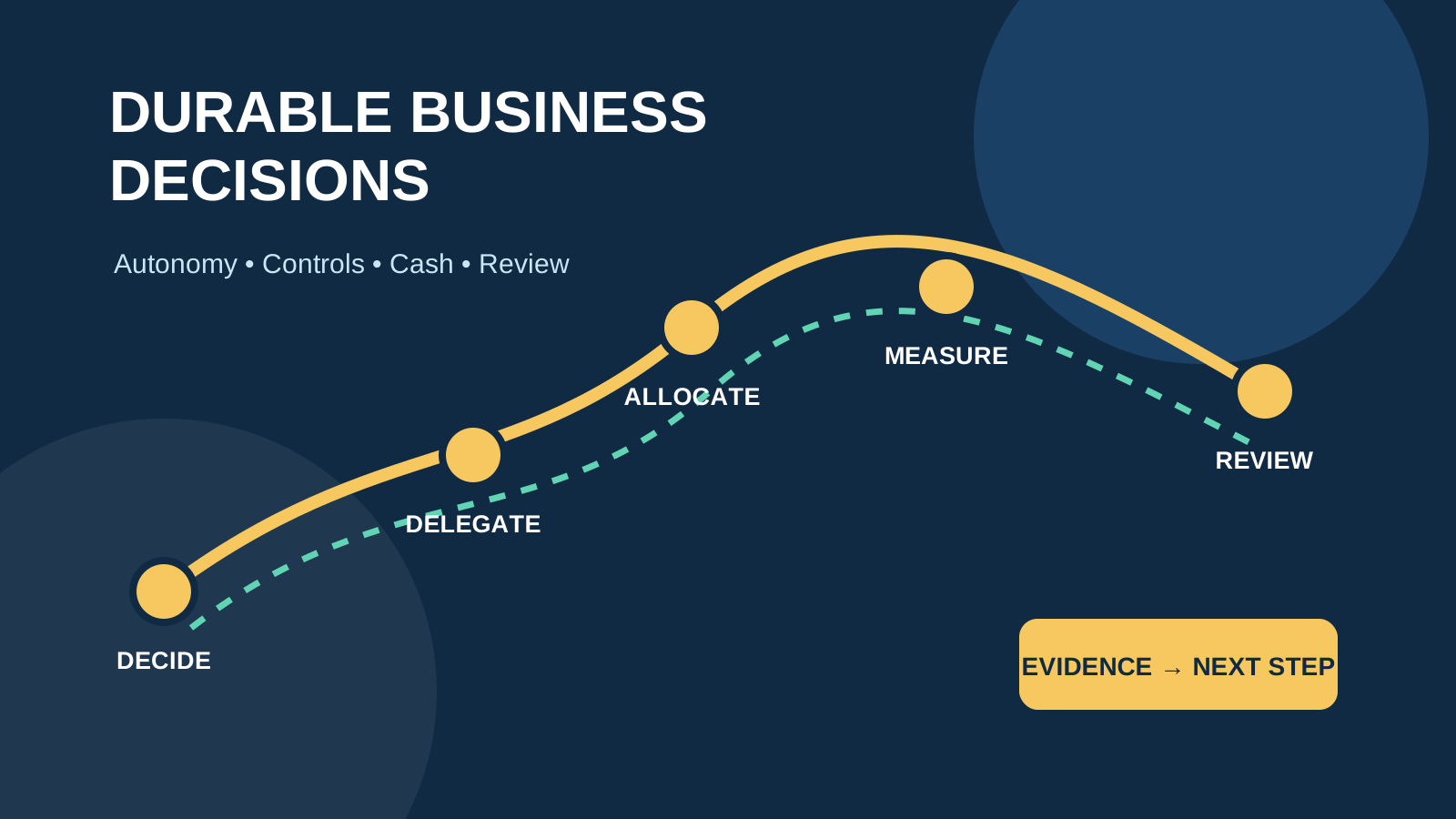
Long-term thinking is not the same as predicting the future precisely. At the end of each month, classify major initiatives as continue, adjust, pause, or stop. Record the original assumptions, evidence since the decision, cash spent and remaining commitment, unintended effects, and next decision date.
This is Wealthy I AM operating advice, not a formal framework attributed to Miles. Its purpose is to make judgment visible and reversible where possible.
A practical 14-day autonomy experiment
Choose one contained workflow that is important but not high-risk. Define the desired outcome and quality boundaries; name one decision owner and escalation contact; set a spending or scope limit; provide relevant information; observe without taking control back at the first discomfort; review errors and hidden costs; then keep, modify, or end the experiment.
Do not use this experiment for immediate safety, regulated activity, sensitive personal data, or obligations you are not qualified to assess.
Mistakes to avoid
Copying Berkshire Hathaway’s structure without its context
A group of businesses, a family company, a nonprofit, and a small agency face different constraints. Borrow principles, not a costume.
Delegating responsibility without resources
A person cannot own an outcome while lacking information, authority, time, or a workable process.
Confusing decentralization with weak controls
Autonomy needs transparent records, clear escalation, and shared standards.
Treating a book’s example as a forecast
A case study can illustrate an idea; it does not establish that the same result will occur in your business.
Measuring only sales
Sales can rise while margins, cash availability, service quality, or operational capacity deteriorate. Review the full chain.
Frequently asked questions
Is The Warren Buffett CEO an investing book?
It is primarily about managers, operating principles, and business leadership associated with Berkshire Hathaway businesses. Readers interested in applying it to investing should do separate research and consider risk, valuation, diversification, and suitability.
Does decentralization mean an owner should stop managing?
No. It changes the owner’s work from making every decision to setting direction, selecting capable decision owners, maintaining controls, and reviewing results.
Can these lessons help a small business?
They can provide questions for a small-business operating system, but appropriate delegation depends on size, risk, skill, cash, and legal obligations. Start with a contained workflow.
Does owner-minded management guarantee wealth?
No. Better decision processes may improve clarity and resilience, but outcomes depend on customers, competition, execution, capital, timing, and factors outside a leader’s control.
A safer way to use the book’s ideas
Read The Warren Buffett CEO as an invitation to inspect how decisions and capital move through an organization. Keep the book’s reported subject separate from your own operating advice. Test one bounded change, measure more than revenue, preserve controls that protect people and cash, and revise the plan when evidence changes.
If you want one next step, schedule a 30-minute review this week: identify one founder bottleneck, one decision that could be delegated safely, and one boundary that must remain shared. Write down the experiment and its review date before you begin.
Sources / Further reading
- <a href=’https://openlibrary.org/works/OL5971358W’>Open Library record for The Warren Buffett CEO</a> — bibliographic source used for title, author, and work identity.
- <a href=’https://books.google.com/books?q=The+Warren+Buffett+CEO+Robert+P.+Miles’>Google Books search for The Warren Buffett CEO by Robert P. Miles</a> — supplementary bibliographic source.
- <a href=’https://covers.openlibrary.org/b/id/304813-M.jpg?default=false’>Open Library Covers API image</a> — cover image source and provenance; reuse rights should be confirmed before publication.