The problem: a return can look attractive while the downside is doing the real work
Many investors ask, “What could this asset earn?” before asking, “What would make this decision difficult to survive?” That order can encourage concentration, leverage, short time horizons, or confidence that is larger than the evidence.
Early answer: The central idea presented in the available Open Library description of The Dao of Capital is a roundabout approach: seek an intermediate positional advantage, think across time, and place protection against severe loss ahead of a forecast. In plain language, do not confuse a direct chase for upside with a durable investment process.
This article is a Wealthy I AM synthesis, not a numbered framework claimed to be the book’s exact table of contents. The available public description supports the book’s broad themes—Austrian economics, market distortions, risk, and a “roundabout” approach across time—but it cannot establish every chapter argument or prove that any strategy will work for a particular reader. The book is an investing perspective, not individualized financial advice.
What The Dao of Capital is about—and what it is not
The cover identifies Mark Spitznagel as the author and Ron Paul as the writer of the foreword. The description presents “Austrian Investing” as a way of seeing markets through time: rather than seeking an immediate decisive win, an investor may use a less direct route to improve position and preserve future choices.
That is different from a promise to predict crashes, beat an index, or profit from every period of stress. A useful reading of the idea is behavioral and process-oriented: structure decisions so that one uncertain forecast does not control your entire financial future.
Seven practical lessons for a more resilient investing process
1. Protect the ability to keep playing
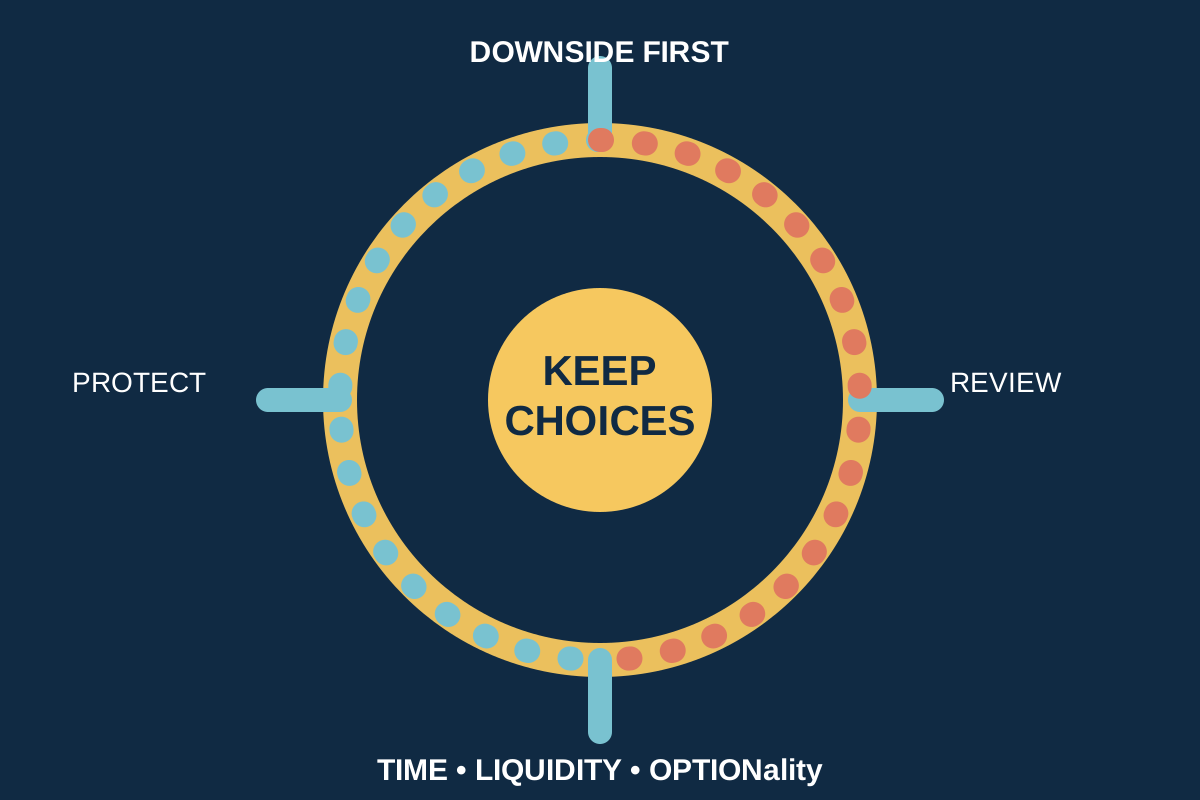
Book idea: The description emphasizes risk and the effect of market routs. Plain-language interpretation: a loss is not merely a smaller number on a screen; it can reduce liquidity, confidence, and the ability to act later.
Practical step: Before evaluating an investment, list the cash you may need for ordinary obligations and near-term known expenses. Keep that planning separate from money allocated to long-term risk. The right buffer depends on your circumstances; do not borrow or invest money you cannot afford to leave exposed.
2. Think in paths, not just endpoints
An investment can reach the same eventual value through very different paths. A severe interim decline may force a sale, trigger a margin call, or change a household decision even if a long-run recovery is possible.
Create a simple path check: “What happens if the price falls sharply? What happens if the thesis takes twice as long? What if income changes at the same time?” These are questions, not forecasts. They reveal whether the plan depends on a single favorable sequence.
3. Treat optionality as a real resource
Optionality means preserving the ability to choose later when new information arrives. Cash reserves, manageable fixed costs, diversified exposure, and the absence of forced borrowing can all preserve choices. They may also have an opportunity cost: money held defensively is not simultaneously pursuing higher-risk returns.
Wealthy I AM application: Make a two-column decision note. On one side, write what the investment could add. On the other, write which future choices it could remove. If the second column is unclear, the research is not finished.
4. Prefer a process that can explain its downside
A process is more useful when it can answer, “What would make me wrong?” A story about a promising asset is not the same as a rule for sizing, reviewing, or exiting it.
For each proposed investment, record:
- the business or asset in one sentence;
- the few factors that must remain true;
- the risks that could impair value;
- the time horizon and liquidity needs;
- what evidence would cause a review.
This does not eliminate uncertainty. It makes uncertainty visible before money is committed.
5. Be skeptical of leverage that converts volatility into urgency
Leverage uses borrowed money or other arrangements that magnify exposure. It can magnify gains, but it can also make a temporary adverse move financially decisive. Interest, collateral requirements, taxes, fees, and timing can matter even when the underlying thesis seems reasonable.
A cautious reader can run the same decision without leverage first. If the unlevered case is unattractive, borrowing does not repair it; it changes the size and speed of the risk. Specific borrowing decisions require professional advice suited to the person’s situation.
6. Use time as part of the analysis
The book’s roundabout language points toward an intertemporal question: what does an action do to later opportunities? A low-cost skill, a robust operating reserve, or a carefully researched asset may be valuable partly because it improves future choices—not because it produces an immediate visible win.
Try a time-horizon audit: label every financial decision short term, medium term, or long term. Then ask whether the funding source and risk level match that label. A long-term idea financed with short-term obligations is structurally fragile.
7. Separate a compelling philosophy from evidence of suitability
A coherent philosophy can improve how you ask questions, but it cannot tell you whether a specific investment fits your goals, tax position, liquidity needs, jurisdiction, or tolerance for loss. Historical examples can also carry survivorship bias: readers may see the cases that remained visible and miss the approaches that disappeared.
Use the book as a lens, then test the lens against primary documents, current facts, costs, and your own constraints. Do not treat the author’s experience as a transferable guarantee.
A 30-minute “roundabout” decision screen
This is an original Wealthy I AM worksheet, not a quoted procedure from the book.
- Define the job. Is this money for liquidity, growth, income, learning, or another goal?
- Write the downside first. Describe a plausible bad outcome without assigning invented probabilities.
- Name the dependency. What must be true for the thesis to work?
- Check the path. Could a drawdown, delay, fee, or income interruption force a bad decision?
- Identify the option preserved. What choice remains available if you wait or size smaller?
- Set a review trigger. Choose a factual change that would make you revisit the idea.
- Pause before action. If you cannot explain the decision in a few sentences, research more or do not proceed.
For a diversified portfolio, this screen can sit beside—not replace—asset allocation, risk tolerance, fees, and tax considerations. For a business owner, the same questions can apply to a large capital purchase or a new debt obligation.
Mistakes to avoid
- Confusing “contrarian” with automatically correct. Being early, different, or unpopular is not evidence of value.
- Turning downside protection into a guaranteed hedge. Protection has costs and may not work as expected in every market condition.
- Using historical crises as a timing system. A past pattern does not identify the next event or its timing.
- Ignoring implementation details. Fees, taxes, liquidity, counterparty risk, and account rules can change an attractive-looking idea.
- Copying a specialist’s method. Experience, resources, and risk capacity differ widely.
- Using a philosophy to avoid measurement. A thesis still needs observable assumptions and a review process.
Frequently asked questions
Is The Dao of Capital a beginner investing book?
It may be useful to a reader interested in risk, cycles, Austrian economics, and long-horizon thinking, but the concepts may require patience. A beginner should pair it with plain-language material on diversification, fees, liquidity, and investment risk.
Does the book teach readers how to predict crashes?
The public description discusses identifying distortions and market routs, but that does not establish a reliable crash-prediction method. Readers should not infer timing ability or guaranteed protection from a book description.
What does “roundabout” investing mean here?
In the book’s described framework, it refers to seeking an indirect or intermediate positional advantage rather than pursuing an immediate decisive result. The practical translation is to value preparation, time, and resilience—not to assume indirect is always superior.
Can I apply these lessons to my portfolio?
You can use the questions as general education, but a portfolio decision depends on personal facts and legal or tax rules that this article does not assess. Consider a qualified professional where the stakes are material.
A grounded next step
Choose one existing investment or proposed purchase and complete the seven-question screen without changing anything today. If the downside, dependency, or review trigger is missing, let that missing information guide your next research step. Resilience is not a promise of higher returns; it is an effort to keep one uncertain decision from removing every later choice.
Conclusion
The Dao of Capital offers a useful challenge to return-first thinking: wealth building is not only about finding upside, but also about preserving the time, liquidity, and judgment needed to remain in the process. Read its ideas as a perspective to test—not as a guarantee or a substitute for personal advice. Start with one decision, write the downside before the upside, and keep your options visible.
Sources / Further reading
– Open Library work record: The Dao of Capital — title, catalogued authors, description, and cover association.<br>
– Open Library search record — title, author names, publication-year listing, and cover ID.<br>
– Open Library Covers API image — image identity/source reference; image-use rights require publisher confirmation before publication.