Money decisions get harder when urgency, anxiety, and confident opinions crowd the room. The problem is not always a lack of knowledge. Often, the decision itself is too vague to examine.
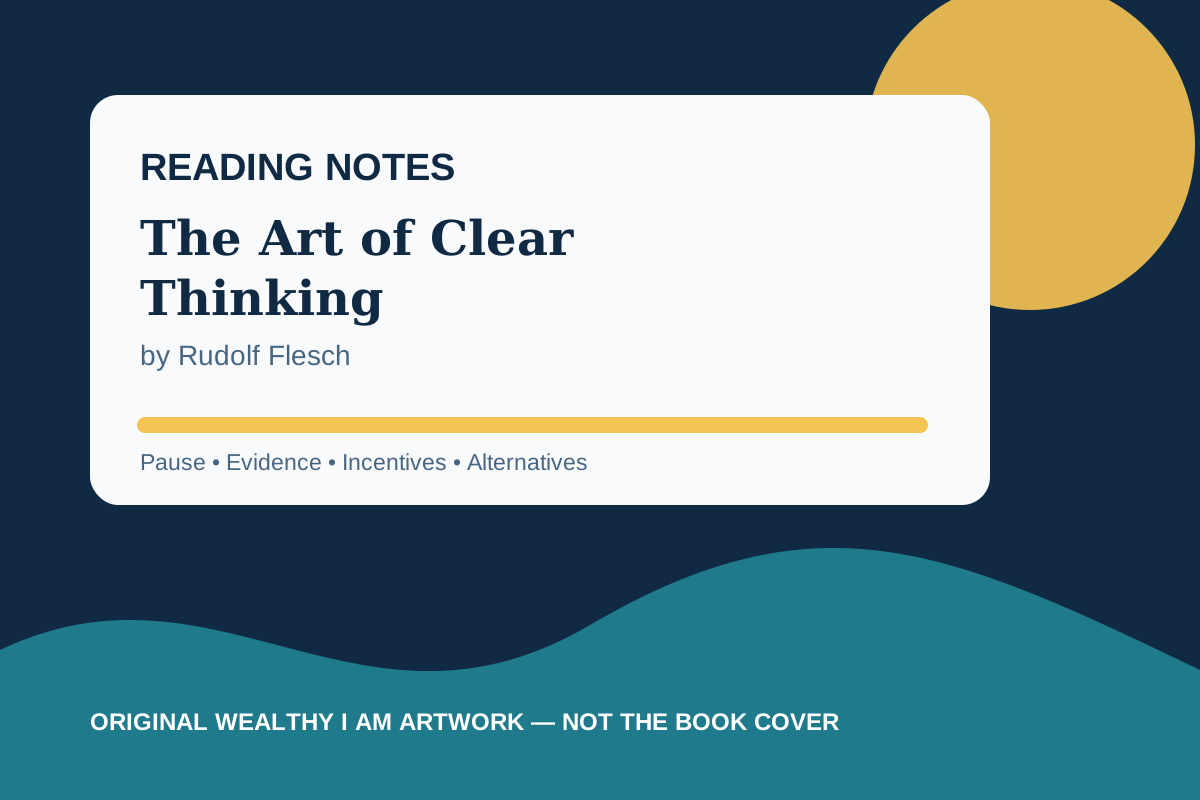
Rudolf Flesch’s The Art of Clear Thinking is not a personal-finance book. Open Library describes it as a 1951 guide to thinking and problem-solving that draws from several fields and includes practical exercises. This article applies that broad theme to money decisions. The five-step method below is a Wealthy I AM framework, not a claim about Flesch’s exact system.
The short version is simple: define the decision, state its purpose, separate evidence from assumptions, make the downside concrete, and choose a reviewable next step.
This is general educational content, not individualized financial, tax, legal, or investment advice.
Why financial questions become unclear
A question such as "Should I invest more?" may contain several separate decisions. The money could be needed soon. Expensive debt may compete for the same cash. The person asking may not have an emergency reserve, may not know the product’s fees, or may be reacting to a recent market move.
When these issues stay bundled together, urgency can pass for evidence. A persuasive sales pitch can feel like research. Fear of missing out can make an optional purchase seem time-sensitive. A recent gain or loss can receive more weight than a long-term plan.
Clear thinking cannot remove uncertainty. It can show which parts of a decision are known, which are assumed, and which still need investigation.
Step 1: Define the decision precisely
"Should I invest?" is too broad to answer. It could mean:
- Should I invest money that I will not need for many years?
- Should I increase a retirement-account contribution?
- Should I buy a particular fund or security?
- Should I invest before paying down high-interest debt?
- How much short-term loss could my finances withstand?
Rewrite the question until another person could tell what a useful answer must address.
For example:
- Vague: "Should I put this money in the market?"
- Clearer: "What portion of the money I will not need for a long time could be invested in a diversified option that fits my plan and my ability to withstand loss?"
The clearer question does not choose an investment. It reveals the information the decision requires: the purpose of the money, the time period, the meaning of diversification, and the consequence of a loss.
Before researching products, complete these four lines:
- I am deciding whether to ____.
- This money is intended for ____.
- I must protect ____.
- I will make or review the decision on ____.
If you cannot fill in those blanks, more product comparisons may only create the appearance of progress.
Step 2: State the purpose and constraints
A financial choice makes sense only in relation to a goal and its limits. Two people can receive the same unexpected sum and face different decisions. One may need the money for a near-term obligation. The other may have no planned use for it for many years. The same asset can create different practical risks for each person.
List the constraints before considering the upside:
- When might the money be needed?
- Must its value remain stable over that period?
- Could access to the money be delayed?
- Are taxes, fees, debt payments, or account rules relevant?
- What other goal would receive less money if this option were chosen?
This step also exposes values that data cannot settle. A decision about leaving a job, buying a home, or starting a business may depend on how much flexibility, uncertainty, or free time a person wants. Those preferences should be stated rather than disguised as financial forecasts.
Step 3: Separate facts, interpretations, and forecasts
A fact is something you can check against a relevant record. An interpretation is what you think the fact means. A forecast is what someone expects to happen. All three can appear in the same advertisement, post, or conversation.
Label important statements in your notes:
- Fact to verify: a balance, fee, interest rate, deadline, tax rule, or contract term.
- Interpretation: an explanation of what that information may mean.
- Forecast: a claim about a future price, return, cost, or outcome.
Suppose an investment has risen recently. The recorded price change is a fact. Calling the investment "safe" is an interpretation. Predicting that the rise will continue is a forecast.
Forecasts are not useless, but they should not borrow the authority of verified facts. Past performance also does not guarantee a future result.
This classification helps with business opportunities too. Revenue shown in an account record is different from an owner’s explanation of why it grew. Both are different from a projection in a sales deck.
Step 4: Identify missing information and make risk concrete
Research becomes unhelpful when it adds facts without improving the decision. Ask a narrower question: What missing information could change my choice?
For a course, rental property, business opportunity, or financial product, that information might include:
- the total cost rather than the headline price;
- cancellation or withdrawal terms;
- taxes and ongoing fees;
- limits on access to the money;
- conflicts of interest;
- the assumptions behind an advertised result; and
- the conditions under which the claimed benefit disappears.
Write a short change-my-mind list:
- What evidence would make this option less attractive?
- Which cost is absent from the headline number?
- Which assumption carries most of the argument?
- Who benefits if I say yes?
- What must I verify independently?
If no evidence could change your mind, you may be protecting an identity or preference rather than evaluating a choice.
Risk also needs a concrete description. "Low risk" and "high risk" mean little without a person, an objective, and a consequence.
Two useful concepts are:
- Risk capacity: the loss, delay, or lack of access that your finances can withstand.
- Risk tolerance: the uncertainty or decline that you can emotionally endure without abandoning the plan.
They are not identical. Someone may feel calm during market declines but still need the money too soon to accept a large loss. Another person may have a long time horizon but discover that volatility leads to impulsive decisions.
Ask what would happen if the value fell, access were delayed, the expected income failed to appear, or the decision had to be reversed. A checklist cannot make an investment safe, but it can make the downside visible.
Step 5: Choose a reversible action and a review trigger
Large commitments feel less confusing when the next action is small and reviewable. That may mean reading the contract, checking a professional’s credentials, requesting a full fee schedule, testing a business idea with a limited budget, or waiting until a near-term cash need is funded.
Create a one-page decision record containing:
- the exact decision and its purpose;
- the facts you verified and where you found them;
- assumptions and forecasts, labeled clearly;
- costs, taxes, conflicts, and access limits still to investigate;
- the main downside scenario;
- the action you will take now; and
- the date or event that will trigger a review.
A review trigger should connect to the plan. A change in the goal, cash need, risk capacity, or documented allocation rule may justify another look. A headline alone may not. Selling, rebalancing, or replacing an investment can create costs and tax consequences, so check the account and rules that apply before acting.
A reversible next step will not always be available. Some decisions have deadlines or require a firm commitment. In those cases, define the smallest amount of money, time, or legal obligation necessary to learn what you need without pretending that the risk has disappeared.
Common mistakes that weaken financial reasoning
Starting with the product
A fund, property, course, or business model is an answer to a question. Comparing products before defining the question can waste time and make marketing categories shape the decision.
Treating plain language as proof
A simple explanation is easier to understand, but simplicity does not make it true. Check the evidence, costs, incentives, and limitations behind the explanation.
Confusing a success story with a likely outcome
One person’s result can show that something happened. It does not establish how common, repeatable, or suitable the result is. Look for the conditions around the story and what the storyteller leaves out.
Researching instead of choosing
More data cannot decide how much flexibility, uncertainty, consumption, or free time you value. At some point, the remaining question may be about priorities rather than facts.
Believing a checklist eliminates judgment
A process can reveal missing questions and weak assumptions. It cannot guarantee a good outcome. Complicated or high-stakes decisions may warrant help from an appropriately qualified professional. Verify credentials, services, fees, conflicts, and legal duties instead of relying on a confident title.
How to apply the idea this week
Choose one pending money decision and write this sentence:
"I am deciding whether to ___ because ___; the most important fact I still need is ___; the assumption I am making is ___; and the downside I must be able to live with is ___."
Then verify one fact from a relevant primary record. Do not take an irreversible step until you understand the main downside and know what would change your mind.
This exercise will not choose for you. It will make the choice easier to inspect, which is more useful than borrowed confidence.
Frequently asked questions
Is The Art of Clear Thinking a personal-finance book?
No. Open Library categorizes the work around logic, thought, reasoning, and psychology. This article applies its broad thinking and problem-solving theme to financial choices.
Did Rudolf Flesch create the five-step financial method in this article?
This article does not make that claim. The five steps are a Wealthy I AM application designed to keep the source’s broad theme separate from the article’s financial guidance.
Can clear thinking prevent investment losses?
No. Better reasoning may help someone notice uncertainty, costs, and downside risk, but it cannot control markets or guarantee an outcome.
What is the fastest way to clarify a money decision?
Define the choice in one sentence, label facts and forecasts separately, and write what evidence would change your mind. That improves the question before you spend time comparing answers.
Conclusion
Clear thinking does not produce permanent certainty. It gives uncertainty a structure. Define the decision, connect it to a purpose, separate evidence from assumptions, describe the downside, and choose a reviewable next step.
The Art of Clear Thinking offers a useful prompt for that discipline. The quality of the result still depends on the information you verify, the risks you can bear, and your willingness to revise an assumption.
Sources and further reading
- Open Library: The Art of Clear Thinking by Rudolf Flesch — bibliographic identity, publication date, subjects, public description, and cover association.
- Open Library Covers API: cover ID 5728967 — exact-work cover provenance. The publisher must confirm use rights or choose an eligible replacement before publication.