Investing becomes confusing when product names and market forecasts arrive before the basic decisions. The Investment Answer by Daniel C. Goldie and Gordon S. Murray offers a shorter route: decide how the portfolio will be managed, how its assets will be divided, how widely it will be diversified, whether implementation will be active or passive, and when holdings will be bought or sold.
Those five choices do not remove risk or produce a guaranteed result. They do give an investor a sequence for evaluating a plan without letting the latest headline dictate it. This summary explains the publisher-identified framework and adds a cautious worksheet for applying it.
This article is general education, not individualized financial, tax, legal, or investment advice. Investments can lose value, and costs, taxes, account rules, and personal circumstances matter.
What The Investment Answer is about
The book presents investing as a manageable set of choices rather than a contest to predict the next winner. Hachette Book Group, the book’s publisher, describes five questions at the center of the approach:
- Should you invest on your own or seek help from an investment professional?
- How should you allocate investments among stocks, bonds, and cash?
- Which specific asset classes should the portfolio include?
- Should implementation be actively managed or passive?
- When should you sell assets, and when should you buy more?
The value of this sequence is practical. Each decision narrows the next one. A fund, stock, or market opinion should not define the plan before the investor has considered management, allocation, diversification, implementation, and maintenance.
The five decisions that shape an investment plan
1. Decide whether to invest alone or seek professional help
The first question is not “What should I buy?” It is “Who will make and maintain the decisions?” Some investors have the time, knowledge, discipline, and interest to manage a straightforward portfolio themselves. Others may benefit from professional help because their finances are complex, they need planning support, or they are likely to make impulsive changes under pressure.
Hiring a professional does not transfer all responsibility. An investor still needs to understand how the adviser is paid, what services are included, whether conflicts of interest exist, and who has custody of the assets. Credentials and legal duties vary by location, so they should be checked with the relevant regulator or professional body rather than inferred from a job title.
A useful test is to write down the tasks the portfolio requires: setting goals, choosing an allocation, selecting holdings, handling taxes where relevant, rebalancing, and reviewing changes in personal circumstances. Then decide which tasks you can perform reliably and which, if any, require qualified help.
2. Choose an allocation among stocks, bonds, and cash
Asset allocation is the division of a portfolio among broad categories such as stocks, bonds, and cash. Each category has different patterns of risk, expected return, liquidity, and sensitivity to economic conditions.
A stock-heavy allocation may offer greater long-term growth potential but can experience substantial declines. Bonds can add income and reduce some forms of volatility, yet they still face interest-rate, inflation, and credit risk. Cash can support near-term spending and stability, but its purchasing power may erode over time.
No single mix is right for everyone. The allocation should reflect what the money is for, when it may be needed, how much loss the investor can financially withstand, and how much fluctuation the investor can tolerate without abandoning the plan. Risk capacity—the financial ability to absorb loss—is different from risk tolerance, which is the emotional willingness to experience uncertainty.
Before selecting products, list each major goal, its likely date, and the consequence of a shortfall. Money for a near-term obligation should not automatically share the same allocation as money intended for a goal decades away.
3. Diversify within the broad categories
The third decision asks which specific asset classes belong inside the broad allocation. Owning “stocks” could mean exposure to one company, one industry, one country, or many markets. The same issue applies to bonds: issuers, maturities, credit quality, and geography can create very different risks.
Diversification spreads exposure so that one holding or narrow segment has less power over the whole portfolio. It can reduce concentration risk, but it cannot prevent losses or guarantee a return. Owning several funds is not necessarily diversified if they contain many of the same securities.
A practical review starts by grouping current holdings by their underlying exposures rather than their brand names. Look for a single employer, sector, country, borrower, or strategy that dominates the result. Also check whether apparently different funds overlap. The aim is not to collect as many holdings as possible; it is to understand which risks the portfolio actually carries.
4. Choose between active and passive implementation
Active management attempts to outperform a market benchmark through security selection, market timing, or both. Passive management generally seeks to track a defined index or market segment rather than beat it through frequent discretionary choices.
The decision involves more than a label. Compare the strategy’s objective, benchmark, fees, trading costs, tax consequences where applicable, transparency, and the behavior required from the investor. A lower-cost passive fund is not risk-free, and an active manager’s past performance does not establish future outperformance. Both approaches can disappoint, and any product can be unsuitable for a particular goal.
For each holding, write four lines: its role, its main risks, its ongoing costs, and the evidence for keeping it. If an active strategy is used, define how its performance and risk will be judged over an appropriate period. If a passive strategy is used, confirm what the index owns and whether that exposure fits the intended allocation.
5. Set rules for buying, selling, and rebalancing
Market movements change a portfolio’s proportions. Rebalancing means moving the portfolio back toward its intended allocation, either by directing new contributions or by buying and selling holdings. Without a rule, investors may buy after enthusiasm has raised prices or sell after fear has already driven them down.
A maintenance policy should define when the portfolio will be reviewed and what can justify a change. Possible triggers include a major life event, a changed time horizon, a material change in income or obligations, or a meaningful drift from the target allocation. A market headline by itself is not necessarily evidence that the investor’s goals have changed.
Buying and selling may create transaction costs, taxes, or account restrictions. The appropriate method and threshold therefore depend on the investor’s situation. The useful principle is to decide the process before a stressful market event, not to pretend that one universal schedule works for everyone.
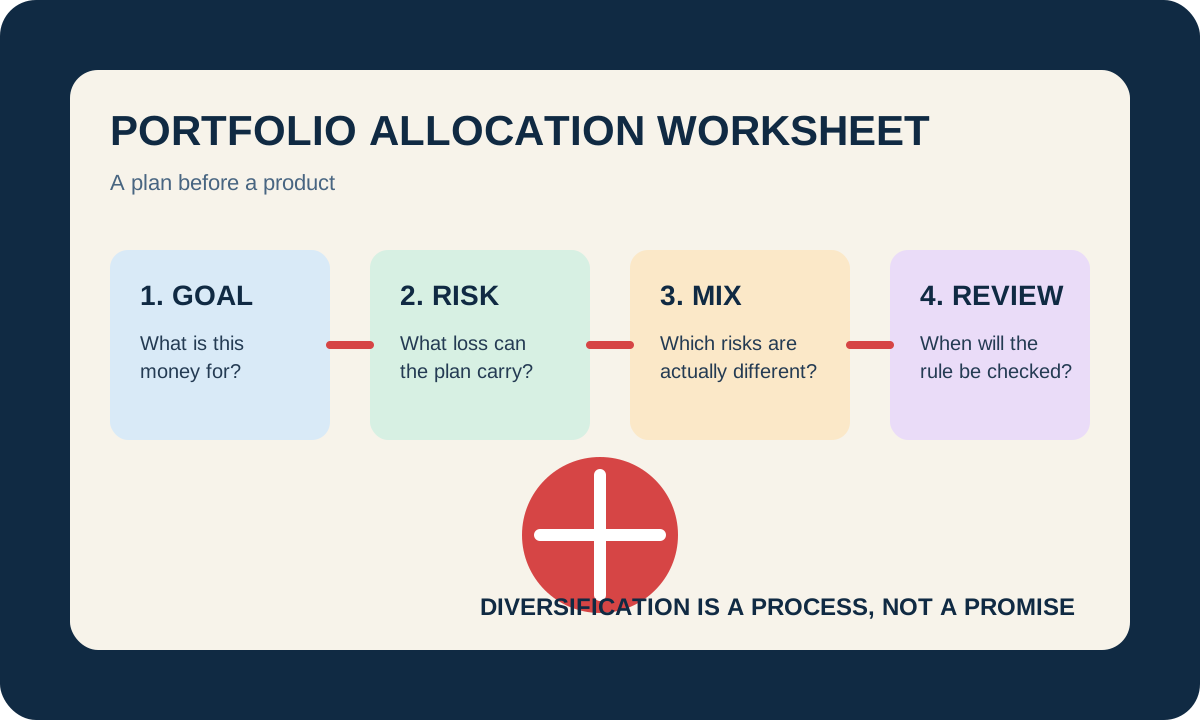
A one-page worksheet for applying the framework
The following worksheet is a Wealthy I AM application, not a claim that the authors prescribe these exact prompts.
- Management: Which tasks will I handle, and where might I need regulated, qualified advice?
- Purpose: What is each pool of money for, and when might it be needed?
- Allocation: What broad mix of stocks, bonds, and cash fits each goal and its constraints?
- Diversification: Which underlying regions, sectors, issuers, maturities, or other exposures do I actually own?
- Implementation: Is each holding active or passive, what does it cost, and what role does it serve?
- Maintenance: When will I review the portfolio, and what evidence would justify buying, selling, or rebalancing?
Keep the answers short enough to revisit. The worksheet is useful because it exposes assumptions. It is not a substitute for current product documents, tax information, legal requirements, or personal advice.
A hypothetical example: two goals, two jobs
Imagine a household has one pool of money for a planned expense in two years and another for retirement several decades away. Treating both pools as one portfolio could hide an important conflict: the nearer goal may require access and stability, while the longer goal may be able to accept more market fluctuation.
The household could first decide whether it needs professional help, then choose a separate allocation for each goal. It could examine diversification within each allocation, select understandable active or passive holdings, and document review rules. The example does not recommend a particular percentage or predict a return. It shows why the five decisions should be connected to the job the money must perform.
Common mistakes the framework can expose
- Starting with a product: a popular security or fund may not fit the goal or intended allocation.
- Mistaking quantity for diversification: several overlapping holdings can reproduce the same concentration.
- Treating “passive” as “safe”: an index fund still reflects the risks of the market it tracks.
- Choosing an adviser by title alone: services, credentials, legal duties, fees, and conflicts require verification.
- Using past performance as a forecast: historical results do not guarantee future outcomes.
- Ignoring liquidity: an asset may be difficult or costly to sell when the money is needed.
- Rebalancing without checking consequences: trades can create costs, taxes, and account effects.
- Changing the plan after one headline: new information about personal goals may matter more than market noise.
Who may benefit from the book?
The publisher describes The Investment Answer as a jargon-free primer for beginners and experienced investors. Its five-question structure may be especially useful for someone who owns investments but cannot explain how the pieces fit together.
Readers looking for individualized allocation percentages, current product recommendations, detailed tax guidance, or a promise of superior returns need more than a short general framework. Product terms and laws change, and a sound process cannot eliminate market uncertainty.
Frequently asked questions
Does the book identify five specific investment decisions?
Yes. Hachette’s official description lists decisions about professional help, allocation among stocks, bonds, and cash, diversification into specific asset classes, active versus passive management, and when to buy or sell.
Does diversification make a portfolio safe?
No. Diversification can reduce dependence on a narrow holding or exposure, but broad markets can fall and investments can lose value.
Is passive investing always better than active investing?
The framework asks the investor to make the choice; it does not make every passive product suitable or every active product unsuitable. Costs, objectives, exposures, evidence, taxes, and personal constraints all matter.
How often should a portfolio be reviewed?
There is no universal schedule. A deliberate periodic review and predefined checks after major personal changes can be more disciplined than reacting to every market movement. Trading consequences and account rules should be considered before acting.
A grounded next step
Take 30 minutes and answer the five questions in one sentence each. If you cannot explain who manages the plan, why the allocation fits the goal, what risks are diversified, why the implementation method was chosen, or what would trigger a trade, identify that gap before adding another investment.
The lasting value of The Investment Answer is not a prediction. It is a decision order. By making management, allocation, diversification, implementation, and maintenance explicit, an investor can evaluate a portfolio as a system rather than a collection of disconnected products.
Sources / Further reading
- Hachette Book Group: The Investment Answer — official title, contributor, subtitle, and five-decision description.
- Open Library work record: The Investment Answer — bibliographic identity, subject classification, and cover association.
- Open Library Covers API, cover ID 6670744 — cover identity/source reference; image reuse rights must be confirmed before publication or an eligible substitute used.