The problem: a low price is not the same as a good business
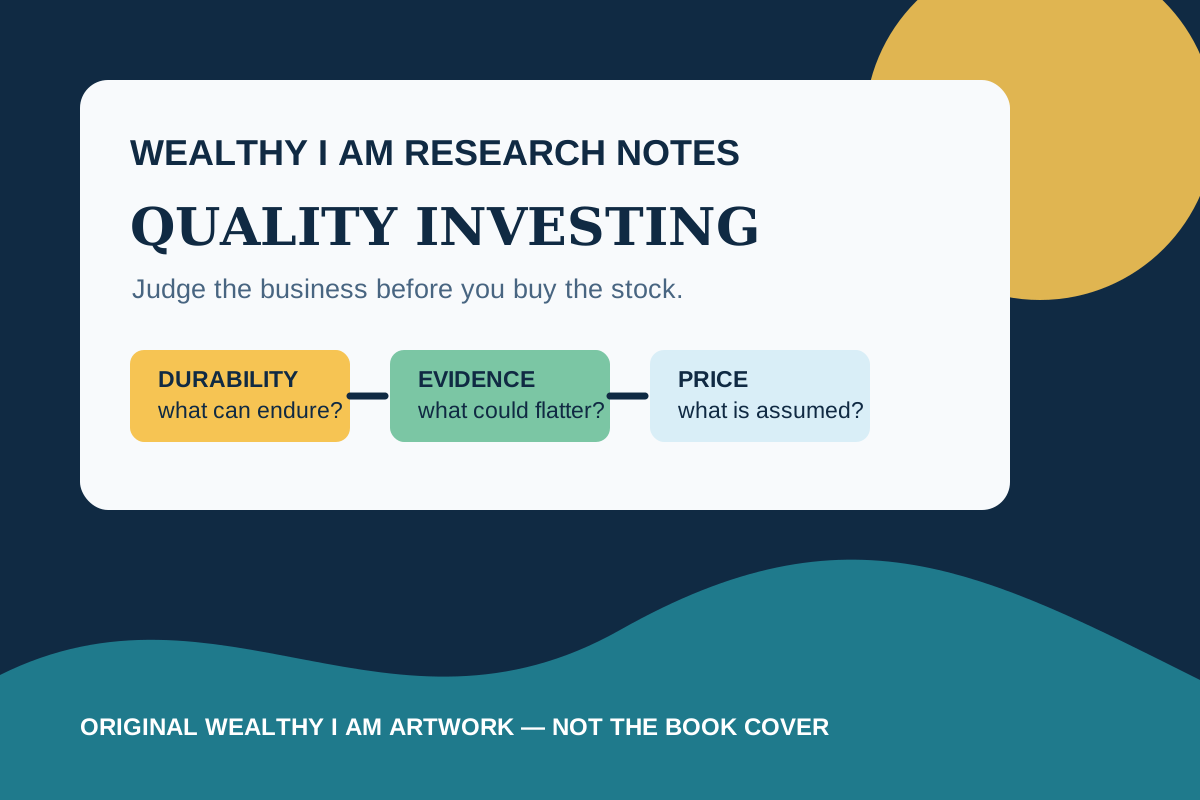
A stock can look inexpensive because its business is weakening. Another can look expensive because investors expect its economics to endure. Quality Investing begins with a harder question: what makes a company capable of prospering over time, and what could prevent it from doing so?
The publisher, Harriman House, describes the book as an account of an under-explored investment philosophy. Its central challenge is defining quality in an investing context. The publisher says the authors focus on companies with attributes that can help them overcome mean reversion—the tendency for exceptional performance to move back toward average—and hold outstanding companies for the long term. This article summarizes that published description and translates it into practical research questions. The checklist and examples are Wealthy I AM applications, not quotations or claims that the authors prescribe these exact steps.
What the book is about—and who may benefit
The book presents quality investing as more than finding a low price or chasing a recent winner. According to the publisher’s synopsis, it explains characteristics that may increase a company’s probability of prospering over time, as well as characteristics that hinder it. It also discusses AKO Capital’s investment philosophy and processes and uses real-life case studies to illustrate traits that can signify quality or merely flatter to deceive.
That makes the book potentially useful for patient investors and learners who want to study business quality, durability, and long-term ownership. It is not a promise of superior returns, a guarantee of safety, or a substitute for reviewing current company information.
Five practical lessons from the publisher-described framework
1. Define quality before trying to measure it
The publisher identifies the difficulty of articulating a clear definition of quality. That is a useful warning against treating one ratio or a recent share-price move as a complete answer.
Application: write one page explaining the customer, product, revenue source, costs, capital needs, and dependencies. Then state what “quality” would mean for this particular business. If the definition relies only on promotional language, the research is not finished.
2. Look for attributes that can endure mean reversion
The publisher says quality investing seeks companies with attributes that can help them overcome the pressure for exceptional performance to become average. That does not mean a company is permanently protected from competition or decline. It means durability is a question to investigate, not an adjective to assume.
Application: list each claimed advantage—such as customer trust, switching costs, distribution, network effects, or cost structure—and identify how a competitor, new technology, regulation, or changing customer preference could weaken it. A familiar brand is not automatically an enduring advantage.
3. Study the traits, not just the outcome
The publisher’s synopsis says the book distinguishes traits that signify quality from traits that merely flatter to deceive. A high growth rate, popular product, or recent margin improvement can be evidence worth studying without being proof of a durable business.
Application: create a small evidence table. For each attractive trait, record the supporting fact, the time period, the possible alternative explanation, and what future evidence would change your view. This keeps a good recent outcome from doing all the argumentative work.
4. Treat long-term ownership as a test of the thesis
The publisher explicitly connects the philosophy with owning outstanding companies for the long term. Long-term ownership is not passive optimism: it requires checking whether the attributes that justified ownership still exist.
Application: keep a decision log covering capital allocation, debt, acquisitions, share issuance, incentives, and responses to setbacks. Separate known facts from uncertainty. Revisit the log after each annual report or material business change. The goal is not to predict every event; it is to notice when the original quality case is no longer intact.
5. Separate business quality from the price you pay
A strong business can still be a poor purchase if the price assumes an unrealistically favorable future. The publisher’s description emphasizes company characteristics and long-term ownership; it does not turn that description into a guaranteed valuation rule. Price discipline is therefore a necessary application when moving from business research to an investment decision.
Application: write a base case, cautious case, and reason-not-to-buy case using ranges rather than false precision. Ask what expectations the current price appears to require. Diversification—spreading money across investments to reduce dependence on one outcome—can also reduce the damage caused by an incorrect judgment.
A 30-minute quality-investing review
- Define quality for this business: what attributes would make its prosperity more durable?
- Describe the customer problem: who pays, and why might demand persist?
- Test the advantage: what evidence supports the claimed attribute, and how could it erode?
- Check for “flattering” evidence: could the recent result be temporary, cyclical, or misleading?
- Review long-term dependencies: consider competition, regulation, concentration, financing, and necessary investment.
- Separate quality from price: record what the current price appears to require.
- Choose a rule: define what would make you research further, wait, diversify, or walk away.
If information is missing, “not enough evidence” is a valid result.
A hypothetical example: quality that endures versus quality that flatters
Imagine fictional Northstar Tools and Harbor Services. Northstar has fast sales growth but needs frequent borrowing and heavy promotion. Harbor grows more slowly, has repeat customers, and produces steadier cash, but faces a credible new competitor. Neither description establishes which is the better investment. Ask which attributes might endure, which results could flatter, what can break the thesis, and what price would make the risk unacceptable. This is a hypothetical application, not a case study from the book, forecast, or recommendation.
Mistakes to avoid
- Calling any profitable or fast-growing company high quality.
- Treating a quality attribute as permanent.
- Confusing a good outcome with a good decision.
- Ignoring price because the business is attractive.
- Assuming long-term ownership means never revisiting the thesis.
- Copying a quality framework without updating facts about the company.
- Overconcentrating because research feels convincing.
Frequently asked questions
Is Quality Investing a mechanical stock-picking system?
The publisher presents the book as an investment philosophy and process focused on company characteristics, long-term ownership, and case studies—not as a guaranteed mechanical system. Readers should consult the book itself for the authors’ complete method.
Does a high-quality company always outperform?
No. The publisher’s description discusses characteristics that may increase the probability of prospering; probability is not certainty. Competition, execution, regulation, valuation, market conditions, and unforeseen events can still change an outcome.
Is it suitable for beginners?
The questions in this article can help a beginner organize research, but financial statements and valuation require learning. Start with a watchlist or paper analysis if useful. Seek individualized tax, legal, or investment advice when appropriate.
Sources / Further reading
Primary content source: Harriman House, Quality Investing product page and publisher synopsis. Bibliographic identity and edition data: Open Library work record; Open Library catalog search. The publisher page supports the summarized framework; consult the full book for a complete account. General education is not individualized financial advice.
A cautious next step
Choose one company you follow and complete the seven-question review without buying or selling anything. Save the sources, mark uncertainties, and revisit the thesis after a defined period. The purpose is not certainty; it is to make assumptions visible before money is at risk. Quality is a research question, not a safety guarantee.