A cautious summary and practical starting point
If your income has risen but your finances still feel fragile, The Next Millionaire Next Door offers a useful corrective: visible consumption is not the same as accumulated wealth. Thomas J. Stanley and Sarah Stanley Fallaw describe the millionaire next door as someone who lives below their means, resists a consumption-heavy culture, and pursues financial goals with discipline.
This article turns that broad catalogued description into seven practical habits. The seven headings are a Wealthy I AM synthesis, not a claim that the authors present this exact numbered framework. The book is best treated as a lens for examining behavior—not as a guarantee, stock tip, or personalized financial plan.
Image credit: Open Library Covers API, cover ID 10407032, associated with the Open Library work The Next Millionaire Next Door. Cover reuse terms should be checked before publication.
What problem does the book help clarify?
A high salary can make spending easier, but it does not automatically create a durable balance sheet. Someone can look prosperous while saving little, carrying expensive debt, or depending on every paycheque. A household may instead build resilience through ordinary choices that attract little attention.
Here, wealth means resources that remain available after current consumption and obligations are accounted for. Financial resilience means having more capacity to handle an income interruption, an unexpected bill, or a change in priorities without immediately taking on harmful debt. Neither term is a promise of comfort or a universal target.
The Open Library description supports the book’s broad emphasis on living below one’s means, resisting hyper-consumption, and pursuing financial objectives with discipline. It does not establish every detail of the full text, so the applications below are clearly presented as interpretation and practice.
Seven quiet habits to test
1. Measure what you keep, not only what you earn
Income is an input; retained resources are what can support future choices. Track take-home income, essential spending, discretionary spending, debt payments, and amounts saved or invested. The aim is not to judge every purchase but to make the gap between inflow and outflow visible.
For example, if a household receives 5,000 units of take-home income and spends 4,850, the remaining 150 is available for reserves, debt reduction, or investing. It is not evidence that the household is financially secure. This is a hypothetical illustration, not a forecast.
Try this: Review the last 30 days and identify three recurring outflows that do not clearly support a priority. Cancel, reduce, or consciously keep each one.
2. Let lifestyle growth lag income growth
When every increase in income becomes a permanent increase in spending, progress can remain hard to see. This does not mean refusing reasonable improvements or treating frugality as a moral test. It means creating a pause before committing to higher fixed costs such as housing, transport, or subscriptions.
Try this: When income changes, direct part of the increase automatically toward a stated goal for a defined trial period. Reassess after the trial instead of making an immediate permanent commitment.
3. Treat status spending as a decision, not a default
Purchases made to signal success can compete with purchases that improve security or usefulness. Status is contextual: professional expenses, reliable transport, and a safe home may be valuable even when visible to others. The useful question is whether a purchase serves your purpose or mainly responds to comparison.
Try this: Before a conspicuous purchase, ask, “Would I still choose this if nobody else knew I owned it?” A yes is not a prohibition; it is a prompt to separate personal value from social pressure.
4. Convert goals into operating rules
“Build wealth” is too vague for a weekly decision. “Transfer a chosen amount on payday to an emergency reserve until it reaches my stated target” is an operating rule. The right amount and target depend on circumstances, so this is not individualized financial advice.
Try this: Write one rule in this form: When [trigger] happens, I will [action] for [period], then review [measure]. Keep it realistic enough to follow during a busy month.
5. Protect time for earning power and learning
Wealth-building is not only a spending problem. Skills, judgment, relationships, and a business can affect future earning power, although outcomes are uncertain. The point is not to turn every hour into a productivity contest; it is to protect time for work that matters.
Try this: Reserve one recurring block for a specific capability that could improve your work. Define the output—an application, prototype, client conversation, or completed lesson—rather than simply counting hours.
6. Use a written filter before committing capital
A pre-decision checklist can slow impulsive choices and expose trade-offs. Before a major purchase, investment, or business commitment, record the purpose, total cost, downside you can tolerate, liquidity needs, and what evidence would change your mind. Liquidity means how readily an asset can be converted into usable cash; a valuable asset may still be difficult to sell quickly at a fair price.
Try this: Write the decision down before money moves and schedule a review date. For investments, consider fees, diversification, time horizon, and the possibility of loss.
7. Define “enough” before comparison defines it for you
Without a personal definition of enough, consumption can expand indefinitely. Enough might include stable housing, flexibility, family support, charitable giving, meaningful work, or the ability to absorb setbacks. Defining it does not eliminate ambition; it gives ambition a direction.
Try this: List three conditions that would make your finances more useful to your life. Identify one current expense, goal, or habit that supports each condition.
A 30-minute quiet-wealth audit
Use this as an original application, not as an official method from the book:
- Describe the destination: Write one near-term financial priority and why it matters.
- Map the flow: List income, fixed commitments, flexible spending, debt payments, and current saving or investing.
- Find the pressure point: Choose the largest recurring mismatch between your priority and actual spending or time.
- Choose one rule: Select one automatic transfer, spending pause, review checklist, or learning block.
- Name the risk: Note what could make the plan fail, such as irregular income, caregiving, health, debt cost, or an unrealistic target.
- Schedule a review: Assess whether the rule was workable and adjust it without treating the first attempt as a character verdict.
If debt is high-cost, an emergency reserve is absent, or an investment decision is complex, consider qualified, jurisdiction-appropriate advice. These ideas do not replace current budget, legal, tax, or investment guidance tailored to your circumstances.
Mistakes to avoid
Confusing frugality with deprivation. A sustainable plan leaves room for priorities and dignity. Cutting a useful expense can backfire if it makes the system impossible to maintain.
Treating affluent behavior as a guarantee. Luck, family resources, health, timing, education, geography, and opportunity influence outcomes. Copying one visible habit cannot reproduce another household’s result reliably.
Turning a behavioral lens into a stock tip. The book does not identify a suitable security, return, tax strategy, or allocation for every reader. Diversification can reduce concentration risk but cannot eliminate investment loss.
Using shame as a budgeting tool. A spending review should create information and choices, not humiliation. Start with one category and seek help when the problem exceeds what a simple tracker can solve.
Who may benefit from the book?
It may help readers who want to examine the difference between looking wealthy and building financial capacity, especially those facing lifestyle inflation or social comparison. It is less suitable as a stand-alone guide to current tax rules, investment-product analysis, debt law, or a personalized plan. Those topics require current, jurisdiction-specific sources and often professional advice.
Frequently asked questions
Is The Next Millionaire Next Door a budgeting book?
It is better understood as a book about behaviors and choices associated with accumulating wealth. Budgeting is one practical way to test whether spending aligns with goals, but it is not presented here as the book’s complete method.
Does living below your means mean never spending on quality?
No. It means spending less than available resources over time, with room for priorities and obligations. A quality purchase can be sensible when it serves a clear purpose and fits the wider plan.
Can these habits make me wealthy?
No outcome is guaranteed. They may clarify trade-offs and support disciplined decisions, but results depend on circumstances, behavior over time, markets, costs, and factors outside your control.
What should I do first?
Track one month of cash flow and choose one small operating rule. A workable rule that you can review is more useful than an ambitious system you abandon.
Further reading and source boundary
The book identity, author attribution, catalog description, and cover provenance were checked against these Open Library records:
- Open Library work record: The Next Millionaire Next Door
- Open Library author record: Thomas J. Stanley
- Open Library author record: Sarah Stanley Fallaw
- Open Library cover image source
Conclusion
The Next Millionaire Next Door offers a useful corrective to the idea that wealth must be visible. Its broad lesson is to examine what remains after consumption, how social pressure shapes choices, and whether discipline is connected to a meaningful goal. The seven habits above are an editorial application of that lens—not a guarantee, universal prescription, or individualized advice.
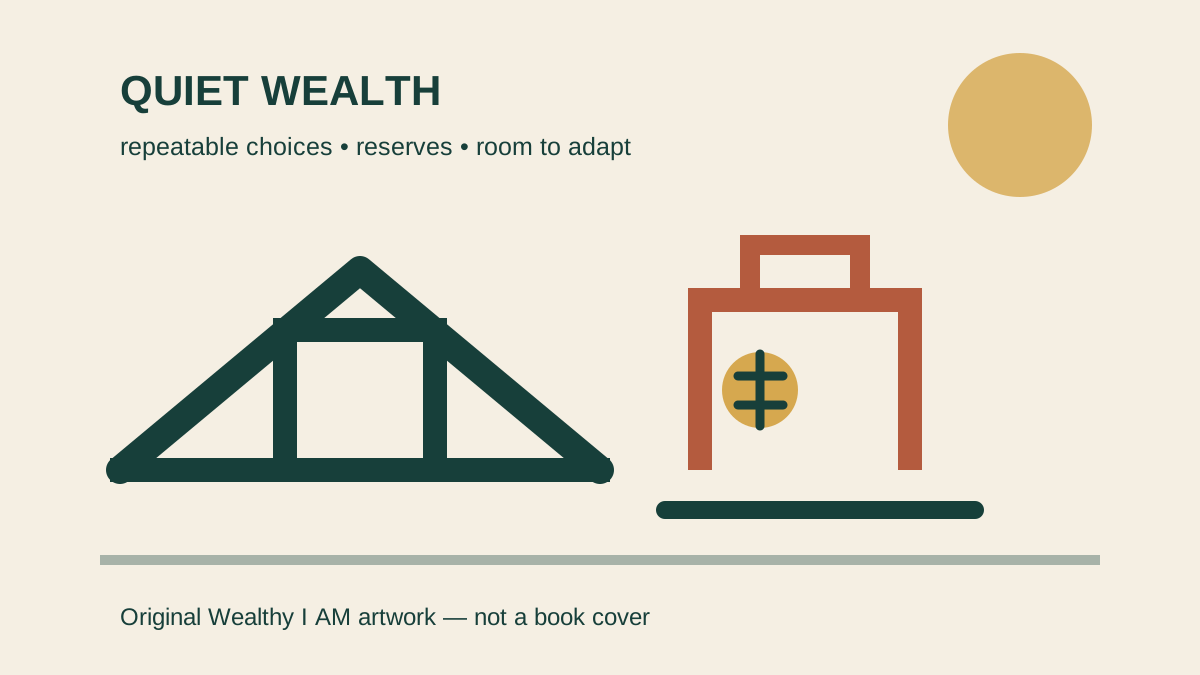
Start with a transparent cash-flow review and one sustainable rule. Then let evidence from your own life guide the next adjustment. Quiet wealth is less about appearing finished than about making repeatable decisions that leave more options open.