If your business feels exciting one week and fragile the next, the problem may not be a lack of ambition. Entrepreneurship combines selling, decision-making, leadership, delivery, and personal resilience, so feedback is uneven: a promising conversation can lift your confidence while a quiet sales week can make the whole plan feel wrong.
Who this is for
This summary is for aspiring or early-stage entrepreneurs who want a practical way to evaluate business decisions without treating motivation as evidence. It is not a substitute for a business plan, bookkeeping, professional advice, or due diligence.
The early answer is simple: treat the business journey as a process to manage, not a mood to obey. The Entrepreneur Roller Coaster: Why Now Is the Time to #Jointheride by Darren Hardy frames entrepreneurship around the highs and lows involved in starting, leading, selling, and persevering through a business journey. The book can be useful as a mindset-oriented starting point. It is not a guarantee of income, and a general business lesson is not individualized financial, legal, or tax advice.
This article offers an editorial synthesis of the book’s broad premise—not a reconstruction of an exact chapter-by-chapter framework—and translates it into a cautious operating practice for readers.
What problem does The Entrepreneur Roller Coaster address?
Many aspiring founders prepare for visible tasks—choosing an idea, making an offer, or setting up a website—but underprepare for the repeated emotional swings that follow. They may make three costly errors: treating a bad day as proof that the business cannot work; treating excitement as proof that a risky decision is justified; or waiting to feel confident before doing the next useful task.
Hardy’s central relevance for wealth-building is behavioral. A business can create income and value, but it can also consume cash, time, and attention. The practical goal is not to eliminate uncertainty. It is to build a decision process that remains usable when confidence rises or falls.
The book’s core idea: manage the ride instead of predicting every turn
The title’s roller-coaster image is a useful way to describe entrepreneurial volatility. It should be read as a metaphor, not as evidence that every business follows the same path. The Open Library record describes the book as covering the entrepreneurial journey, selling, leadership, productivity, and perseverance. That evidence supports a broad lesson about resilience; it does not establish that a particular routine or tactic will produce a particular financial result.
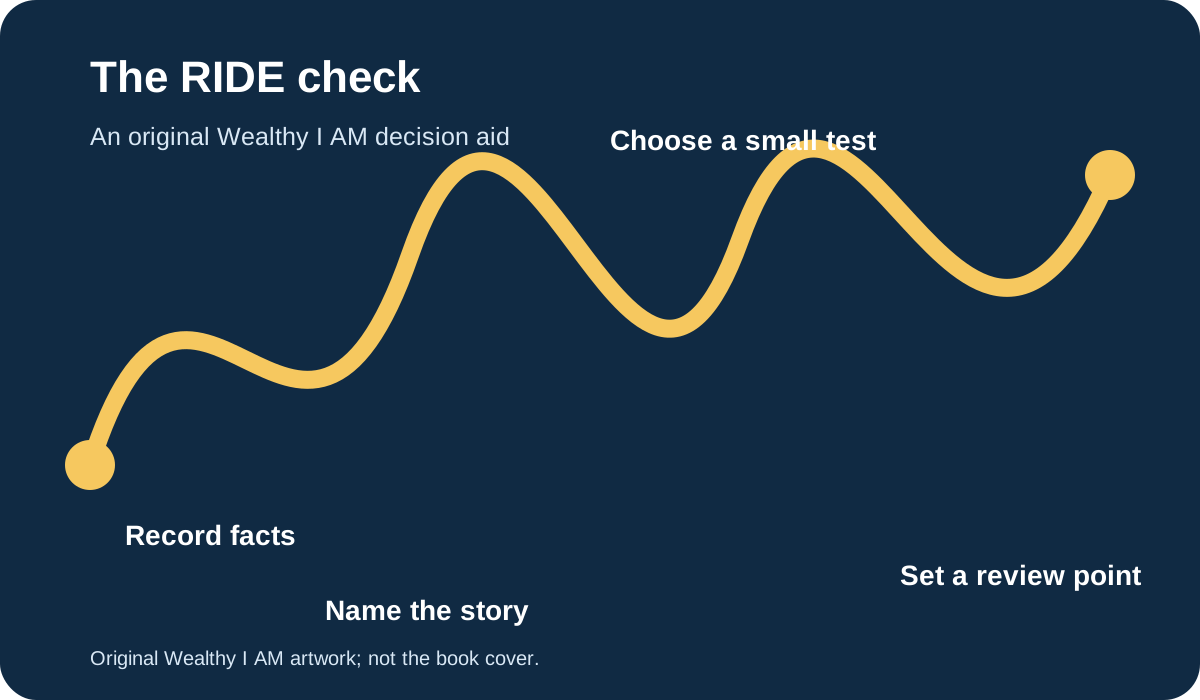
A Wealthy I AM application is the <strong>RIDE check</strong>:
- <strong>R — Record the facts.</strong> What happened in cash, sales activity, delivery, customer feedback, or capacity?
- <strong>I — Identify the interpretation.</strong> What story are you telling yourself about those facts?
- <strong>D — Decide the smallest reversible step.</strong> What can you test without committing money or time you cannot afford to lose?
- <strong>E — Establish a review point.</strong> When will you look at the evidence again?
The framework separates a real signal—such as a missed payment or repeated customer objection—from an emotional interpretation such as “nothing is working.” It also prevents optimism from turning into an irreversible bet.
Lesson 1: Expect emotional variability without making it your strategy
A founder’s emotional state changes faster than a business’s underlying economics. A single compliment, refund request, or sales call can change the day’s mood. That mood may be real, but it is not automatically a reliable business indicator.
Create a weekly operating note with three columns: observable facts, current interpretation, and next action. Keep the facts concrete: invoices issued, cash received, open customer commitments, delivery backlog, and questions customers repeatedly ask. Do not turn the note into a forecast.
A hypothetical example: a freelance designer receives no new inquiry for five days. The fact is a quiet inquiry period. The interpretation might be “the market has rejected me.” A reversible next action could be to contact a small number of past clients with a specific service update, then review responses on a stated date. The example demonstrates a process, not a likely outcome.
Lesson 2: Treat selling as a core business skill, not a character test
Selling is the process of explaining a useful offer, understanding a customer’s situation, and deciding whether there is a fit. It is not proof of personal worth. Separating the person from the offer makes it easier to learn from rejection without using pressure or manipulation.
A safer sales loop is:
- Describe the customer problem in the customer’s language.
- Ask what they currently do and what it costs them in time, money, or frustration.
- Explain what your offer does and does not include.
- State the price, timing, and important constraints plainly.
- Record objections as information rather than arguing with them.
Do not claim that a prospect needs an offer when you do not know that. Do not borrow money, sign a long contract, or increase fixed costs merely to feel committed. If the offer depends on regulated advice, licensing, safety, or legal compliance, obtain appropriate professional guidance before acting.
Lesson 3: Build resilience with systems, not slogans
Persistence is useful only when paired with learning. Repeating an untested action can multiply waste. A resilient operator protects enough runway—the time current resources can support the business—to make decisions without panic, while recognizing that runway varies with obligations, revenue, and risk.
A weekly resilience system can review:
- <strong>Money:</strong> cash on hand, committed expenses, receivables, and upcoming obligations.
- <strong>Customers:</strong> active conversations, fulfilled work, unresolved problems, and recurring requests.
- <strong>Delivery:</strong> the step most likely to delay promised work.
- <strong>Self:</strong> sleep, health, and recovery; exhaustion is not evidence of commitment.
- <strong>Learning:</strong> one assumption to test next week.
This is Wealthy I AM advice, not a claim that Hardy presents this exact checklist. Its purpose is to make perseverance measurable and safer.
Lesson 4: Use constraints to improve decisions
A founder under pressure may respond by adding products, advertising, tools, or staff. Sometimes that is appropriate; sometimes it only increases complexity. Before adding a commitment, name the constraint it is supposed to solve.
Ask: What specific problem is this purchase or hire meant to address? What evidence says the problem is material? Is there a smaller test? What is the maximum affordable loss if the test fails? What would make us stop, change, or continue?
This approach keeps entrepreneurial energy separate from the assumption that bigger bets are better. A profitable business can be valuable even when it grows deliberately rather than dramatically.
Lesson 5: Separate identity from business results
Business results matter, but they are not a complete measure of a person. When identity and revenue become indistinguishable, a founder may hide weak numbers, accept unsuitable customers, or make desperate promises.
Write two statements: “The business currently produces these observable results…” and “I want to practice these behaviors regardless of this week’s result…” The first keeps accountability. The second preserves agency. Neither statement guarantees success. Together, they make it easier to correct course without turning correction into shame.
Lesson 6: Convert ambition into a bounded experiment
A goal such as “build a successful business” is too broad to guide a safe next move. Convert it into a test with a clear audience, offer, action, budget, and review date.
For example, a hypothetical service provider might test one narrowly described offer with a small audience over a defined period. The test should record inquiries, conversations, completed work, direct costs, and customer feedback. Those observations can inform the next decision; they cannot prove a business model will scale.
Keep personal and business money separated where legally and practically appropriate. Consider insurance, contracts, taxes, consumer-protection rules, and entity requirements with qualified local professionals. The correct setup depends on jurisdiction and circumstances.
Lesson 7: Define wealth more broadly than a dramatic business outcome
Entrepreneurship is often presented as a route to freedom, but freedom can also mean control over commitments, adequate liquidity, meaningful work, or the ability to decline unsuitable opportunities. A business that raises revenue while creating unmanageable risk may not improve financial security.
Define a personal scoreboard that includes reliable cash-flow information; manageable obligations; customer value and retention signals; time and health boundaries; and progress toward a personally meaningful financial objective.
Use this scoreboard to ask whether the business is serving the life you want. The answer may be to grow, stay small, change the offer, pause, or exit. None of those choices is automatically virtuous.
Mistakes to avoid when applying the book’s message
Mistaking enthusiasm for evidence
Confidence can help you act, but it cannot replace customer feedback, cash-flow records, or due diligence.
Copying someone else’s risk tolerance
A founder’s obligations, savings, health, market, and legal environment are different from another person’s. Do not imitate a dramatic entrepreneurial decision without understanding the downside.
Using persistence to avoid a diagnosis
If customers repeatedly decline, delivery fails, or the economics do not work, continuing unchanged is not resilience. Diagnose the offer, audience, price, cost structure, or process.
Neglecting personal financial protection
Do not risk essential household money on an untested venture. Maintain appropriate reserves and seek qualified advice when financial, tax, legal, or safety stakes are material.
How to use The Entrepreneur Roller Coaster as a reading tool
Read it for its broad perspective on entrepreneurial highs and lows, selling, leadership, and perseverance. Then annotate each idea in three labels:
- <strong>Book idea:</strong> what the source appears to argue, based on the available description and source record.
- <strong>Evidence needed:</strong> what you would need to verify before treating the idea as a business fact.
- <strong>My experiment:</strong> a small, reversible action that fits your resources and responsibilities.
This prevents a motivational message from becoming an unsupported forecast.
Frequently asked questions
Is The Entrepreneur Roller Coaster a business plan?
No. The available catalog description presents it as practical guidance about the entrepreneurial journey, including emotional highs and lows, selling, leadership, productivity, and perseverance. A business plan still requires customer research, financial assumptions, operations, risk review, and—where relevant—professional advice.
Is the book suitable for a first-time entrepreneur?
It may provide useful orientation about the emotional and practical demands of entrepreneurship. Beginners should pair that perspective with basic bookkeeping, customer validation, cash-flow planning, and local legal or tax guidance where needed.
Does persistence guarantee entrepreneurial success?
No. Persistence can support learning and follow-through, but results also depend on demand, execution, resources, competition, timing, and chance. Persistence should include the ability to change course.
How can I apply the ideas without taking a large financial risk?
Use a bounded experiment: define one assumption, choose a small test, set a maximum affordable loss, and establish a review date. Do not commit essential funds or sign obligations you do not understand.
What is the main takeaway?
Expect volatility, separate facts from interpretations, keep selling and learning ethical, and make the next decision small enough to evaluate. A calmer process is more useful than a promise that the ride will be smooth.
A practical next step
Before your next major business decision, complete the RIDE check on one page. Record the facts, name the story you are adding, choose a reversible action, and set the date when you will review the result. If the decision affects essential finances, legal obligations, health, or safety, pause and obtain qualified advice.
Conclusion
The Entrepreneur Roller Coaster is best approached as a perspective on the emotional volatility of building and leading a business—not as a guarantee that optimism or persistence will create wealth. Its broad lesson is compatible with a more grounded practice: measure what happened, test what you do not know, protect your downside, and keep your identity larger than your latest result.
The next useful move is not to make the biggest bet. It is to make the clearest small decision you can afford to learn from.
Sources / Further reading
- Darren Hardy, The Entrepreneur Roller Coaster: Why Now Is the Time to #Jointheride, Open Library catalog record: https://openlibrary.org/works/OL20029608W
- Open Library bibliographic and work record used for title and author identity: https://openlibrary.org/works/OL20029608W
This article distinguishes the catalog’s broad description from the original Wealthy I AM applications. The sources do not establish individualized financial outcomes, forecasts, or guarantees.