If your income feels stuck, it is tempting to treat every new side-hustle idea as an escape hatch. That can create the opposite problem: too many projects, unclear cash flow, and commitments you cannot afford to support. The useful question is not “How can I become rich quickly?” It is “Which earning idea can I test carefully, serve well, and turn into durable surplus?”
In brief: Loral Langemeier’s The Millionaire Maker presents a Wealth Cycle approach focused on identifying opportunities, increasing income, and building multiple cash-producing activities. The practical takeaway is best treated as a planning lens—not a guarantee: choose one customer problem, test one offer, track real cash, and protect your downside before adding complexity.
> Evidence boundary: The available inventory record identifies the book, author, year, category, broad description, and Open Library work record. The seven lessons below are a Wealthy I AM editorial synthesis, not a claim that the book uses these exact numbered headings. The source record does not establish that any particular income level, timeline, or result is typical.
Who this book may help—and who should be cautious
This summary is most useful for a worker, freelancer, or small-business owner who wants to think more deliberately about earning capacity. It may also help someone who has several possible business ideas but no way to decide which deserves attention first.
It is not a substitute for a budget, a tax professional, legal advice, a business valuation, or individualized investment advice. A new business can lose money, consume time, create liability, and produce irregular income. If you have high-cost debt, limited emergency savings, dependents, or unstable employment, a low-cost test may be more appropriate than a large launch.
The central idea: wealth starts with a reliable surplus
The book’s broad premise, as recorded in the inventory, is active wealth creation: identify opportunities, increase income, and develop more than one cash-producing activity. In plain language, that means improving the gap between what comes in and what must go out, then deciding how any surplus will be used.
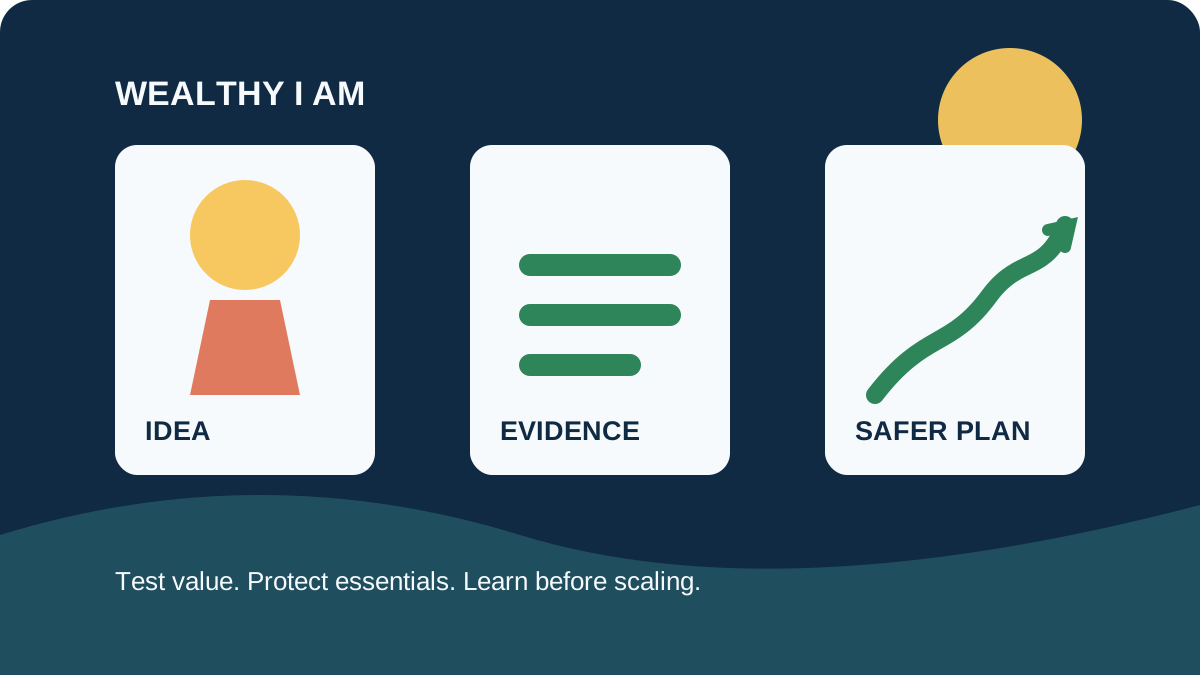
That is different from collecting side hustles. A second activity only helps if its revenue, costs, taxes, time, and risks are understood well enough to improve your overall position. Wealthy I AM’s application is therefore a surplus-first test: do not scale an idea because it sounds exciting; scale only after observing evidence that customers value it and the economics are not worsening.
Seven practical lessons from The Millionaire Maker
1. Treat earning power as something you can develop
A fixed salary is only one source of earning capacity. Skills, relationships, problem selection, distribution, and the ability to deliver a useful result can also affect income. This does not mean every reader should become an entrepreneur. It means you can examine which part of your current work creates value and which adjacent capability could be tested.
Try this: list three skills people already ask you to use. For each, write the problem it solves, who experiences that problem, and what a small paid test might look like. Do not spend heavily before you can describe the customer and outcome clearly.
2. Start with a customer problem, not a product fantasy
An “income idea” becomes more credible when it responds to a specific problem for a specific group. “I want to sell coaching” is vague. “I help independent designers organize project handoffs” is a starting point that can be discussed with real people.
Hypothetical example: Maya thinks local contractors need a new software product. Before building it, she interviews five contractors about how they currently schedule jobs. If the recurring problem is actually missed follow-ups, she might test a simple reminder service instead. This example is illustrative, not evidence that the book reports Maya or this outcome.
Action: write one sentence using this format: “I help [specific customer] reduce or achieve [specific problem or outcome] through [small, testable offer].” Ask for reactions before buying tools, inventory, or advertising.
3. Build one dependable activity before adding several
Multiple income streams can diversify opportunity, but they can also multiply distraction. A small service, rental activity, product, or commission stream may have different costs and risks. The first goal should be learning whether one activity can deliver consistently—not creating an impressive list of projects.
Use a simple readiness gate:
- Can you explain the offer in one sentence?
- Have real prospective customers shown a concrete sign of interest, such as a paid trial or written commitment?
- Do you know direct costs, expected time, taxes to reserve, and likely overhead?
- Can you stop or shrink the test without putting essential bills at risk?
If the answer is “no” to most of these, the next step is discovery, not expansion.
4. Measure cash, not applause
Revenue is money received from customers. Profit is what remains after relevant costs. Cash flow is the timing of money entering and leaving the activity. They are related but not interchangeable. A business can report sales and still run short of cash because invoices are unpaid, inventory is tying up funds, or expenses arrive before customers pay.
A basic monthly worksheet can track:
- cash received;
- direct delivery costs;
- software, travel, insurance, and other operating costs;
- taxes or professional fees to reserve;
- hours spent; and
- cash left after those items.
Do not present a hypothetical worksheet as a forecast. Use actual records, label estimates, and revisit assumptions. If the activity cannot produce a positive contribution after realistic costs and time, pause before scaling it.
5. Use a wealth cycle, not a one-time windfall mindset
The inventory description connects the book with identifying opportunities, increasing income, and building cash-producing activities. A practical interpretation is cyclical: learn, make an offer, deliver, review the numbers, improve, and decide whether to reinvest.
That cycle helps prevent a common mistake—treating one good month as proof of a permanent business. Ask what created the result: repeat demand, a one-off referral, seasonal timing, unusual effort, or an unsustainable discount. Reinvestment should follow evidence and capacity, not excitement.
6. Protect the downside before chasing the upside
Entrepreneurial language can make risk sound like courage. In practice, risk includes debt, legal exposure, lost wages, customer concentration, health strain, and the possibility that money will not return on schedule. A cautious plan defines what you can afford to lose in time and money before the test starts.
Possible guardrails include a fixed trial budget, no borrowing for an unvalidated idea, separate business records, written contracts where appropriate, and a stop condition. Local rules on registration, taxes, licensing, employment, consumer protection, and insurance vary; consult qualified professionals when those issues apply.
7. Convert extra income into durable wealth deliberately
More income is not the same as more wealth if lifestyle costs rise just as fast. Once an activity produces surplus, give that money a job: strengthen cash reserves, reduce expensive debt, fund necessary business improvements, or invest according to a diversified plan that fits your goals and risk capacity.
The order will differ by person. The important separation is between the book idea—create more earning capacity—and Wealthy I AM advice—decide cautiously what the surplus should do next. Neither reading this book nor following a generic sequence guarantees financial independence.
A low-risk 30-day implementation plan
Week 1: Choose one problem and one customer
Write three possible offers, then select the one with the clearest customer access and lowest test cost. Speak with people who might actually buy. Ask about their current process, cost, delay, frustration, and alternatives. Do not ask only whether they “like” the idea.
Week 2: Offer a manual version
Deliver the smallest useful version without building a full system. Set a clear price or a clearly labelled free discovery step. Record what the customer receives, how long it takes, and what changes after delivery.
Week 3: Review the economics
Record cash received and every material cost. Include your time as a decision input even if you are not paying yourself yet. Separate facts from assumptions. If you cannot explain why the activity should become more efficient or valuable, do not add scale yet.
Week 4: Decide: improve, pause, or expand carefully
Continue only if there is evidence of demand and a manageable downside. Improve the offer if the problem is real but delivery is inefficient. Pause if interest is weak or the economics depend on unrealistic assumptions. Expansion is an option—not a moral test.
Mistakes to avoid
- Confusing many ideas with many income streams: several untested projects can make cash flow harder to understand.
- Counting gross sales as wealth: subtract direct and operating costs, taxes, and the value of time.
- Borrowing before validation: debt can turn an uncertain experiment into a fixed obligation.
- Copying someone else’s path: a strategy that fits one person’s skills, capital, market, or timing may not fit yours.
- Ignoring compliance: tax, licensing, contracts, employment, privacy, and insurance questions are jurisdiction-specific.
- Treating a motivational claim as a forecast: keep outcomes conditional and based on your records.
Frequently asked questions
Is The Millionaire Maker a personal-finance book or a business book?
The inventory classifies it under entrepreneurship, income growth, and wealth creation. Its emphasis is therefore more active than a basic budgeting guide. Readers still need separate planning for spending, reserves, debt, taxes, and investing.
Does the book promise multiple income streams?
The inventory description says it presents a Wealth Cycle approach involving multiple cash-producing activities. That does not prove that multiple streams are suitable for every reader or that they produce a particular result. Start with one manageable test and measure it.
How much money should I invest in a new idea?
There is no universal amount. Set a limit based on money you can lose without jeopardizing essentials, and confirm legal and tax obligations. A smaller manual test can reveal more than a large speculative launch.
Can a side business replace a job?
It might for some people, but this article cannot predict that outcome. Consider stability, benefits, taxes, insurance, dependents, and several months of actual records before making a major employment decision. Professional advice may be appropriate.
What is the best first step after reading the book?
Write one customer problem, one small offer, one test budget, and one stop condition. Then speak with potential customers and record evidence rather than relying on enthusiasm.
Keep the book idea separate from your wealth plan
The Millionaire Maker can be read as an invitation to build earning capacity. Wealthy I AM’s more cautious application is to test one useful offer, understand the real economics, protect essential finances, and allocate any surplus intentionally. That distinction keeps motivation from becoming a substitute for evidence.
A grounded next step
Before launching anything, schedule a 45-minute review. Leave with a one-sentence offer, five customer questions, a maximum test budget, a record-keeping method, and a date to decide whether to continue. If the idea cannot survive that small amount of clarity, it is not ready for a larger commitment.
This is general education, not individualized financial, tax, legal, or investment advice. Results vary, and business activity can lose money.