When a business feels busy but the money still feels unclear
A growing business can have sales, customers, and a full calendar while the owner remains unsure whether it is truly becoming healthier. The problem is often not a lack of effort. It is a lack of a shared way to read the numbers.
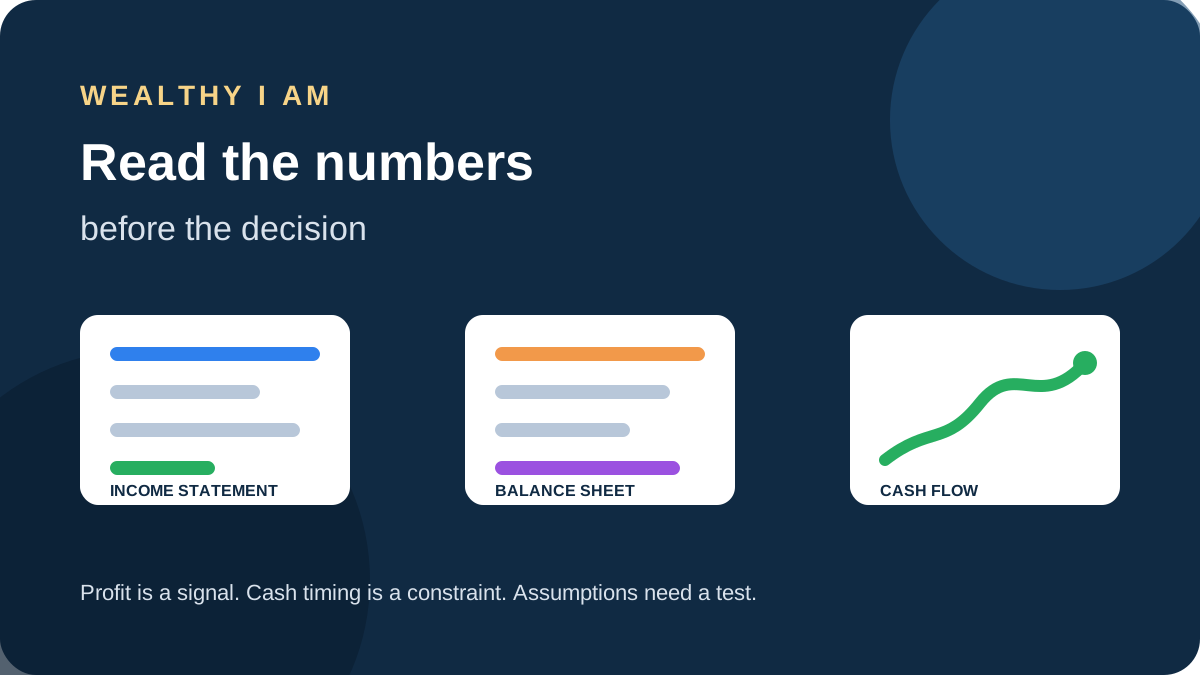
The short answer is this: use the income statement, balance sheet, and cash-flow view together, then connect each number to a business decision. Profit can describe performance over a period, but cash timing determines what the business can pay now. The balance sheet shows what the business owns, owes, and has left over. None of these views, alone, is a complete picture.
Karen Berman and Joe Knight make that financial literacy the subject of Financial Intelligence for Entrepreneurs: What You Really Need to Know About the Numbers; the edition’s cover also credits John Case. This article is a Wealthy I AM interpretation and practical application, not a substitute for the book, bookkeeping, tax advice, or individualized financial advice.
You will learn how to use five questions to read a business more clearly, test decisions with simple scenarios, and avoid common mistakes such as treating revenue as cash or treating one good month as proof of a durable model.
The promise: by the end, you can build a one-page numbers review for one decision you need to make this month.
What the book is trying to solve
The book is aimed at entrepreneurs and non-financial managers who must make decisions using financial information. Its central idea is practical: financial statements are not merely reports prepared for specialists; they are a language for discussing how a business creates, uses, and retains value.
That idea matters for a freelancer deciding whether to hire, a shop considering inventory, or a service company evaluating a new offer. The same vocabulary can help a team distinguish an attractive story from an economically workable choice.
The three views to keep together
- Income statement: a period-based view of revenue, expenses, and reported profit. It helps you ask whether the operation produced a surplus under the accounting rules being used.
- Balance sheet: a point-in-time view of assets, liabilities, and equity. It helps you ask what resources and obligations exist now.
- Cash-flow view: a view of cash entering and leaving the business. It helps you ask whether available cash can support payroll, suppliers, debt payments, taxes, and planned investment when they fall due.
These are related but not interchangeable. A sale may be recorded before the customer pays. A profitable month may coincide with a cash squeeze if receivables are slow or inventory absorbs money.
Five practical lessons for better business decisions
The following lessons are editorially synthesized from the book’s subject and are not presented as the book’s exact numbered framework.
1. Ask what the number is actually measuring
A number has a definition, a time period, and an accounting context. Before reacting, ask: What is included? What is excluded? Is this a flow over a period or a balance at one date? Is it cash, an accounting measure, or an estimate?
Wealthy I AM application: put the reporting period and definition beside every metric in a decision memo. “Sales” is less useful than “invoiced sales for April, before refunds,” if that is what the figure means.
Try this: choose three metrics in your next meeting and write one plain-language sentence explaining each. If the team cannot agree on the sentences, the decision is not ready.
2. Do not confuse profit with cash
Profit and cash answer different questions. Profit may reflect earned revenue and recognized expenses. Cash answers whether money is available at the moment bills are due. The gap can arise from payment terms, inventory, equipment purchases, debt principal, or other timing differences.
Hypothetical illustration: a consulting firm invoices a client for work completed in June, but the contract allows payment in August. The invoice may support June revenue under the firm’s accounting method, while June cash has not increased. This is an illustration, not a forecast or a claim about every accounting system.
Try this: for a major sale, write down the expected invoice date, collection date, direct costs, and cash commitments that arrive before collection. Review the assumptions with the bookkeeper or accountant.
3. Follow the economics behind the margin
A margin describes the portion of revenue left after a defined group of costs. It is not automatically a measure of quality, and it can change when prices, mix, labor, acquisition costs, or overhead change.
The useful question is not simply “Is the margin high?” It is “What would have to remain true for this margin to persist?” A business may look stronger because of a temporary pricing change, an unusually favorable customer mix, or costs that have not yet appeared.
Wealthy I AM application: create a small bridge from revenue to the profit measure you use. Label direct costs, operating costs, owner compensation, and one-time items according to your actual records. Avoid relabeling ordinary costs as exceptional merely to improve the story.
4. Treat ratios as prompts, not verdicts
Ratios compress information. They can help you notice movement in liquidity, debt, profitability, or operating efficiency, but a ratio does not explain the cause. The same figure can mean different things in different industries, stages, or accounting systems.
Use a ratio to generate a question: Why did it change? Is the movement seasonal? Did the denominator change? Is the comparison period appropriate? What operational event sits behind it?
Try this: select one ratio that matters to your decision. Compare it with the business’s own recent history, document the reason for any material movement, and seek an industry comparison only when its definition is genuinely comparable.
5. Make the decision and the assumptions visible
Financial intelligence is useful when it changes behavior. A decision should identify the expected benefit, the resources required, the timing, the downside, and the evidence that would cause you to pause or change course.
For example, a hiring decision might include expected responsibilities, total employment cost, ramp-up time, cash runway impact, and a review date. It should not rely only on a hoped-for revenue increase.
Try this: write one base case and one downside case. State which assumptions are uncertain, who owns each assumption, and when you will review the result. This does not remove uncertainty; it makes uncertainty easier to manage.
A 30-minute numbers review you can use this week
This is original Wealthy I AM guidance inspired by the book’s emphasis on financial understanding.
- Name the decision. Write one sentence, such as “Should we add this recurring software cost?”
- Collect the source figures. Use the relevant reports and label the date range, accounting basis, and missing information.
- Map the cash timing. Note when cash leaves and enters, not just when revenue or expense is recorded.
- List the drivers. Identify three to five variables that could change the result: price, volume, conversion, labor time, payment delay, or another decision-specific factor.
- Stress one assumption. Ask what happens if the benefit arrives later, the cost is higher, or demand is weaker than expected. Do not call the output a prediction.
- Set a review trigger. Define a date or observable condition that prompts a reassessment.
If the review exposes a tax, legal, lending, employment, or accounting issue, stop and obtain advice from a qualified professional in the relevant jurisdiction.
Mistakes to avoid
Looking only at revenue
Revenue can grow while margins, collections, or obligations worsen. Pair revenue with cash timing and the cost required to produce it.
Using a spreadsheet that has no owner
A model is not a control system if nobody records assumptions, updates actuals, or explains variances. Assign an owner and a review rhythm.
Comparing unlike businesses
A ratio or margin copied from another company may use different definitions, financing, seasonality, or customer economics. Treat comparisons as contextual evidence, not instructions.
Hiding uncertainty behind precise decimals
More decimal places do not create better information. Show ranges or scenarios when the inputs are uncertain, and explain what would change the view.
Treating the book as a guarantee
Financial literacy can improve questions and decisions; it cannot guarantee a particular profit, investment result, or business outcome. Circumstances, execution, market conditions, and risk capacity differ.
Who should read this book?
It is a sensible candidate for an entrepreneur, manager, or professional who wants a non-specialist introduction to financial statements and business decision-making. It may be less useful as a standalone technical accounting manual or as individualized advice for a complicated tax, financing, or investment question.
Frequently asked questions
Is this book only for business owners?
No. Managers and professionals who make resource decisions can also benefit. The application is strongest when the reader has real reports or decisions to examine.
What should I learn first: profit or cash flow?
Learn how they differ, then read them together. Starting with the decision and its timing can show which view deserves more attention.
Can a profitable business run short of cash?
Yes, depending on collection timing, inventory, capital spending, debt obligations, and other cash movements. The exact explanation requires the business’s records.
Is financial intelligence the same as accounting expertise?
No. Financial intelligence means understanding enough about the numbers to ask better questions and make more informed decisions. It does not replace professional accounting work.
What is one low-risk first step?
Choose one upcoming decision and create the six-line review above using current records. Do not commit money based only on the worksheet; use it to identify what must be verified.
Sources / Further reading
- Open Library: Financial Intelligence for Entrepreneurs, catalogued 2008 edition
- Image credit: original Wealthy I AM article-specific SVG illustration, created in-house; created in-house; no third-party cover image used.
Conclusion
The book’s durable lesson is not to worship a metric. It is to connect definitions, timing, economics, and uncertainty to the decision in front of you. Before your next business commitment, take 30 minutes to read the three financial views together, label the assumptions, note when cash moves, and decide what would trigger a review. Bring unresolved questions to the person responsible for the records or to a qualified professional where appropriate. That process can make the next conversation more precise without pretending that every decision will succeed.