If a business decision feels like a puzzle, the missing piece may not be more confidence. It may be recognizing that your result depends partly on what customers, competitors, suppliers, employees, lenders, or partners do next.
The practical lesson of The Art of Strategy is to stop evaluating a choice in isolation. List the other players, identify their incentives, think through plausible responses, and choose an action that remains sensible after the likely reaction. Avinash K. Dixit and Barry J. Nalebuff introduce game theory through practical examples about competition, cooperation, negotiation, and strategic choice. The seven lessons below are a Wealthy I AM synthesis for everyday money and business decisions—not a claim that the authors present this exact numbered framework.
This is a general-education article, not individualized financial, tax, legal, or business advice. A strategic model can improve a decision process, but it cannot remove uncertainty or guarantee a financial result.
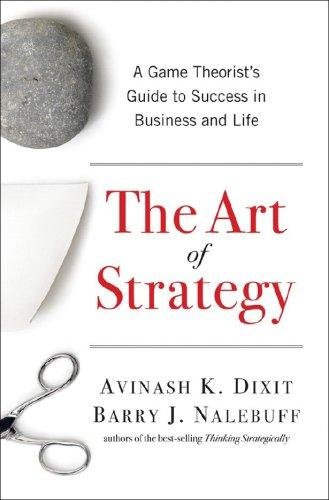
Image: cover of The Art of Strategy: A Game Theorist’s Guide to Success in Business and Life. Source: Open Library Covers API; publisher must confirm use rights and featured-media attachment before publication.
What problem does The Art of Strategy help solve?
Many money decisions are treated as one-person choices: Should I raise my price? Should I launch this product? Should I negotiate harder? Should I invest in this opportunity? But other people are usually part of the decision. A price increase can change customer demand. A discount can invite a competitor to respond. A generous payment term can affect a supplier’s behavior and your cash position.
Game theory is a way to study those interdependent choices. In plain language, it asks: What will the relevant people do when they see my move, and how should their expected response change my plan?
Dixit and Nalebuff use accessible examples to introduce this kind of strategic reasoning. The book is not a personal-finance plan, stock-picking system, or guarantee of business success. Its value for a wealth-building reader is as a decision lens: it can help you notice incentives, timing, commitments, and reactions before you commit scarce money or effort.
The seven practical strategy lessons
1. Name the players before you choose a move
A decision looks simpler when you omit everyone else affected by it. A small business owner might think, “I will offer a lower price and sell more.” A fuller map includes existing customers, prospects, competitors, distributors, and the owner’s own cash reserve.
Wealthy I AM application: before a consequential choice, write down the players who can materially change the outcome. For each one, note what they want, what they know, what they can do, and what constraints they face. This does not require mind-reading. It is a prompt to replace a one-player story with a more complete one.
Try it: create a four-column note: player, objective, available action, likely response to your move. If a player cannot affect the decision, remove them from the model.
2. Separate stated preferences from real incentives
People may describe what they want, but incentives shape what they are able or willing to do. A customer may say price matters most while repeatedly choosing the option that saves time. A partner may support growth in principle but resist a plan that increases operational risk.
This is not a reason to distrust everyone. It is a reason to examine the structure around a decision. Rewards, penalties, deadlines, information, habits, and alternatives can all influence behavior.
Example: imagine a hypothetical consultant deciding whether to accept a large project with payment due after completion. The headline revenue may look attractive, but the client’s payment timing changes the consultant’s cash-flow exposure. A deposit, milestone invoice, or smaller pilot might align incentives more safely—subject to the parties’ contract and local rules.
Try it: ask, “What would make the other party’s best practical option different?” Then test whether a change in timing, scope, proof, or risk-sharing improves the arrangement.
3. Think one response ahead, then keep going only when useful
A common mistake is to plan your move without planning the reaction. The opposite mistake is building an elaborate prediction tree that creates false precision. Useful strategic thinking usually starts with one or two credible responses.
Suppose a business cuts its price. A competitor might match it, ignore it, or target a different customer segment. Customers might buy more, wait for another discount, or infer that quality has changed. Each response creates a different next decision.
Try it: write “If I do X, the most plausible response is Y. If Y happens, I will do Z.” Then add one alternative response and a condition that would make you change course. These are scenarios, not forecasts.
4. Look for the decision that changes the game
Some moves do more than produce an immediate result. They alter the choices available to everyone later. A clear service guarantee can reduce buyer uncertainty. A focused niche can make direct comparison less relevant. A long-term supplier relationship may improve reliability but also reduce flexibility.
The book’s strategic lens encourages attention to commitments, credibility, and the rules of interaction. A commitment is useful only if other people believe it and if you can actually honor it. An empty threat or an unsustainable promise can weaken your position.
Wealthy I AM application: prefer commitments that are specific, affordable, and observable. For a small business, that might mean documenting a narrow delivery standard rather than promising everything to everyone. For a household, it might mean automating a chosen savings transfer only after checking that the account can support it.
5. Change incentives before demanding better behavior
When a process repeatedly produces an unwanted result, exhortation may be less effective than redesign. If a team misses an important task because ownership is unclear, another motivational speech may not solve the bottleneck. If customers delay decisions because the offer is confusing, urgency language may not fix the underlying uncertainty.
Try it: describe the behavior you want, the current payoff for each party, and the friction that blocks the desired action. Then test one small change in information, timing, ownership, or risk. Measure what actually happens rather than assuming the redesign worked.
This is an application of strategic thinking, not a claim that every problem is an incentive problem. Skills, resources, trust, regulation, and personal circumstances can matter too.
6. Distinguish cooperation from dependence
Cooperation can create more value than isolated action, but cooperation also creates vulnerability when one side has too much control or when the agreement is vague. A joint project, referral arrangement, or shared investment may look attractive while leaving responsibilities, exit terms, or downside exposure unclear.
Try it: before cooperating, answer five questions in writing: What does each party contribute? What does each receive? What information is shared? What happens if assumptions change? How can either party exit or resolve a dispute? For contracts, employment, lending, property, or regulated matters, obtain qualified professional advice appropriate to your jurisdiction.
The goal is not to eliminate trust. It is to give trust a workable structure.
7. Protect against being wrong about the model
Strategic reasoning is only as good as the assumptions underneath it. You may misunderstand a competitor’s costs, a customer’s alternatives, a partner’s priorities, or your own capacity. A neat diagram can create an illusion of control.
Use a short decision log: the choice, key assumptions, plausible responses, downside, review date, and what evidence would change your view. Avoid recording only the outcome. A good outcome can follow from luck, and a poor outcome can follow from a sound decision made under uncertainty.
Try it: identify the assumption with the greatest ability to damage the plan. Seek one piece of information that tests it before making an irreversible commitment. If the cost of testing is meaningful, cap the test with a small budget or pilot.
A practical five-step strategy screen
Use this worksheet for a business, career, or household decision that is important enough to examine but not so urgent that a quick safety decision is required.
- State the decision. Write the choice in one sentence and define what “better” means: cash resilience, learning, flexibility, profit, time, or another priority.
- Map the players. Include people who can respond materially, not every imaginable observer.
- List two or three responses. Mark which are plausible, uncertain, or unsupported by evidence.
- Compare robust options. Prefer an option that remains acceptable across several plausible responses, especially when the downside is difficult to reverse.
- Set a review trigger. Name the fact, date, or threshold that would cause you to continue, modify, pause, or stop.
This screen does not calculate an investment’s intrinsic value, replace due diligence, or predict markets. It is a disciplined pause before commitment.
Mistakes to avoid when using game theory for money decisions
Treating every interaction as a contest
Competition is only one type of strategic relationship. Cooperation, repeated dealings, reputation, and mutual gains can matter. Assuming an opponent everywhere can destroy useful relationships.
Confusing a clever tactic with a durable strategy
A short-term maneuver may create a response that makes the broader position worse. Test whether your move remains sensible after others adapt.
Using invented certainty
Labels such as “likely” or “rational” should be supported by observed incentives and evidence, not by confidence. Keep uncertain assumptions visible.
Ignoring power and information differences
Not all players have equal bargaining power, time, money, or information. A theoretically tidy agreement may be impractical or unfair in the real world.
Overlooking downside and reversibility
If a decision can create debt, legal exposure, safety risk, or a hard-to-reverse commitment, slow down and seek appropriate advice. Strategic sophistication is not a substitute for risk controls.
Frequently asked questions
Is The Art of Strategy a personal-finance book?
No. It is an introduction to strategic reasoning and game theory through practical examples. This article applies that lens to wealth and business decisions; it is not a summary of a personal-finance program.
What is the simplest game-theory question to ask?
Ask: “If the other people involved see my move, what might they do next?” Then identify which response would matter most and whether you can test your assumption safely.
Can game theory help me choose stocks?
It may help you think about incentives, competitors, and strategic position, but it does not by itself value securities, predict prices, or establish suitability. Investing decisions require separate research, diversification and risk considerations, and attention to your goals and capacity for loss.
Should I always anticipate the worst response?
No. Consider plausible responses and meaningful downside, but do not treat an extreme possibility as the base case without evidence. Scenario testing is for preparation, not panic.
What if I do not have enough information?
Make the information gap explicit. Seek a low-cost test, ask a decision-relevant question, delay an irreversible commitment when practical, or choose an option that limits downside while you learn.
Sources / Further reading
<ul> <li>Open Library work record for The Art of Strategy — title, original publication year, authorship, edition list, and broad description.</li> <li>Open Library search record for The Art of Strategy — bibliographic cross-check.</li> <li>Open Library Covers API image — cover source; the publisher must confirm edition and use rights before publication.</li> </ul>
Conclusion: make the next move easier to evaluate
The Art of Strategy offers a useful correction to isolated decision-making: outcomes often depend on reactions. For a practical starting point, take one decision this week, map the relevant players, write two plausible responses, and identify the smallest safe test of your most important assumption. The result will not guarantee wealth, but it can make your reasoning more transparent—and your next move more deliberate.