The reader problem: wanting more income without a clear next move
Many people know that earning more could make saving and investing easier, but “make more money” is not an actionable plan. It can also encourage risky shortcuts: buying a course before testing demand, starting several projects at once, or treating an inspiring story as proof that a particular business model will work.
The short answer: the useful idea to take from The Millionaire Mindset: How Ordinary People Can Create Extraordinary Income by Gerry Robert is not a guarantee of extraordinary income. It is a prompt to examine your beliefs about earning, look for value you can create, and test opportunities with small, observable steps before committing significant time or money.
This is a practical, cautious synthesis—not a chapter-by-chapter substitute for the book. The available Open Library record verifies the title, author, subtitle, bibliographic identity, and broad subject classification, but it does not provide a full description of the book’s framework. Treat the ideas below as prompts to investigate, not as individualized financial advice.
Who this is for: readers interested in the book’s income-building theme who want practical application without treating mindset as a wealth guarantee. If you need a budgeting, tax, debt, or investment plan, use sources designed for that purpose and consider advice suited to your circumstances.
Image credit: Open Library Covers API, exact-title/author record. Source: Open Library cover image. Reuse rights should be checked before publication.
What is The Millionaire Mindset about?
The Open Library catalog classifies the work under “Success” and “Success in business.” Alongside the title and subtitle, that catalog context points toward the relationship between beliefs, opportunity, initiative, and the ability to create income. That is different from saying that mindset alone creates wealth.
Because the available catalog record does not establish a complete chapter-by-chapter framework, the seven lessons in this article are a Wealthy I AM editorial synthesis and application—not a claim that Robert presents these exact numbered headings.
A realistic reading has three parts:
- Mindset: notice assumptions that may limit the kinds of problems, customers, or roles you consider.
- Value: identify a specific result someone may reasonably pay for.
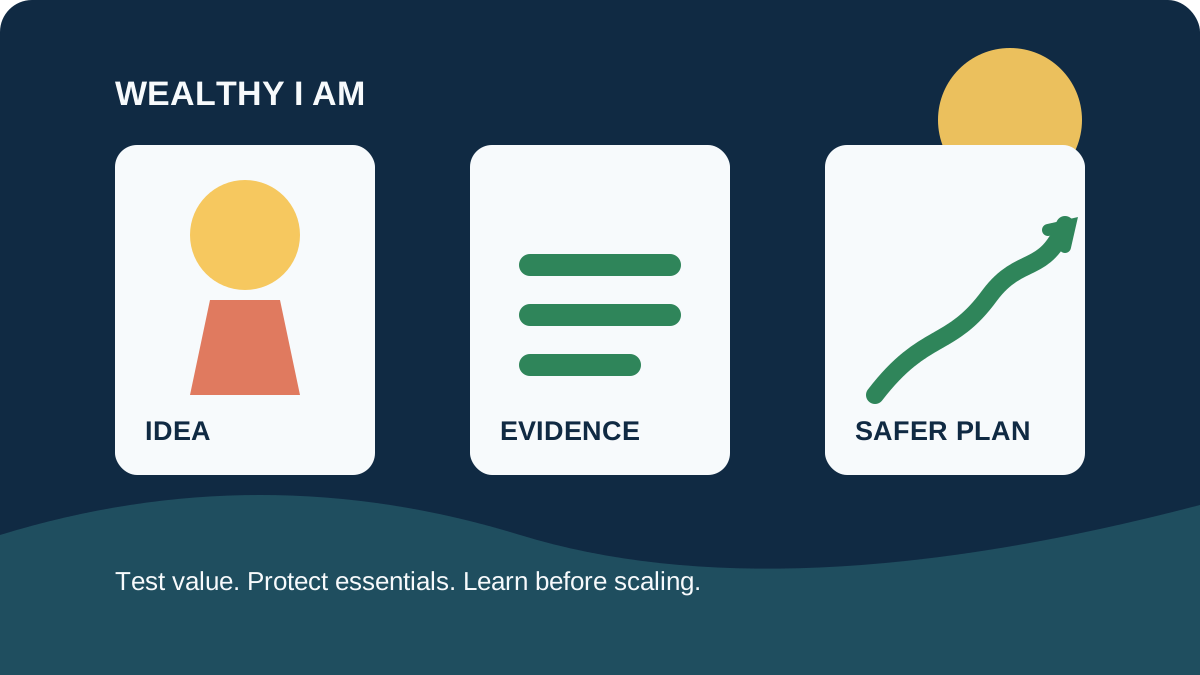
- Evidence: test the idea while protecting cash, time, health, and existing obligations.
The benefit is a better decision process. You may discover a useful offer, a higher-value skill to develop, or a project that should be abandoned before it becomes expensive.
Seven practical lessons inspired by the book’s wealth-building theme
1. Treat income as a design problem, not only a pay problem
A salary is one way to earn. Other possibilities include improving a scarce skill, serving a clearer customer need, negotiating responsibilities, creating a service, or building an asset. The book’s entrepreneurial emphasis can widen the question from “How do I work harder?” to “What valuable outcome can I help produce, and how is that outcome paid for?”
Try this: list three ways your current knowledge could save someone time, reduce a costly mistake, or help them reach a concrete goal. Do not assume the list is a business yet; it is a set of hypotheses.
2. Separate a belief from evidence
A belief such as “people will pay for this” is not the same as evidence that a defined person has a problem, understands the proposed solution, and will make a permitted, affordable purchase. Confidence can help you start; it cannot replace testing.
Try this: write two columns: “What I believe” and “What would show me I am wrong?” This makes optimism compatible with learning.
3. Start with value that is specific enough to observe
Vague promises are hard to sell and hard to evaluate. “Business coaching” is broad; “a two-hour review that leaves a small business with a prioritized cash-flow checklist” is more specific. The second description still needs validation, but the result can be discussed and reviewed.
Hypothetical example: a freelance bookkeeper notices that local contractors struggle to organize invoices before tax appointments. Instead of immediately building software, she could ask prospective clients about their current process, offer a limited paid organization service where appropriate, and record which problem they actually want solved. This is an illustration, not a forecast.
4. Use small experiments to protect downside
A small experiment is a bounded test with a defined cost, time limit, success signal, and stop condition. It is not a reason to ignore contracts, licensing, taxes, employment rules, or consumer-protection obligations.
A simple experiment brief:
- Customer: Who specifically has the problem?
- Pain: What happens if it remains unsolved?
- Offer: What narrow result will you provide?
- Test: What conversation, sample, or paid pilot can provide evidence?
- Limit: What is the maximum cash and time you will risk?
- Stop rule: What result means you revise or stop?
5. Build earning capacity before chasing scale
Earning capacity can include communication, technical competence, sales, analysis, reliability, or management. These are not automatic wealth assets, and no skill guarantees a higher income. They can, however, improve the range of work you can perform and the problems you can credibly solve.
Try this: choose one skill connected to a real market or role. Spend four weeks producing evidence of competence—a work sample, completed project, or documented improvement—rather than only consuming material about the skill.
6. Convert extra income into resilience and ownership carefully
More income can disappear if every increase is matched by higher fixed expenses. A cautious sequence is to understand your cash flow, address urgent high-cost obligations, build an appropriate reserve, and then consider diversified long-term investing or business reinvestment that fits your circumstances.
This is a Wealthy I AM application, not a claim that Robert prescribes this exact sequence. Investment choices involve loss risk, fees, taxes, liquidity needs, and personal constraints. A regulated professional may be appropriate for individualized decisions.
7. Review the system, not just the result
A good month can come from luck; a poor month can reflect timing rather than a bad idea. Review inputs and assumptions: number of relevant conversations, quality of the offer, delivery capacity, costs, repeat demand, and the opportunity cost of continuing.
Ask monthly: What did I learn, what changed in the customer’s behavior, and what is the next smallest test? The answer should be more specific than “work harder.”
A 30-day application: the income-opportunity audit
Use this as a low-risk worksheet, not a promise of a new income stream.
Week 1: Map your useful assets
Write down skills, experience, relationships, tools, and constraints. Include time available, cash you can afford to lose, caregiving or health needs, and any employment restrictions. Constraints are part of the plan, not a character flaw.
Week 2: Interview the problem, not your idea
Have respectful conversations with people who may experience the problem. Ask what they do now, what is frustrating, what they have already tried, and what a satisfactory result would look like. Do not present politeness as demand.
Week 3: Offer a narrow test
Create the smallest legitimate version of the service, work sample, or product concept. Price and terms should be clear; do not work beyond your capacity or make claims you cannot substantiate.
Week 4: Decide using evidence
Continue, revise, pause, or stop. Record the evidence and the cost. If the test shows interest but weak willingness to pay, the problem may be positioning, urgency, trust, affordability, or the proposed solution—not simply a need for more motivation.
Mistakes to avoid
- Confusing ambition with a business model: a goal is not a customer, offer, or delivery process.
- Borrowing heavily to test an unproven idea: debt can turn a learning exercise into a financial emergency.
- Copying a success story: survivorship bias hides attempts that did not work and conditions that differed.
- Ignoring opportunity cost: a project may consume time better used for health, employment, family, or an already promising path.
- Treating mindset as blame: income is affected by skills and choices, but also by market conditions, discrimination, health, caregiving, geography, and access to capital.
- Scaling before repeatability: more customers amplify a weak process, hidden costs, and poor service.
Frequently asked questions
Is The Millionaire Mindset a personal-finance plan?
Not in the narrow sense of a budgeting, debt, tax, or portfolio manual. It is better understood as an income and entrepreneurial mindset book. Readers still need a separate plan for cash flow, protection, taxes, and investing.
Does the book say mindset alone creates wealth?
The available catalog record does not verify every formulation in the full book. A careful interpretation is that mindset may influence action; it does not remove uncertainty, unequal circumstances, or business risk.
What should a beginner do first?
Choose one real problem connected to a skill you can develop or already possess. Speak with potential users, define a small test, set a loss limit, and keep your essential obligations protected.
Should I quit my job to pursue an income idea?
Not on the basis of a book summary. Consider income stability, savings, benefits, obligations, legal restrictions, and evidence of demand. A part-time test may be more appropriate, but the right choice depends on your circumstances.
How is this different from investing advice?
The article discusses earning capacity and opportunity testing. It does not recommend a security, fund, property, loan, or tax strategy. Investing and business decisions can lose money, and individualized advice may be necessary.
Sources / Further reading
- Open Library: The Millionaire Mindset by Gerry Robert — bibliographic identity and work record.
- Open Library Covers API: cover image — image provenance and identity record.
A practical next step
Before buying a tool, course, or business asset, complete the one-page experiment brief above. If you cannot name the customer, problem, test, limit, and stop rule, the next step is probably research—not spending.
Conclusion
The Millionaire Mindset is most useful when it moves the reader from vague desire to disciplined questions: What value can I create? Who needs it? What evidence would change my mind? How can I test it without endangering my essentials?
Keep the book idea separate from the Wealthy I AM application. Robert’s broad income-building theme can inspire initiative, while your own plan must account for cash flow, risk, health, obligations, legal context, and uncertainty. A safer definition of a millionaire mindset is not certainty that wealth will arrive. It is the habit of turning an appealing possibility into a small, honest test—and learning before the cost becomes large.